Use to summarize this article


- AI-powered personalization is the biggest shift for 2026, with companies seeing 25–40% conversion rate improvements
- Motion design must serve strategic purpose. Purposeful animation replaces paragraphs of explanation for complex B2B products
- Mobile-first is non-negotiable. Over 72% of web traffic comes from mobile, and cross-device journey optimization is critical
- Speed remains a silent conversion killer. A one-second delay costs 7% in conversions
- Modular design systems, accessibility compliance, and dark mode are now enterprise-level expectations, not nice-to-haves
For B2B SaaS, AI, and cybersecurity companies, your website is your primary sales engine. The 2026 web design trends proving successful are evolving into more sophisticated conversion drivers for 2026.
At Flowtrix, we've transformed 120+ B2B websites into predictable inbound engines. Modern web design web development requires understanding client side presentation and technical architecture-whether working with a front end developer or managing a content management system (CMS), success requires speed, clarity, and conversion.
Why 2026 Web Design Trends Matter
B2B buyers complete 70% of their buying journey before talking to sales. The web design best practices 2026 working now-speed, mobile-first, clear value props-remain critical. 2026 brings more sophisticated implementations for static websites and dynamic web applications, creating web pages that efficiently convert visitors into leads.
1. AI-Powered Personalization: From Generic to Contextual
The biggest shift for 2026 is intelligent personalization that adapts to visitor behavior in real-time. Instead of showing every visitor the same homepage, your website dynamically adjusts based on company size, industry, or behavior patterns.
This requires sophisticated implementation across both client side presentation and server side programming. Modern content management systems (CMS) support these dynamic experiences through application programming interfaces (APIs) that connect user data with real-time content delivery.
Companies implementing AI-driven personalization see conversion rate improvements of 25-40%. When a VP of Marketing lands on your site and immediately sees relevant case studies from similar companies, you've shortened their evaluation process by weeks.
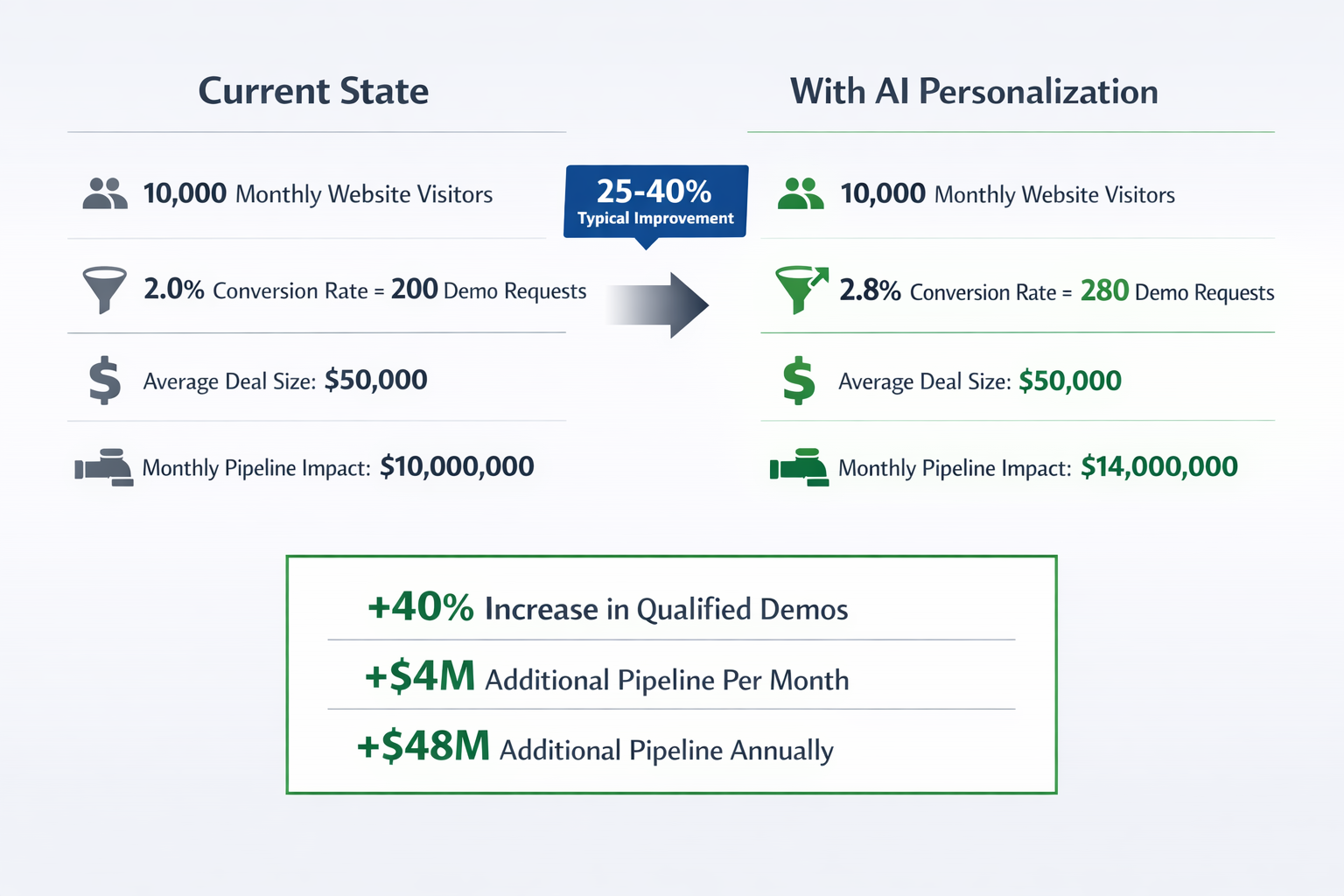
Real-World B2B Application:
Think about a cybersecurity platform. When a financial services company visits, the hero section highlights banking fraud prevention, compliance certifications appear prominently, and case studies from JPMorgan or Goldman Sachs surface first. When a healthcare organization visits, HIPAA compliance takes center stage with healthcare-specific testimonials.
The technology stack behind this involves IP enrichment databases, behavioral tracking that respects privacy regulations, and a content management system that can serve variations without creating duplicate pages that harm SEO. Your front end developer needs to implement this in ways that maintain performance-personalization shouldn't add more than 50ms to load time.
Privacy-First Personalization:
The key in 2026 is balancing personalization with privacy. We're not talking about creepy tracking. Modern approaches use first-party data, company firmographic information, and behavioral signals that users expect and appreciate. The personalization feels helpful, not invasive.
We're integrating smart personalization layers into our Webflow builds-creating 3-5 strategic variations that speak directly to your core ICPs without complex maintenance. For most B2B SaaS companies, this means variations for SMB vs Enterprise, different industry verticals, or different stages of the buyer journey.

2. Motion Design That Actually Serves Purpose
In 2026, the differentiator isn't whether you use motion-it's whether motion serves strategic purpose. Purpose-driven motion guides attention, explains complex concepts, or provides feedback.
Implementing effective motion requires collaboration between designers and your front end developer team. Using CSS (Cascading Style Sheets) animations and modern frameworks and libraries, you create smooth interactions that enhance experience without harming performance.
For complex B2B SaaS products, motion replaces paragraphs of explanation. A well-executed animation showing data flow communicates more effectively than 500 words. We implement Lottie animations and WebGL effects that maintain sub-2-second load times.
3. Minimalism Meets Maximum Information
2026 designs embrace bold typography and generous whitespace while using progressive disclosure to layer information. Your hero section might be beautifully minimal, but hover states, expandable sections, and contextual tooltips provide depth without clutter.
Enterprise buyers need detailed information. The modern approach makes it accessible when needed-expandable feature comparisons, inline specs, and progressive navigation that adapts to engagement levels.
The Technical Challenge:
Modern database management systems combined with flexible content management systems (CMS) allow you to structure information hierarchically. Whether using HTML (Hypertext Markup Language) for structure or advanced programming languages for dynamic content, the goal is presenting information progressively.
This is where smart information architecture becomes crucial. Your primary navigation might show 5-7 main categories, but each category can expand to reveal subcategories without leaving the page. Product features can be organized in progressive layers-high-level benefits visible immediately, technical specifications available on-demand.
B2B SaaS Example:
Consider a data analytics platform. The homepage shows three core value propositions with clean, minimal design. But hovering over "Real-time Analytics" reveals a slide-in panel with technical details, supported data sources, and relevant case studies. Clicking "See Technical Specs" opens an inline accordion without navigation.
This approach respects both the executive who wants quick validation and the technical buyer who needs architectural details. Both get what they need without the page feeling cluttered or the information feeling hidden.
In Webflow, we build component systems that allow marketing teams to add detailed product information without compromising clean aesthetics-one of the web design best practices 2026 that separates amateur builds from enterprise-grade implementations. These systems use CMS collections, custom code embeds, and interaction design to create information hierarchies that feel intuitive.
4. Mobile-First Is Non-Negotiable (But You're Probably Doing It Wrong)
Over 72% of web traffic comes from mobile devices in 2026. Mobile-first means designing the mobile experience first, then expanding to desktop-not squishing your desktop design to fit smaller screens.
This approach requires your front end developer to think differently about how web pages are structured. Using responsive frameworks and libraries, modern websites and web applications adapt fluidly across screen sizes without compromising functionality.
Cross-Device Journey Optimization:
The latest web design trends 2026 focus on seamless cross-device experiences. Someone starts researching on their phone during their commute, continues on a tablet at lunch, and books a demo on desktop at their office. Your website needs to optimize for this journey.
This is where modern web development gets sophisticated. Session persistence across devices, progressive web app (PWA) capabilities, and cloud-based form saving ensure users never lose progress. If someone fills out half a demo form on mobile and switches to desktop, that information should be there waiting for them.
Mobile UX Principles for B2B:
B2B mobile design differs from consumer apps. Your users aren't casually browsing-they're evaluating serious purchase decisions worth tens or hundreds of thousands of dollars. The mobile experience needs to be:
- Information-dense but scannable: Break complex information into digestible chunks
- Touch-optimized: Buttons need finger-friendly tap targets (minimum 44px)
- Thumb-zone aware: Navigation works thumb-first for one-handed use
- Form-friendly: Minimize typing, use dropdowns and pre-fill where possible
One client increased mobile conversions by 35% just by redesigning their demo request form for single-handed use. We reduced form fields from 8 to 4, made buttons larger, and used smart defaults. The result? More demos booked from mobile without sacrificing lead quality.
5. Accessibility Isn't Optional-It's Your Competitive Advantage
WCAG 2.2 AA compliance is becoming required for enterprise contracts. Beyond compliance, accessible design improves conversions for all users. 15% of the global population has some form of disability-that's potential customers you're excluding.
Many web design best practices 2026 for accessibility-clear contrast, readable fonts, logical structure-benefit everyone. Keyboard navigation, screen reader optimization, and focus management are standard requirements in RFPs.
Modern platforms like Webflow build accessibility into foundations. Semantic HTML (Hypertext Markup Language), ARIA labels, and proper alt attributes on images are essential elements of modern web development.
6. Speed Is Still Your Silent Conversion Killer
Google's Core Web Vitals directly impact conversion rates. A one-second delay in page load decreases conversions by 7%. For a company doing $5M ARR with 10,000 monthly site visitors, that one second costs hundreds of thousands in lost pipeline.
2026 Speed Requirements:
- Largest Contentful Paint (LCP): Under 2.5 seconds
- First Input Delay (FID): Under 100 milliseconds
- Cumulative Layout Shift (CLS): Under 0.1
2026 Core Web Vitals Checklist
- Largest Contentful Paint (LCP) under 2.5 seconds
- First Input Delay (FID) under 100 milliseconds
- Cumulative Layout Shift (CLS) under 0.1
- Image optimization with lazy loading enabled
- Critical CSS inlined for above-the-fold content
- Edge caching configured for static assets
Modern approaches combine image optimization, lazy loading, critical CSS (Cascading Style Sheets), and edge caching. Technical implementation requires expertise in both client side optimization and server side scripting language efficiency. Whether building static websites or complex web applications, performance optimization should be part of initial web development architecture.
7. Modular Design Systems for Agility at Scale
Enterprise B2B companies are moving to component-based systems. Marketing teams launch landing pages quickly using pre-approved components without code. One Series B client went from 3-week timelines to same-day launches, testing 5-10 campaign variations.
We build component libraries in Webflow covering 80% of content needs. This leverages content management systems (CMS) supporting reusable components through structured database management-whether using an object oriented programming language or application programming interfaces (APIs), modular architecture is essential for scalable web development.
8. Video Content Integration Done Right
The latest web design trends 2026 shift to strategic placement: product demos in context, customer testimonials, and short explainers. Modern approaches use thumbnail images with play-on-demand, progressive loading, and adaptive streaming-a 45-second pricing page demo converts 30% versus a 3-minute homepage video at 5%.
9. Dark Mode and Custom Color Systems
Dark mode is now a strategic branding decision for 2026. For technical audiences-developers, data scientists, security professionals-it's their default. Your front end developer implements CSS (Cascading Style Sheets) variables and theme switching across all web pages. Custom color systems beyond primary/secondary colors become signature brand elements.
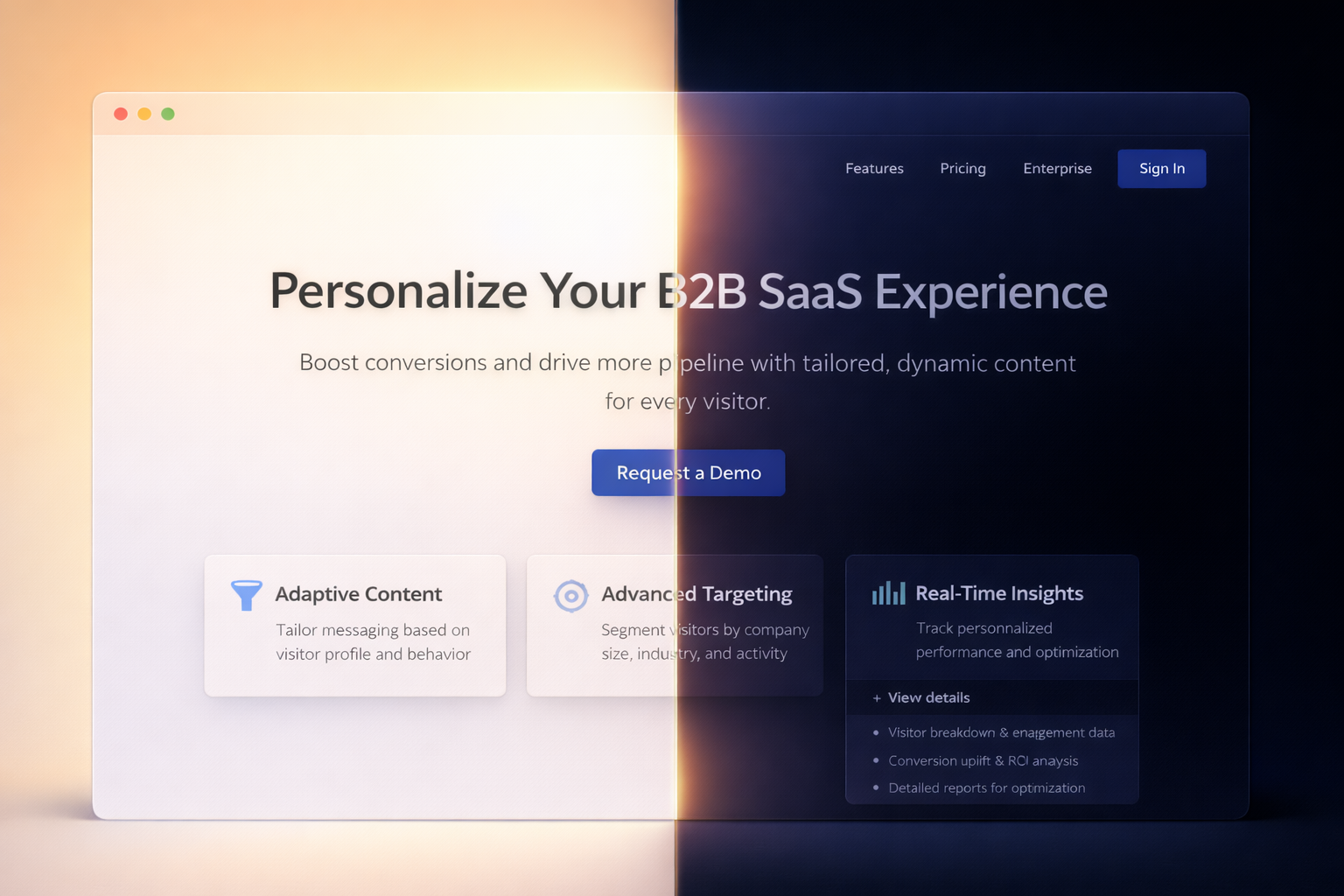
10. Zero-Click Information Architecture
The best B2B sites minimize clicks to conversion through intelligent architecture. Users understand value proposition, see social proof, review pricing, and access demos without navigating multiple pages. Techniques include slide-in panels, expandable calculators, inline previews, and contextual CTAs adapting to scroll depth.
11. Trust Signals and Social Proof Integration
Trust signals move from footer badges to dynamic, contextual proof points. What works: industry-specific case studies for relevant visitors, real-time signup indicators, G2/Capterra live ratings, and video testimonials from recognizable brands. Trust signals appear where objections arise-security badges on pricing, customer logos on products, testimonials near forms.
The Webflow Advantage for 2026
As a certified Webflow Enterprise Partner, Webflow excels for 2026: infrastructure optimized for Core Web Vitals, pixel-perfect design control, marketing team empowerment without developer dependencies, enterprise scalability with multi-language support, and clean semantic HTML (Hypertext Markup Language) with built-in SEO.
Unlike static websites requiring constant developer intervention or complex web applications needing extensive server side programming, Webflow's visual environment bridges the gap. The platform excels at design-driven development where the visual system becomes the source of truth, and the content management system (CMS) supports dynamic content without sacrificing performance.
How to Actually Implement These Trends
What This Means for Your 2026 Planning
If you're a Head of Marketing, CMO, or Founder planning website investments, here's what you need to know:
1. Budget Realistically:
A proper website revamp with 2026 best practices costs $25K-60K for mid-market B2B companies. Enterprise implementations exceed $100K. You're buying strategic positioning frameworks, custom UI/UX design systems, component-based development using modern frameworks and libraries, technical SEO optimization, scalable content management systems (CMS) architecture, and ongoing support.
2. Timeline Expectations:
Comprehensive revamps take 10-16 weeks: discovery and strategy (weeks 1-2), information architecture (weeks 3-5), UI design and components (weeks 6-9), Webflow development and CMS setup (weeks 10-13), QA and optimization (weeks 14-16). Rush jobs skip critical steps like user research and performance optimization.
3. Internal Requirements:
Allocate 10-15 hours of stakeholder time, content writing support, access to product and sales teams, executive review at milestones, and internal QA before launch. The best projects are collaborative.
4. Ongoing Investment:
Budget 2K-15K monthly retainers for continued improvement including design/development hours, CRO experiments, performance monitoring, SEO updates, and new integrations. Companies seeing best ROI treat websites as living systems.
5. ROI Framework:
Set baseline metrics, then track conversion rates, time on site, demo page traffic, form completions, and mobile vs desktop performance. We typically see meaningful improvements within 60-90 days post-launch.
Conclusion
Strategic alignment with business objectives separates trends that matter from trendy nonsense. The modern web design trends here-AI personalization, purposeful motion, mobile-first thinking, accessibility, speed, modular systems, and video-drive conversions.
Whether optimizing static websites or building web applications, your front end developer team implements web pages that load quickly and convert effectively. From client side presentation to server side programming, every element supports conversion goals-what web development refers to as "user-centric design."


At Flowtrix, we build websites that drive pipeline and give teams tools to optimize continuously. The best 2026 web design trends evolve into powerful 2026 conversion tools with thoughtful implementation.
If your website predates 2023, it shows age in performance and conversion. Companies winning in 2026 turn visitors into customers efficiently.
Ready to transform your B2B website? Let's talk strategy.
FAQ's




.webp)




.svg)

.svg)



%201.svg)


.svg)
.svg)