

Use to summarize this article


- Most AI startup websites fail because they explain the product instead of persuading the buyer — jargon-heavy headlines, feature-first thinking, and missing social proof are the biggest killers.
- A high-converting AI website follows a clear flow: outcome-driven hero, problem-solution narrative, product demos, layered social proof, and a single primary CTA.
- The pages that actually drive pipeline are the homepage, dedicated solution pages, a transparent pricing page, and detailed case studies with real metrics.
- Webflow gives AI startups the speed, CMS flexibility, and performance that WordPress, custom code, and basic no-code builders cannot match at scale.
- Your website is not a one-time project — treat it as a living product with ongoing messaging tests, CRO experiments, and content updates.
Your AI product does something genuinely impressive. It processes data at a speed humans cannot match. It automates decisions that used to take entire teams. It solves a specific, painful, expensive problem for a specific audience.
But when a Head of Marketing at a Series B company lands on your website, they have about ten seconds to decide if they are in the right place. If they cannot figure out what your product does, who it is for, and why they should care in that window, they are gone. No demo request. No follow-up email. Just a closed tab and a visit to your competitor.
This is the core challenge of AI startup website design in 2026. You are selling something complex to someone busy, skeptical, and overwhelmed with options. You need to make them get it fast. You need to make them feel confident. And you need to give them a clear reason to take the next step.
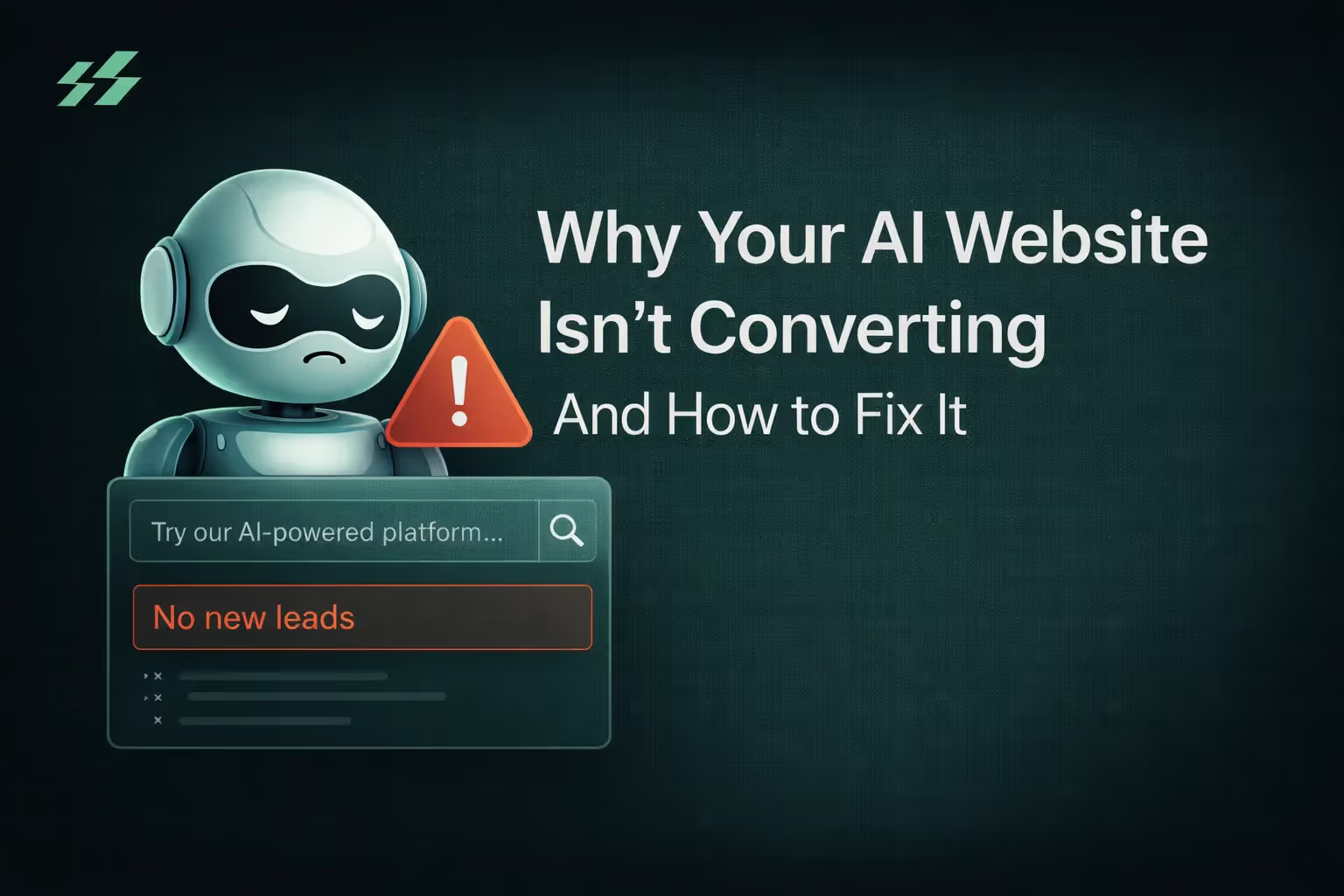
Most AI startup websites fail this test. Not because the product is bad. Not because the team is not talented. But because the website was built for the founder, not the buyer.
This guide is for Heads of Marketing, CMOs, and founders at B2B SaaS and AI companies who are serious about turning their website into a pipeline asset. We will cover what is broken on most AI startup websites, what a high-converting site actually looks like, and the design principles that separate the best from the rest.
Why Most AI Startup Websites Fail to Convert
We have worked on 120+ websites for B2B SaaS, AI, and cybersecurity companies. The websites that fail to convert do not fail because they look bad. Most of them look fine. They fail because they were built to explain, not to persuade.
There is a critical difference between a website that explains your product and a website that persuades your buyer. The first one satisfies the founder. The second one drives demo requests.
Here are the patterns we see on AI startup websites that kill conversions:
Jargon-heavy headlines:
"Next-generation AI-powered workflow orchestration infrastructure." That tells a potential buyer absolutely nothing. What does it do? Who does it help? What problem does it solve? If your headline requires domain expertise to understand, you have already lost most of your audience.
The best AI startup websites lead with outcomes, not architecture. They tell the buyer what life will look like after they start using the product. Simple, specific, and direct.
Feature-first thinking:
Founders know their product deeply. So they naturally want to explain every capability, every integration, every clever technical decision that went into building it. The problem is that buyers do not care about features. They care about what those features will do for their business.
"Automated data pipeline with real-time ML inference" means nothing to a VP of Marketing who just wants to know if this will reduce their reporting time. Lead with the outcome. Explain the feature as the proof.
No clear conversion path:
A visitor lands on your homepage. They scroll through the hero section, past a feature list, through some logos, and into a long paragraph about your mission. Then they hit the footer. There was no moment where a clear, compelling reason to take action appeared.
The best AI startup websites treat every section as a step in a sequence. Hero to problem to solution to proof to CTA. Each section has a job. Each section leads somewhere.
Too much competing for attention:
Five different CTAs on one page. Three different audiences addressed in one hero section. A navigation menu with twelve options. A homepage that tries to speak to enterprise, mid-market, and startup buyers all at once.
Every time you add something to a page, you are taking attention away from something else. The most effective AI startup websites have ruthless clarity. One primary audience. One primary action. One primary message.
No social proof where it matters:
Trust is not assumed in B2B SaaS. Buyers are evaluating you against established competitors with brand recognition, G2 reviews, and case studies with real numbers. If your website has no client logos, no testimonials, and no case studies, you are asking buyers to take a leap of faith they are simply not prepared to take.
The Anatomy of a High-Converting AI Startup Website
If you look at the best B2B SaaS and AI websites, they share a common structure. They are not necessarily the flashiest or most expensive. But they are built around a clear understanding of how their buyer thinks, what they need to see, and what will make them take action.
Here is what that looks like in practice:
The hero section: earn the next scroll
Your hero section has one job. Make the visitor want to keep reading. It does not need to explain everything. It needs to answer one question clearly: what does this do for me?
The structure that works for AI startup websites: a headline that leads with an outcome or a specific problem, a subheadline that adds one layer of context, a primary CTA that matches the stage of the buyer, and a supporting visual that shows the product or its effect.
What does not work: a motion graphic that takes fifteen seconds to load, a headline that uses your product name as if it is already famous, and three CTAs pointing to different places.
Problem and solution flow: make them feel understood
After the hero, the most effective AI startup websites spend time on the problem before they jump to the solution. This is counterintuitive for founders who want to show the product as quickly as possible. But buyers make decisions emotionally first and rationally second.
If you can make a potential buyer feel like you understand exactly what they are going through before you show them your product, they arrive at the product section already primed to believe it will work. Spend time naming the pain. Make them nod. Then show the solution.
Product section: show, do not describe
This is where most AI startup websites make their biggest mistake. They replace the product demonstration with a list of features. Features require mental work. The buyer has to translate "automated ML inference pipeline" into what it actually means for their team.
Use product screenshots, short video demos, and diagrams that show the product in use. Show the before and after. Show the workflow. Show what it looks like when your AI is actually working for a real user on a real problem.
Buyers who see the product working are significantly more likely to book a demo. Show them the product. Do not describe it.
Social proof: earn trust at every scroll depth
Trust signals should not all be grouped into one section at the bottom of the page. They should appear throughout the buyer journey, placed at the exact moments where doubt is most likely to arise.
Client logos near the top of the page for immediate credibility. A specific testimonial near the product section that directly addresses a concern buyers typically have. Case study links near the CTA for buyers who need more evidence before they commit. Review badges near pricing for buyers who are close to deciding.
We build social proof into every page we design at Flowtrix. For AI and B2B SaaS companies, it is one of the highest-leverage changes you can make. Our guide on 12 Effective Social Proof Strategies for B2B SaaS Websites covers exactly how to place and structure proof elements for maximum impact.

The Pages That Actually Drive Pipeline
A great AI startup website is not a single page. It is a system of pages that moves the right buyer from first awareness to a booked demo call. Each page has a specific role in that system.
Every Pipeline-Driving Page Should Have
- A clear primary audience — one ICP per page, not three
- One primary CTA that matches the buyer's stage in the journey
- Social proof placed at exact moments where buyer doubt arises
- Product visuals that show the tool working — not just a feature list
- Case studies filterable by industry, company size, and use case
- Transparent pricing info — enough for a directional decision before the demo
Homepage: the hub of your inbound machine
Your homepage is not a product page. It is a gateway. Its job is to confirm to the right buyer that they are in the right place and give them a compelling reason to go deeper. It should speak to your primary ICP clearly, establish credibility fast, and drive toward one primary action.
The homepage structure that works consistently for AI companies: a strong hero section above the fold, a proof bar with client logos immediately below, a problem-solution flow across two or three sections, a featured case study or testimonial, a product overview section with visual support, and a closing CTA.
What does not work: a homepage that tries to serve three different buyer types simultaneously, eleven navigation links, and a primary CTA hidden below the fold.
Product and solution pages: go deep for the serious buyer
Buyers who click into your product or solution pages are further along in their research. They already believe the category matters. Now they are evaluating whether your specific product is the right fit.
This is where you can go deeper. Explain the specific problem the product solves. Walk through the workflow. Show the integration with tools they already use. Include a specific case study from a company that looks like their company. And make the CTA reflect where they are in the process. A buyer this far in does not need "Learn More." They need "See It In Action" or "Book a Demo."
For AI companies with multiple use cases or multiple target audiences, individual solution pages work significantly better than one generic product overview page. A Head of Security at a cybersecurity company needs different language and different proof than a Head of Growth at a SaaS company. Build pages for each of them.
Pricing page: remove the uncertainty
Most AI startup pricing pages are either completely empty or completely overwhelming. Both are conversion killers.
Buyers who reach your pricing page are seriously interested. They want to know if this is within their range before they spend time on a demo call. If your pricing page just says "Contact us for pricing," you are forcing them to invest time in a call before they have any context. Many will not bother.
Give buyers enough to make a directional decision. You do not need to publish exact numbers. But you should tell them what tier makes sense for a team of their size, what is included at each level, and what the process looks like from demo to contract. Remove the uncertainty that stops buyers from taking the next step.
Case study pages: the most powerful conversion tool you have
Nothing converts a B2B SaaS buyer like a detailed case study from a company that looks exactly like them. Not the best headline copy you have ever written. Not the most impressive product demo. A real story from a real company with a real result.
Structure your case studies around four elements: the context and problem the client was dealing with, why they chose your product over alternatives, what the implementation looked like, and the specific results they achieved. Use real metrics wherever possible. "40% reduction in reporting time" is more persuasive than "significantly faster reporting."
Make your case studies searchable and filterable by industry, company size, and use case. A buyer from a cybersecurity company should be able to find a case study from another cybersecurity company in under thirty seconds.
AI Website Design Principles That Drive Demo Bookings
Great AI startup website design is not about following trends. It is not about picking the right color palette or choosing between a light and dark mode. It is about applying a set of principles that consistently move buyers toward action.
Here are the principles that the best AI startup websites apply:
Simplicity is a conversion tool:
The AI category is dense. Buyers are already dealing with information overload before they land on your site. Every design element that adds cognitive load is a design element that is hurting your conversion rate.
White space is not wasted space. It gives buyers room to focus on what matters. Clean typographic hierarchy makes content scannable. One idea per section keeps the message from getting lost. The most effective AI startup websites feel easy to use because they are built with the buyer in mind, not the brand team.
Mobile is not optional:
A significant percentage of your buyers will research your product on their phone before they ever sit down at a laptop. This is especially true for senior buyers doing preliminary research during commutes, in meetings, or before bed.
If your mobile experience is slow, hard to read, or breaks on common screen sizes, you are losing qualified leads before they have even seen your product. Mobile performance is not a nice-to-have. It is a baseline requirement.
Speed signals trust:
There is a psychological effect that most website owners underestimate. When your website loads slowly, buyers do not just feel inconvenienced. They start to wonder if your product will also be slow. If your company is serious. If you have the technical foundation to solve their problems.
Page speed is a trust signal. It is also a direct conversion factor. Pages that load in under two seconds see significantly higher conversion rates than pages that take four or five seconds. If your site is slow, fix that before you do anything else.
Navigation should guide, not overwhelm:
Most AI startup websites build navigation menus that try to surface everything. Every product. Every use case. Every resource. The result is a menu that overwhelms buyers before they have even read the first line of your homepage copy.
Your navigation has one job: help the right buyer get to the right page in the fewest possible clicks. For most AI startup websites, that means three to five primary navigation items that match the main stages of the buyer journey: what it does, who it is for, proof it works, and how to get started.
Design for your category, differentiate within it:
AI, cybersecurity, and enterprise SaaS companies have established visual languages. Dark, structured layouts. Clean typography. Data-forward visuals. Technical credibility signals. If your website looks like a consumer lifestyle brand, buyers will not take you seriously regardless of how good your product is.
Fit the expectations of your category first. Then find your differentiation within those expectations. Your brand personality, your visual style, your tone of voice. These are how you stand out. Your homepage layout is not.
Why Webflow Is the Right Platform for AI Startup Website Design
Most AI startups launch on WordPress, a no-code builder, or a custom-coded site. All of these work at first. But as the company grows, they all become bottlenecks in different ways.
WordPress requires constant plugin management and developer involvement for meaningful changes. No-code builders hit their ceiling when you need enterprise-level performance and CMS flexibility. Custom-coded sites are expensive to maintain and slow to update.
The problem in all three cases is the same: your marketing team cannot move fast. They cannot test a new hero headline without a developer. They cannot launch a campaign landing page without a sprint. They cannot rebuild the pricing page when the positioning changes.
Webflow is built for exactly this use case. Marketing teams can make real changes in real time. Developers can build scalable, component-based architecture. The platform handles hosting, performance, and security at the infrastructure level. And the CMS can handle complex content structures without breaking.
At Flowtrix, we build every AI and B2B SaaS website on Webflow. We are a certified Webflow Enterprise Partner, nominated for Webflow Partner of the Year 2025, and have delivered 120+ projects for companies across the US, UK, Europe, and the Middle East. Companies like Databahn, Akirolabs, and Fuxam trusted us with exactly this challenge.
For a detailed look at how AI companies can get the most out of the platform, read our guide on Integrating AI with Webflow.
Common Mistakes in Startup Website Design (And How to Avoid Them)
Even well-funded AI startups make the same mistakes. Here is what to watch for and how to course-correct.
Launching without a conversion strategy:
A lot of startup company website design projects begin with visual references and end with a beautiful site that does not convert. The design process consumed all the attention. The conversion strategy never got defined.
Before any design work starts, you need three things: a clear definition of who your primary buyer is, what action you want them to take, and what message will resonate with them. Everything else in the design process follows from those answers.
Copying competitors without understanding why they work:
It is tempting to look at a competitor that appears to be doing well and reverse-engineer their website structure. But you are looking at the output, not the strategy. You do not know if that beautiful site is actually converting. You might be copying a design that looks impressive and performs poorly.
Build from your own buyer research. Talk to your best customers. Find out what made them choose you. What concerns they had before signing. What they needed to see to feel confident. Build your website around those answers.
Treating the website as a launch, not a product:
The biggest mistake in website design for startups is treating the website as a one-time project. Launch it. Celebrate. Move on. Eighteen months later, the site has not changed and the business has changed completely.
The best B2B SaaS and AI companies treat their website as a living product. They test messaging. They update case studies when new results come in. They launch new solution pages when they enter new verticals. They run CRO experiments to improve conversion rates on high-traffic pages.
If you want a website that evolves with your business, working with a Webflow agency on a support retainer after launch is often more valuable than the initial build.
Underinvesting in technical SEO from day one:
A beautiful website that no one finds is not doing its job. Technical SEO is not an add-on you layer on after launch. It needs to be built into the site architecture from the beginning. URL structure, page speed, metadata, mobile performance, schema markup, and internal linking strategy all need to be planned before a single page is designed.
We use the Flowtrix Schema App on every Webflow project to implement structured data correctly. For AI and SaaS companies, schema markup helps search engines understand your content and can improve click-through rates from search results significantly.
What to Look for in a Website Design Agency for Startups
Not every web agency understands what an AI or B2B SaaS company actually needs. The agency that builds beautiful consumer brand websites is not the same agency that should be building your enterprise-grade AI startup website.
Here is what to look for when choosing a partner:
- Conversion focus over visual focus: The agency should talk about demo requests, pipeline, and qualified inbound before they talk about color palettes and animations.
- B2B SaaS and AI experience: Consumer and B2B website design are completely different disciplines. Long sales cycles, multiple stakeholders, content-heavy sites, and enterprise trust requirements need specific expertise.
- Webflow or platform depth: General web development experience is not the same as deep Webflow expertise. If you are building on Webflow, you need a team that lives in it every day.
- SEO and technical foundations: Strategy and design mean nothing if buyers cannot find you. Your agency should treat SEO as a core deliverable, not an afterthought.
- Ongoing support options: The agency relationship should not end at launch. Look for teams that offer retainer support so the site can grow and evolve with your business.
Flowtrix specializes in working with Series A to Series C B2B SaaS, AI, and cybersecurity companies who are serious about their website as a pipeline tool. We combine strategy, UX design, Webflow development, and SEO into one end-to-end engagement. Our revamp projects typically start at $25,000 and scale based on scope and complexity.
How to Know When It Is Time for a Website Redesign
Not every AI startup needs a full redesign right now. But there are clear signals that tell you when the website is actively costing you pipeline. If two or more of these are true for your business, a revamp should be on your roadmap.
The clearest signal of all is this: if you are sending qualified traffic to your website and those visitors are not converting into demo requests or signups at a rate you are happy with, the website is the constraint. Everything else, your ads, your content, your outbound, is feeding a leaky bucket.
Getting Your AI Startup Website Right in 2026
The bar for ai website design keeps rising every year. More AI companies are entering the market. Buyers are doing more research independently before speaking to anyone in sales. And the gap between AI startups with strong websites and those with weak ones is becoming a meaningful competitive advantage.
The companies that win in 2026 will treat their website as a strategic asset. They will design for their buyer, not their own preferences. They will build on platforms that let their marketing team move fast. They will invest in conversion, not just aesthetics. And they will treat the website as an ongoing product that gets better over time.


A high-converting AI startup website does four things consistently. It makes the value proposition immediately clear to the right buyer. It builds trust through proof before it asks for commitment. It creates a clear and frictionless path to the next action. And it performs well technically on every device and in every context.
These are not design challenges. They are strategy challenges. And they require a partner who understands both.
At Flowtrix, we help B2B SaaS and AI companies at Series A to Series C turn their website into a predictable inbound and demo booking engine. If you are ready to build a site that actually drives pipeline, book a call with our team and let us walk you through what a conversion-focused website revamp looks like end to end.
FAQ's









.svg)

.svg)



%201.svg)


.svg)
.svg)