

Use to summarize this article


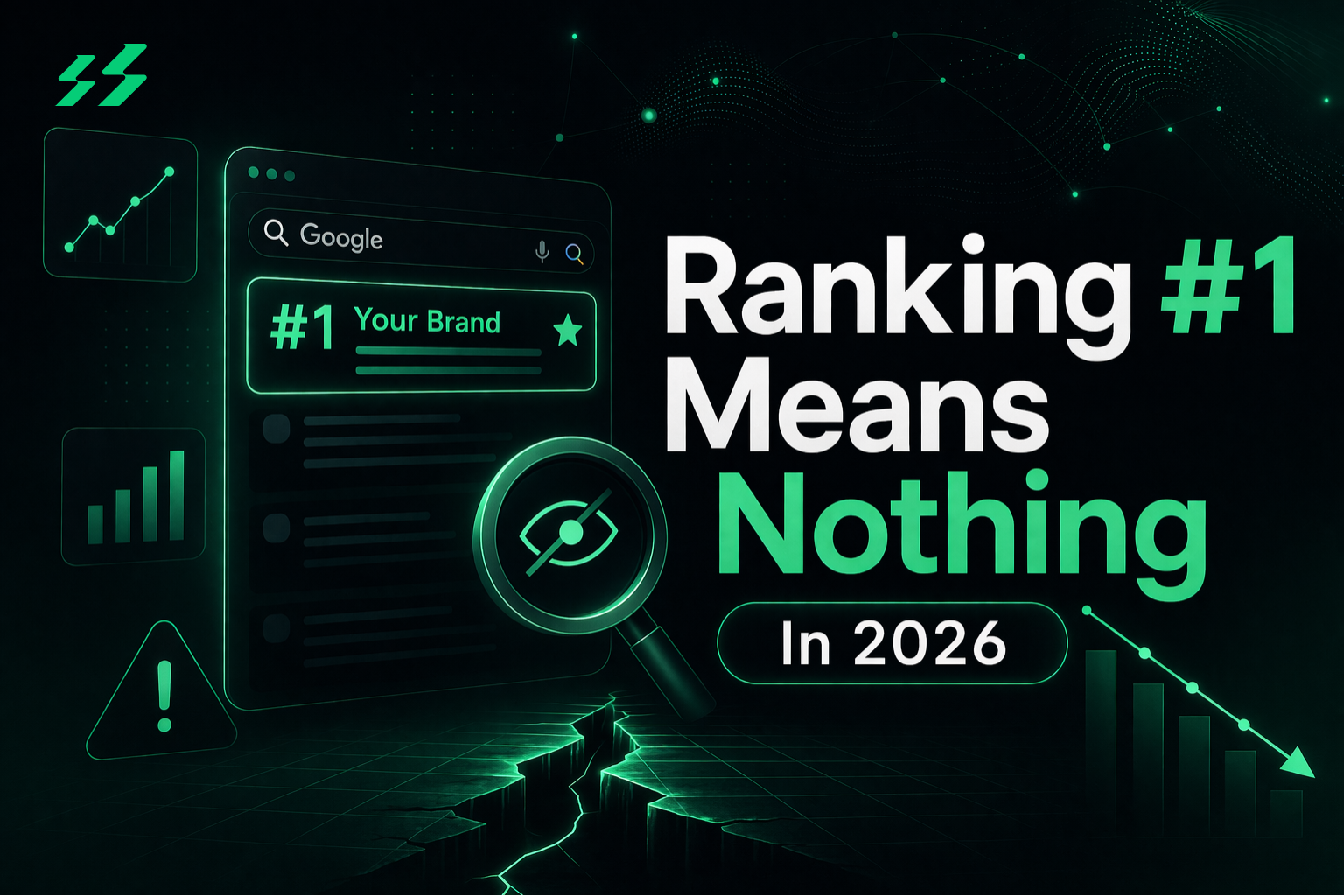
- Ranking #1 on Google no longer guarantees visibility, over 60% of searches now end without a click thanks to AI Overviews and SERP clutter
- The shift is from SEO to Generative Engine Optimization (GEO), where the goal is being cited by AI models, not just ranked by crawlers
- AI crawlers skip bloated websites, clean semantic code, fast load times, and advanced Schema are now prerequisites for AI citation
- Winning in 2026 requires modular content, JSON-LD Schema, original data, and strong brand sentiment across Reddit, G2, and industry forums
- New KPIs like Share of Model, AI referral traffic, and high-intent brand search matter more than raw organic sessions or keyword position
Imagine this scenario: You are the VP of Marketing at a high-growth B2B SaaS company. For the last twelve months, your team has executed a flawless content strategy. You’ve invested heavily in long-form content, built an impressive backlink profile, and optimized your core web vitals.
On a Tuesday morning, you open your SEO tracking tool. There it is, the holy grail. You have officially captured the #1 organic position on Google for your most lucrative, high-intent keyword. You take a screenshot. You send it to the CEO on Slack. You celebrate.
But a month goes by, and the pipeline hasn’t moved. In fact, organic traffic to that specific page has flatlined, and demo requests are down 15%.
You haven't been penalized by an algorithm update. Your tracking software isn't broken. You are experiencing the most dangerous paradox in modern digital marketing: You are ranking #1, but you are completely invisible to the buyer.
Welcome to the 2026 search landscape.
At Flowtrix, we build high-performance Webflow platforms for the world’s leading SaaS, AI, and enterprise tech companies. We audit hundreds of websites a year, and we see the same fatal flaw repeated across the industry: brands are optimizing for a version of Google that died three years ago.
This 3,000-word masterclass will break down exactly why the #1 ranking is no longer a guarantee of visibility, the mechanics of the "Zero-Click" SERP, and the exact technical and content playbooks you need to regain your share of voice in the era of Artificial Intelligence.
Chapter 1: The Screen Real Estate Crisis (The Anatomy of the 2026 SERP)
To understand why your #1 ranking is invisible, you have to look at the physical real estate of a modern Search Engine Results Page (SERP), especially on a mobile device.
Ten years ago, ranking #1 meant you were the first thing a user saw after the search bar. Today, the "Above the Fold" viewport has been entirely hijacked by Google’s push toward monetization and AI synthesis.
The Modern User Journey on a High-Intent Search
Let's trace what happens when a B2B buyer searches for "Enterprise AI Data Fabrics."
- The Ad Block: The top 20% of the screen is dominated by 2 to 4 Google Sponsored Ads.
- The AI Overview (Google SGE): Below the ads sits a massive, generative AI summary. This AI Overview takes up 50% to 70% of the screen. It features synthesized paragraphs, comparison tables, and direct answers pulled from various sources (which often aren't the top-ranking sites).
- People Also Ask (PAA): If the user scrolls past the AI Overview, they are hit with an accordion of 4 to 6 "People Also Ask" dropdown questions.
- The "Hidden" #1 Organic Link: Finally, after scrolling past ads, a generative AI essay, and a block of accordion questions, the user arrives at your #1 ranked organic link.
The Verdict on Visibility
By the time the user reaches your #1 ranking, they have already been offered the answer to their question by the AI Overview. Why would a busy CTO click your link and read a 3,000-word blog post when Google’s Gemini model just gave them the exact pricing, features, and API limits in a digestible table?
They won't. This is the dawn of the Zero-Click search.
Chapter 2: The "Zero-Click" Phenomenon Explained
A "Zero-Click" search occurs when a user enters a query, gets the answer directly on the search engine results page, and leaves without clicking a single external link.
In 2026, data suggests that over 60% of all Google searches end without a click. For informational B2B queries, that number can surge as high as 75%.
Why Do Users Prefer Zero-Click?
You might assume users want to visit your beautifully designed website, but human psychology dictates otherwise.
- The Death of Patience: B2B buyers are fatigued. They don't want to dig through marketing fluff, pop-up newsletter forms, and cookie consent banners just to find out if your software integrates with Salesforce.
- Trust in Synthesis: When an AI Overview answers a question, it cites multiple sources. A user views this as a "consensus" answer, which feels more objective than reading a single company's biased landing page.
The Metric Trap
Your SEO dashboard (like Ahrefs or Semrush) might show that a keyword has a "Search Volume of 10,000 per month." What the tool doesn't explicitly highlight is that 8,000 of those searches are satisfied by the AI Overview. You are celebrating ranking #1 for a keyword that drives zero actual traffic. Your dashboard is lying to you through omission.
Chapter 3: The 3 Scenarios of the "Invisible #1"
Not all invisible rankings are created equal. Depending on the intent of the search, your #1 spot is failing you for different reasons. Let’s break down the three most common use cases we see at Flowtrix.
Scenario A: The Informational Invisibility
- The Query: "What is Product-Led Growth (PLG)?"
- Your Position: You rank #1 with a beautifully crafted, 4,000-word definitive guide to PLG.
- Why You Are Invisible: The AI Overview provides a flawless, 3-paragraph definition of PLG, complete with bulleted benefits and a list of PLG metrics (like CAC and LTV). The user reads it and closes the tab. Your masterpiece is never seen.
Scenario B: The Comparative Invisibility
- The Query: "Webflow Enterprise vs. WordPress VIP for SaaS"
- Your Position: You rank #1 with a detailed comparison landing page.
- Why You Are Invisible: The user asks Perplexity or Google SGE. The AI generates a customized, side-by-side HTML table comparing server speeds, security protocols, and total cost of ownership. The AI actually pulls this data from a Reddit thread and a G2 review, entirely bypassing your #1 ranked page because your page wasn't formatted with machine-readable data tables.
Scenario C: The Technical "Crawl Failure" Invisibility
- The Query: "SOC2 Compliant Payroll API"
- Your Position: You rank #1 for the broad keyword.
- Why You Are Invisible: Your site is built on a heavy, outdated WordPress theme loaded with React layers that don't render instantly. When the AI bot tries to quickly parse your page to synthesize an answer for the AI Overview, it times out due to code bloat. The AI skips your site and cites the competitor in position #4 because their site loaded faster and had a cleaner DOM structure.
(This is precisely why Flowtrix migrates enterprise clients to Webflow, clean code is a prerequisite for AI citation).
Chapter 4: The Paradigm Shift – From Ranking to Citing
If ranking #1 doesn't guarantee visibility, what does?
The answer is Citation.
In the AI era, you do not want to be a destination; you want to be a Source. If the AI Overview is taking up 70% of the screen, your new goal is to be the hyperlinked footnote inside that AI Overview.
This requires a fundamental shift from Search Engine Optimization (SEO) to Generative Engine Optimization (GEO) and Answer Engine Optimization (AEO).
| Feature | Traditional SEO | GEO / AEO |
|---|---|---|
| Objective | Rank URL in the top 10 blue links | Get cited by AI models |
| Content Structure | Long-form, narrative, keyword-dense | Modular, fact-dense, chunked data |
| Code Architecture | Standard HTML, meta tags | Advanced JSON-LD Schema, entity mapping |
| Authority Signals | Backlinks from high-DR websites | Brand mentions, sentiment on Reddit and G2 |
| Target Audience | The Google indexing crawler | The Generative LLM synthesizer |
Chapter 5: The Flowtrix Playbook for True AI Visibility
How do you fix the Invisible #1? At Flowtrix, we engineer digital platforms that are structurally built to dominate both the traditional SERP and the generative AI ecosystem.
Here is the exact blueprint we use to transition our B2B SaaS clients from "invisible rankings" to "highly-cited authorities."
Step 1: The Content Restructuring (Modular Architecture)
AI models are impatient. They do not want to read an introduction about "the fast-paced digital landscape." They want the facts, immediately.
The Fix: Implement the Inverted Pyramid Framework on every page.
- The Target Question: Make your H2 headers the exact natural language questions your buyers are asking. (e.g., "How much does a Flowtrix Webflow migration cost?")
- The Immediate Answer: The very next line of text must be a bolded, 40-to-60-word paragraph that directly answers the question. Do not use marketing fluff. Use hard numbers.
- The Formatting: If you are explaining a process, use a numbered list. If you are comparing features, use an HTML table. Generative AI models are highly proficient at parsing tables and will almost always prioritize structured table data over paragraph text.
Step 2: Advanced Schema Markup (The Language of the Machine)
This is the most critical technical fix, and it is where 90% of legacy websites fail.
If your website is written in English, the AI has to interpret it. If your website is wrapped in JSON-LD Schema, the AI can read it as absolute mathematical fact. Schema is a vocabulary of microdata that tells the AI exactly what a string of text represents.
At Flowtrix, we inject advanced Schema architectures into our Webflow builds:
- SoftwareApplication Schema: For our SaaS clients, we hardcode their pricing, operating system requirements, and aggregated user reviews (e.g., 4.8/5 stars) directly into the page code. When an AI overview generates a list of "Best CRMs," it instantly pulls our client's pricing and star rating because the Schema handed it over on a silver platter.
- FAQPage Schema: If you have an FAQ section, it must be wrapped in this code. This allows Google Assistant and Google SGE to natively read your answers to users.
- Organization & Person Schema: We link your company authors directly to their verified LinkedIn profiles and published works. This feeds Google’s E-E-A-T (Experience, Expertise, Authoritativeness, Trustworthiness) requirements, proving to the AI that a real, verified human wrote the content.

Step 3: Eliminating Code Bloat with Webflow
You cannot execute a modern GEO strategy on an archaic technical foundation.
If your #1 ranking is invisible, it might be because your website is built on a heavy WordPress instance bogged down by 30 outdated plugins. When OpenAI's search bot or Google's Gemini crawler visits your site, it has a strict "Crawl Budget." If it has to dig through 5,000 lines of messy CSS and unnecessary <div> tags just to find your paragraph text, it will time out and leave.
The Flowtrix Webflow Advantage:
We design exclusively in Webflow because it generates clean, semantic HTML5 code.
- We use proper "header", "main", "article", and "aside" tags.
- We ensure near-perfect Core Web Vitals scores.
- When an AI crawler hits a Flowtrix-built site, there is zero friction. The machine instantly understands the hierarchy of the page, ingests the Schema, extracts the modular content, and leaves with your brand registered as the authoritative source.
Step 4: Engineering "Information Gain"
AI models are trained to avoid redundancy. If your #1 ranking blog post says the exact same thing as the posts ranking #2 through #10, the AI has no specific reason to cite you. You offer zero Information Gain.
To guarantee citation, you must publish things the AI cannot find anywhere else:
- Original Data: Stop referencing standard HubSpot statistics from 2021. Conduct your own surveys. Publish proprietary benchmark reports. If you publish a stat saying "Webflow migrations increase conversion by 42%," the AI must cite you when it uses that stat.
- Contrarian Opinions: Publish thought leadership that actively disagrees with the industry consensus. AI models love to provide balanced answers (e.g., "While most experts suggest X, Flowtrix advocates for Y...").
- Quotes from Entities: Interview your CEO or Lead Developer and include their direct quotes. AI models recognize human experts as valuable "Entities" and will cite their exact words.
Chapter 6: The "Brand Sentiment" Reality Check (Why Off-Page Matters More Than Ever)
Let’s say you’ve fixed your website. You migrated to Webflow with Flowtrix, your Schema is perfect, and your content is modular.
You could still be invisible if you ignore the broader internet ecosystem.
Generative AI models do not just read your website; they read the entire internet. They synthesize information from Reddit, Quora, G2, Trustpilot, and X (formerly Twitter) to understand the public sentiment around your brand.
The "Consensus" Engine
If a user asks an Answer Engine, "What are the downsides of [Your Software]?" the AI will not look at your website's pricing page. It will scour Reddit threads and customer review sites.
If you rank #1 organically for your brand name, but the AI Overview above your link generates a bulleted list of complaints pulled from a two-year-old Reddit thread, your #1 ranking is actively hurting you. The buyer will read the AI's negative synthesis and bounce.
The Fix:
You must treat Community Management and Digital PR as core SEO functions.
- Engage on Forums: Have your technical team actively answer questions on Stack Overflow, Reddit, and niche Slack groups.
- Incentivize Reviews: Build a robust pipeline to generate fresh, positive reviews on G2, Capterra, and Trustpilot. AI models heavily weight these platforms when determining product viability.
- Digital PR: Get your brand mentioned (even without a backlink) in respected industry newsletters and publications. AI models map these "co-occurrences" to build trust in your brand entity.
Off-Page Authority Audit for AI Visibility
- Fresh positive reviews on G2 and Capterra within the last 90 days
- Active engineering presence on Stack Overflow and niche Slack groups
- Branded Reddit threads monitored and constructively replied to
- Quarterly digital PR placements in respected industry newsletters
- Proprietary data or benchmark report published in the last 6 months
- Named experts with linked author profiles across all blog content
Chapter 7: Redefining Your KPIs in the Zero-Click Era
The hardest part of solving the "Invisible #1" problem is convincing your executive board that the old metrics are dead.
If you successfully pivot to an Answer Engine Optimization strategy, your top-of-funnel organic traffic might actually decrease. Why? Because the AI is now accurately answering basic questions using your brand as the citation, meaning users don't need to click through to your blog to find the definition.
You must adopt the 2026 Marketing Dashboard:
If your brand search is up, your demo requests are up, and your pipeline velocity is accelerating, it does not matter if your top-of-funnel blog traffic is down 20%. You have successfully captured the AI.
Chapter 8: The Flowtrix Case Study – From Invisible to Inevitable
To ground this in reality, let's look at how Flowtrix solved this exact problem for a Mid-Market FinTech client.
The Problem: The client ranked #1 for "Automated Accounts Payable Software", a massive, high-volume keyword. However, their conversion rate was a dismal 0.4%. They were invisible. Users were searching the term, reading the Google AI Overview detailing what AP software was, and ignoring the client's link entirely.
The Flowtrix Audit & Execution:
- The Pivot: We realized that users searching that term didn't want a definition; they wanted a comparison.
- The Rebuild: We migrated their archaic WordPress site to a lightning-fast Webflow Enterprise environment.
- The AEO Implementation: We created a dedicated "Competitor Comparison Hub." We built extensive HTML data tables comparing their software to the top 3 legacy competitors. We injected SoftwareApplication schema and FAQPage schema.
- The Information Gain: We published a proprietary data point showing that their automated AP software reduced invoice processing time by exactly 4.2 days compared to the industry average.
The Result:
| Client | Metric | Before | After | Result |
|---|---|---|---|---|
| Mid-Market FinTech | Enterprise Demo Requests | Baseline | +145% in 60 days | Pipeline surge |
| Mid-Market FinTech | AI Citation in SGE and Perplexity | Zero citations | Cited in comparison queries | AI recognized |
| Mid-Market FinTech | Invoice Processing Benchmark | Industry average | 4.2 days faster | Proprietary stat |
| Mid-Market FinTech | Organic Top-of-Funnel Traffic | High volume, low intent | Down 12% | Intentional tradeoff |
Within 60 days, Google SGE and Perplexity began synthesizing our client's comparison tables directly into their Answer Engines. When users asked AI to compare AP software, the AI explicitly cited our client's "4.2 days" statistic.
While their overall organic traffic dropped by 12% (because they lost the low-intent "definition seekers"), their Enterprise Demo Requests increased by 145%. They stopped being an invisible link and became the definitive, AI-recommended answer.
Conclusion:
The #1 organic spot on Google is no longer a trophy; it is often a tombstone.
If you are relying on legacy SEO tactics, bloated CMS platforms, and keyword-stuffed blog posts, you are optimizing for a version of the internet that no longer exists.
In 2026, visibility belongs to the brands that provide the most accurate, structured, and machine-readable facts. It belongs to the brands that understand the difference between writing for a crawler and structuring data for a synthesizer.


At Flowtrix, we don’t just build aesthetic websites. We build AI-ready architectures. By combining world-class B2B UI/UX design with deep technical Webflow development and advanced Schema engineering, we ensure that your brand isn't just ranked, it is recognized, cited, and trusted by the world's most powerful AI models.
Your dashboard might be lying to you, but your pipeline doesn't have to.
Stop settling for invisible rankings. Let’s engineer your platform for true AI visibility.
Book a Strategy Call with the Flowtrix Team Today
FAQ's










.svg)

.svg)



%201.svg)


.svg)
.svg)