







Use AI to summarize this article




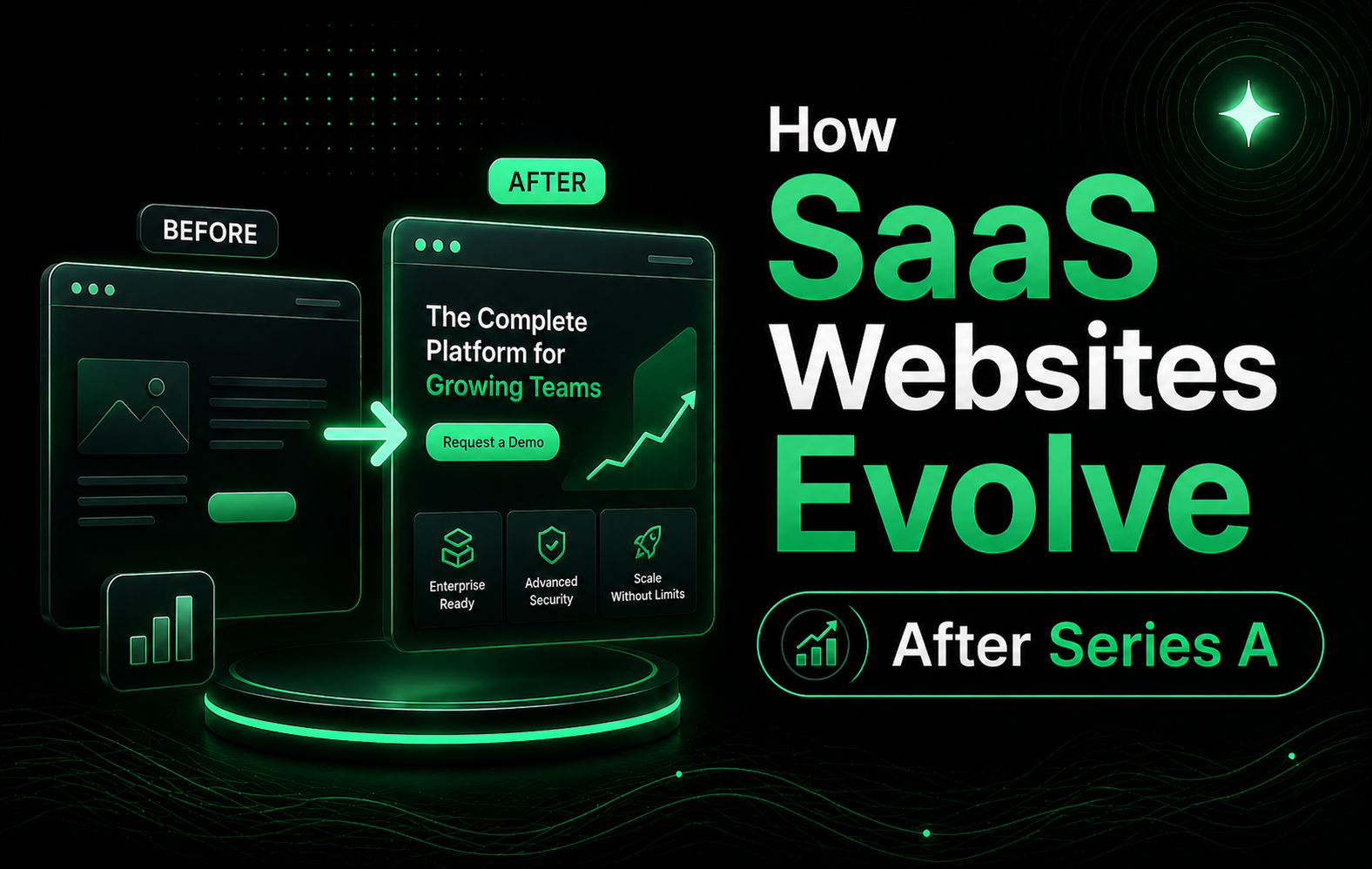
About three weeks before a Series A announcement, almost every founder does the same thing. They open Wayback Machine and pull up their old homepage.
It is never a comfortable look. The seed-stage site is rough in a way that reads as honest later on. Small team, early product, a founder still figuring out what the thing even was. The new site, the one about to go live with the round, is supposed to be the grown-up version of that. Better design, better copy, proof that the company arrived.
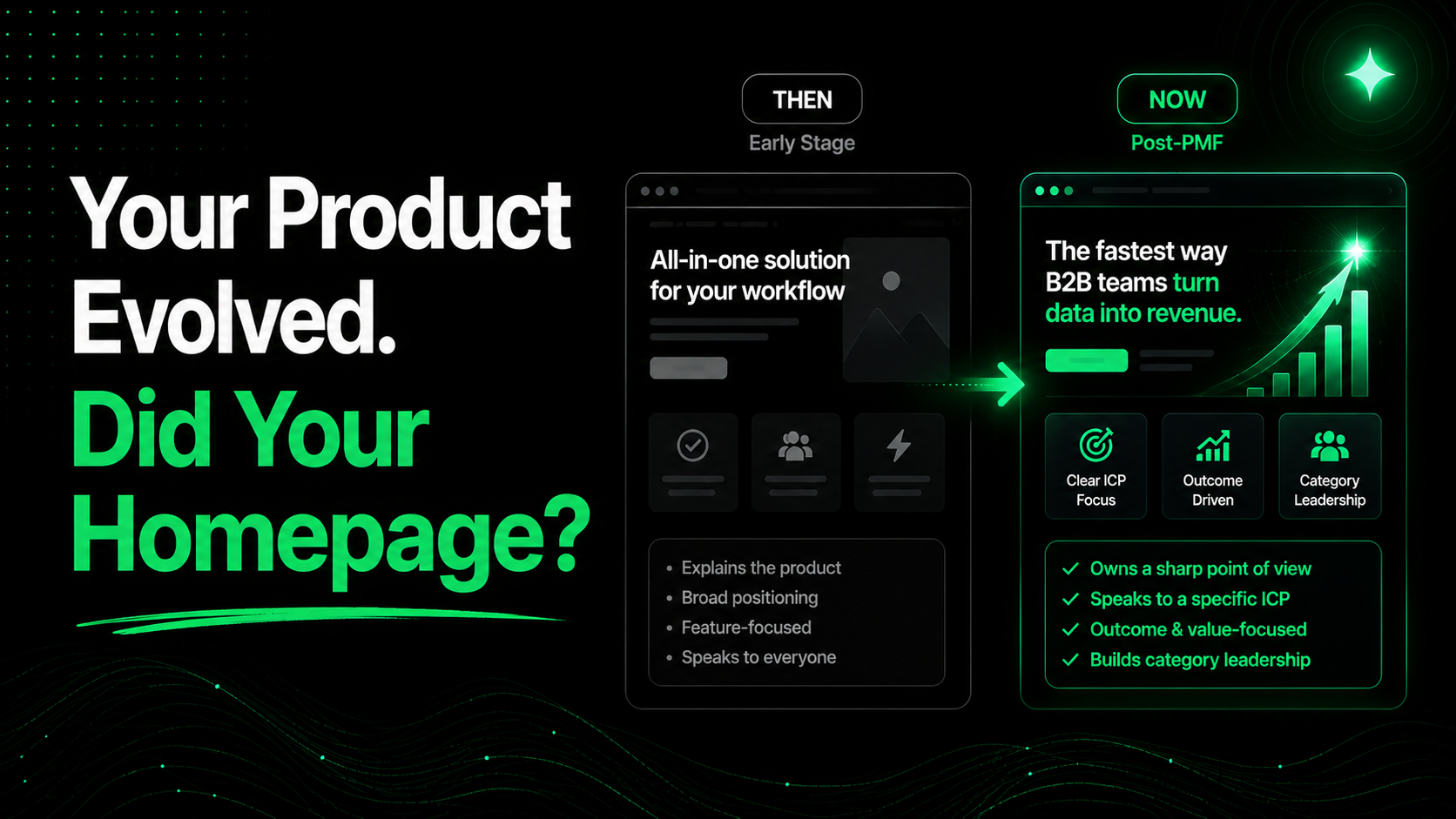
Then you compare the before and after, and most of the time the only thing that actually changed is how it looks.
We went through 20 B2B SaaS companies that raised Series A rounds between 2023 and 2025 to see what they changed on their websites in the six months around the announcement, and which of those changes did anything for the business. The company names below are composites, not real businesses, but the patterns are real and they repeat with almost boring consistency. If you want the short version of how we'd fix this on a live site, that's what our website revamp work is built around.
The headline finding: most companies change the wrong things and leave the right things untouched.
How we scored the 20 companies
We split the set into four categories, five companies each: Revenue and GTM, Customer Success and Retention, HR Tech and People Operations, and Developer Tools and Infrastructure. Every company raised between 8M and 45M.
For each one we looked at six things, before and after the announcement:
Hero messaging: Did the headline move from broad and categorical to specific about who it's for and what problem it solves?
Social proof: Did proof grow up from a logo wall into named, quantified case studies?
Conversion infrastructure: Pricing page, demo flow, CTA placement.
Technical performance: PageSpeed, Core Web Vitals, mobile.
Competitive positioning: Did the site build an actual wedge, a reason this tool wins, or just list features?
SEO and AEO foundations: Title tags, schema, and whether the site was set up to show up in AI search at all.
Each one scored 0 for no change, 1 for partial, 2 for meaningful. Twelve points possible. The average across all 20 companies came out to 5.8.
That number is the whole story before we even get into the teardown. The typical Series A site update fixes fewer than half the things that move the business.
Revenue and GTM tools
This category scored highest, 7.2 on average, mostly because these teams tend to be marketing-led and understand messaging.
The best one in the group rewrote its hero from "Smarter pipeline management for sales teams" to something close to: "Sales leaders at 50 to 500 person SaaS companies are running their forecast on a spreadsheet they don't trust. We give them a pipeline view built on data their reps actually log." Three named case studies went up inside 60 days of the announcement, each with real numbers. A pricing page launched. Mobile PageSpeed went from 61 to 78. The old headline could have belonged to any pipeline tool. The new one is specific enough that the wrong buyer disqualifies themselves on sight, which is exactly what you want at this stage. What they missed: no FAQ schema, no AEO setup, so the search spike from the announcement had nowhere to land in AI results.
The worst in the group did the opposite. Same seed-stage headline left in place, no case studies, no pricing page, but they added 22 logos, expanded the team section, and grew the nav to six top-level items. Every section got bigger. Nothing got sharper. A prospect landing on that site after the announcement has more to read and less reason to act.
That gap, between the company that rewrote the argument and the company that just added volume, is the whole teardown in miniature.
Customer success and retention tools
Average score 5.4, and the widest spread in the set. The single best teardown (10 out of 12) and the worst (3 out of 12) both lived here.
The 10 was a full rebuild. The hero went to: "Your CS team finds out a customer is churning when they tell you they're leaving. We surface the signal 60 days before that conversation." That's a consequence-first headline. It names the exact moment a CS leader dreads and sells the fix to that specific failure. Four named case studies with churn and NRR numbers. Transparent pricing on the first two tiers. Rebuilt mobile experience. FAQ schema. And it was the only company in all 20 that implemented llms.txt before the announcement. The one weak spot was the competitor comparison page, which named rivals but compared feature lists instead of explaining why this approach actually wins.
The 3 is the cautionary tale. New logo, new typography, new color system, slightly faster load. Hero untouched. Zero new case studies. No pricing page. This is a company that hired a brand firm, ran a visual refresh, and did not touch a single messaging or conversion lever. A new coat of paint on an argument that wasn't working.
HR tech and people operations
Average 5.0, and the worst category for technical and AEO work. Zero of the five added any AI search infrastructure.
The standout rewrote its hero to: "HR leaders at 200 to 2,000 person companies are making workforce decisions with 6-month-old survey data. We give them real-time signals, so they're not the last person in the room to know something is wrong." That last line lands because it names a real professional fear, being blindsided by a resignation or a team blowup you should have seen coming. That kind of emotional specificity converts. What they left on the table: PageSpeed stuck at 59 on mobile, and no AEO at all.
The weakest move in the category, and maybe the whole set, was a company that put its investor's name directly in the hero: "HR software that works, now backed by [Investor]." Enterprise HR buyers do not pick vendors based on who wrote the check. The investor name belongs in a press strip or the About page, not in the one sentence that's supposed to explain why the product exists. The core message, "HR software that works," which says nothing, went unchanged.
Developer tools and infrastructure
Average 6.0. Strongest technical work, weakest messaging evolution, which tracks with who founds these companies.
The best one pulled off the hardest thing in dev tools: keeping technical credibility while adding commercial context. Hero went to "Data engineering teams at Series A+ companies are rebuilding their pipeline infrastructure every 12 months because the tools they started with don't scale. We're the last pipeline infrastructure they'll need to build." Bold claim, but it's followed immediately by named enterprise case studies with throughput numbers, so it earns the right to make it. Best PageSpeed in the whole set at 91. What it missed: nothing on build versus buy, which is the question asked in every single enterprise dev-tools evaluation.
Another in this group built separate journeys for three buyers, developer, engineering manager, and CTO, with different nav entry points and content paths. Most sophisticated structural change in the dataset. The cost: all that conditional routing dragged PageSpeed from 79 down to 64. Clever UX is the most common source of new technical debt.
The six patterns that held across all 20
Design changes are universal. Messaging changes are not: Eighteen of 20 made some visual update. Eleven touched the hero. Only seven of those eleven were real shifts in specificity. The rest were lateral, different words at the same level of vague. Design investment is nearly automatic at Series A. Messaging investment is the exception.
The pricing page is the highest-leverage missing piece: Fourteen of 20 had no pricing page before the round. Ten of those added one, but six used "contact us" on every tier, which strips out most of the value. Two companies still had no pricing page more than a year after closing. A pricing page, even a partial one, qualifies buyers before they ever talk to sales.
Case study depth beats logo volume: Companies that added three or more named, quantified case studies outperformed the logo-adders on every metric we could see, time on site, demo requests, return visits. The clearest example is the company that bolted on 22 logos and zero case studies and posted the worst engagement in its category. Buyers want one customer's specific outcome, not 22 silhouettes.
CTA placement is broken almost everywhere: Fourteen of 20 had their main CTA only at the very bottom of the homepage. Seven had no CTA in the nav at all. The fix is simple: a CTA visible above the fold, again after the social proof, and again at the bottom, plus one persistent in the header. Announcement traffic, journalists and investors, scrolls fast and rarely reaches the footer.
AEO is the most consistently skipped investment: Zero of 20 had llms.txt before their announcement. Four had FAQ schema. None had structured content built for AI citation. And this is the gap that's growing fastest right now.
This matters more every quarter. G2's March 2026 research found that 51% of B2B software buyers now start their research with an AI chatbot more often than with Google, up from 29% in April 2025. More striking, 69% said they chose a different vendor than they'd originally planned because of AI guidance, and one in three bought from a vendor they'd never heard of before. Forrester's 2026 buyers' journey survey of nearly 18,000 buyers found that twice as many named generative AI or conversational search as their most meaningful research source than any other option, ahead of vendor websites and sales reps. PR Newswire + 2
So when your Series A announcement drives a buyer to ask ChatGPT "what's the best tool for [your category]," a site with no AEO foundations sends that buyer to a generic answer, or a competitor's. The fix takes a few hours. The return compounds for a year or more. It's the highest-ROI thing most Series A companies aren't doing, and it's a core part of how we handle SEO and structured data.
The top scorers all did the messaging work first: The four companies that scored 8 or higher shared exactly one trait the other 16 didn't: they had a written positioning brief before any design work started. One team described it as the hardest two weeks before the rebuild, and the reason the rebuild actually landed. The low scorers almost all started with a Figma file or a design reference and worked backward to figure out what to say. That process gives you a beautiful site that doesn't know its own argument.
How to run this teardown on your own site
You don't need an agency to do the first pass. You need an hour and some honesty.
Score yourself on those six dimensions, zero to two, same as we did. The lowest scores are your highest-leverage fixes, and they're almost always messaging and conversion before design.
What this means if you're about to announce
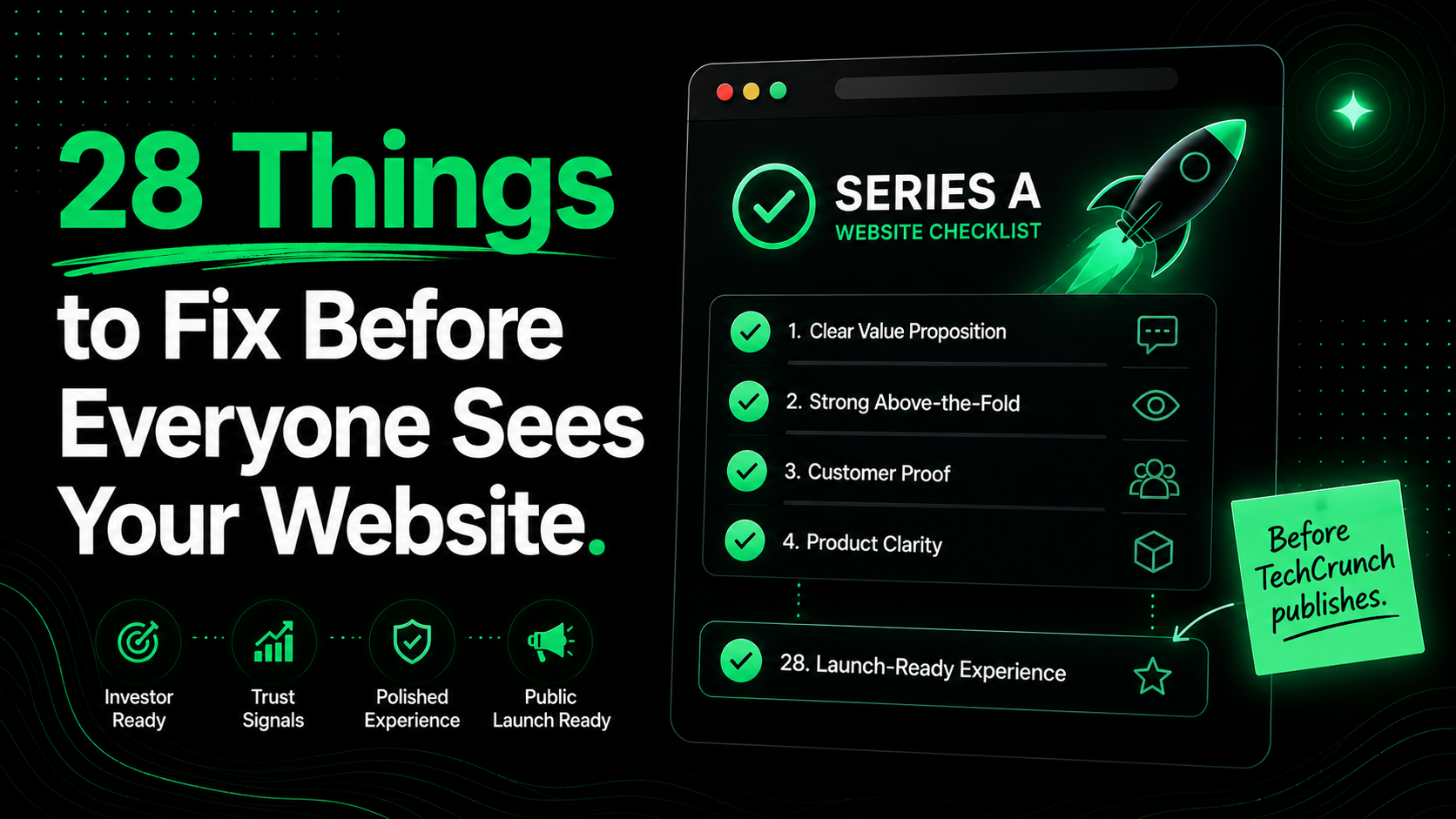
Do the things 15 of 20 skipped. Quantified, named case studies. A pricing page with real tier logic on at least two tiers. FAQ schema. AEO foundations. A CTA at three scroll depths. A hero that names the problem and the consequence, not the product category.
Don't burn budget on the things 18 of 20 did that changed nothing. A visual refresh with no messaging work. Logos with no stories behind them. Nav expansion with no positioning clarity underneath it.
And do the one thing only four of 20 did well. Start with positioning, not design. The difference between a 9 out of 12 site and a 4 out of 12 site is almost never the design quality. It's whether someone sat in a room and answered the hardest question before anyone opened Figma: what is the most honest, most persuasive thing this company can say to the buyer it most needs to win?
That question is worth two weeks of a founder's time. The answer is worth every dollar the site costs.




.avif)





.svg)
.svg)

