

Use to summarize this article


- A Series A announcement sends 5,000 to 15,000 visitors to your site in 48 hours: investors, enterprise buyers, future hires, journalists, and competitors, each reading it for something different
- The full checklist covers 28 items across messaging, social proof, technical performance, SEO and AEO, conversion infrastructure, and operational readiness
- If you are short on time, 12 of the 28 items matter most: positioning, social proof quality, technical baselines, and CTA consistency
- The 72 hours after the embargo lifts need a named owner and a monitoring plan, not just a launched site
- Getting the site right before the announcement is a compounding asset for the next 24 months, not a one-week sprint
The round closes on a Tuesday. The wire lands. The PR firm has the TechCrunch embargo locked for 6am. Someone on your team pings you at 11pm: is the website ready?
You know the answer. You have been avoiding it for three weeks.
Most Series A founders spend the last 72 hours before an announcement doing triage, not strategy. The hero headline gets a pass. The funding amount gets dropped in somewhere visible. A press bar goes up. Then the embargo lifts and somewhere between 5,000 and 15,000 visitors land on the site in the next 48 hours: investors, enterprise buyers, future hires, journalists. The site fails most of them quietly, in about 22 different ways nobody thought to check.
At Flowtrix we run pre-announcement sprints for exactly this window. We revamp B2B SaaS, AI, and cybersecurity websites for companies from Series A to Series C, and the week before a funding announcement is one of the most common reasons a founder calls us.
Who actually lands on your site after the embargo lifts?
Most founders picture their customers when they think about announcement traffic. That is maybe a fifth of it.
Series B investors who did not participate in your round check your site within hours. They read the homepage like a pitch deck: market clarity, positioning confidence, evidence of traction. Enterprise buyers already sitting in your pipeline treat the funding news as a buying trigger. A prospect stuck in evaluation for 90 days sees the TechCrunch article and it answers the unspoken question of whether you will still exist in two years. They come back to the site to confirm the product is real.
Executive candidates read the announcement and immediately look you up. They are checking stage, culture, and team caliber against the job they would be leaving. Journalists covering adjacent categories pick up the story from newsletters and aggregators and land on your site before they write a word. Your competitors are there within the hour, benchmarking your positioning and sharpening their own.
Every one of these visitors is asking a different question, and none of them will tell you what it is. Your site has to answer all five without anyone having to ask.

The Audit, Launch, Compound model
After running pre-announcement sprints for founders across a few dozen rounds, we kept seeing the same mistake. Companies solve for the wrong 48 hours. They obsess over the exact hour the embargo lifts and ignore the three weeks before it and the ten weeks after. The work actually splits into three windows: Audit, Launch, and Compound.

| Attribute | Audit | Launch | Compound |
|---|---|---|---|
| Timeframe | 3 weeks before | Hours 0 to 6 | Hours 6 to 72 and beyond |
| Primary focus | Messaging, proof, technical, SEO/AEO, conversion, ops | Press bar, inbox response, error monitoring | Attribution, follow-up, compounding traffic |
| Who owns it | Marketing lead, with founder sign-off | A single named owner for the window | Marketing and sales, working the CRM data |
| Risk if skipped | Site fails silently on launch day | Leads and errors go unhandled | Announcement traffic never compounds |
Stage 1: Audit, the 28-item pass
This is the bulk of the work, and it should start three weeks out, not three days out. The 28 items fall into six categories: messaging and positioning, social proof, technical performance, SEO and AEO foundations, conversion infrastructure, and operational readiness.
What the messaging and positioning items cover:
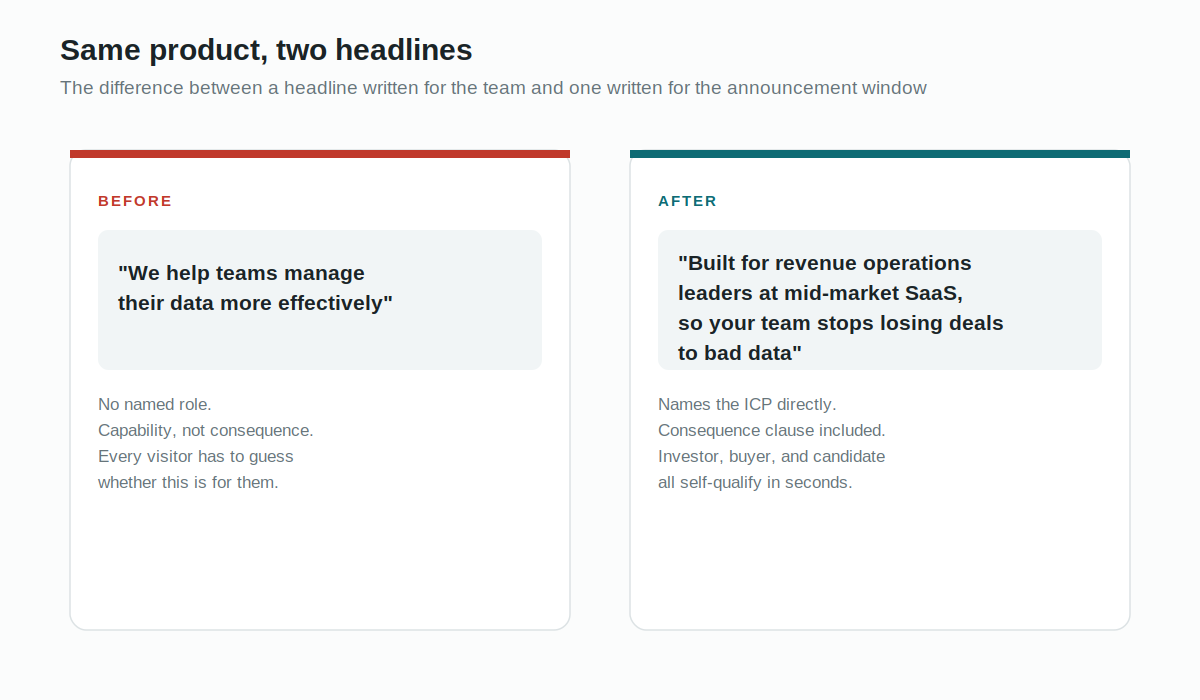
Your hero headline was probably written 18 months ago, when you were still figuring out who your best customer actually was. Read it now and ask whether it names a specific role at a specific company type with a specific problem. Check that the subheadline includes a consequence, not just a capability. There is a real difference between "we help teams manage X" and "so your team stops losing Y." The second version converts better and signals maturity to any investor reading it. Confirm the homepage is factually consistent with the embargo copy, product screenshots reflect the current version, and any deprecated features or old pricing tiers are gone. Competitive references date faster than anything else on a B2B site. If your "why us" section name-checks a competitor who has since been acquired, you look uninformed to the exact people who know your category best.

What the social proof items cover:
Logos are not case studies. Testimonials without numbers are not case studies. You need at least three published customer stories with named companies and specific outcomes before the embargo lifts, because enterprise buyers arriving from the announcement need evidence, not brand recognition. Confirm every customer logo on the site is still authorized. Every B2B SaaS company has one logo left over from a customer who churned or got acquired, and the announcement window is not when you want to discover that. Check that traction numbers on the homepage are accurate as of announcement day, and stage the TechCrunch logo and article link so it can go live the moment the embargo lifts.
What the technical performance items cover:
Run PageSpeed Insights on your homepage right now. Below 70 is a problem. Below 60 is a credibility issue for a company that just announced funding. Confirm the site can handle a traffic spike of 2,000 to 10,000 visitors in a six-hour window, test every conversion path cold on mobile and desktop, and run a broken link check across the full site. A 404 hit by a journalist during the announcement window sends the wrong signal at the worst possible time.
What the SEO and AEO items cover:
Rewrite your meta description if it still reads "Home | [Company]." Update Crunchbase, LinkedIn, and your Google Business Profile before the announcement, since investors and buyers cross-reference all three. Add FAQ schema to the homepage if it is not there already, since the announcement triggers a wave of category and brand-name search that structured data helps you capture. Then check the part almost nobody checks: open ChatGPT and Perplexity and ask "tell me about [Company]" and "who are the best tools for [category]." If a competitor is cited and you are not, your AEO foundations need work before the announcement, not after.
What the conversion infrastructure and operational readiness items cover:
Pick one primary CTA and make it consistent across every page. Confirm every demo request and form submission flows into your CRM with source attribution, so announcement leads do not land in an untagged inbox. Make sure the pricing page exists and communicates value even without exposing enterprise numbers. Update the careers page, since executive candidates will check it within the hour, and update the team page to match who is actually on your Slack today.
Stage 2: Launch, the first 6 hours
The embargo lifts. The TechCrunch logo and article link go live on the press bar within the first hour. Someone is watching the demo request inbox and responding within 60 minutes, not by end of day. Someone is watching for site errors and form failures, because this is the exact window a traffic spike will find them. The announcement gets posted on the company LinkedIn page and the founder's personal page, with UTM parameters already set on the TechCrunch link so hour six's traffic report actually means something.
Flowtrix has delivered 120+ revamps for B2B SaaS, AI, and cybersecurity teams. Explore the work behind the messaging.

A pre-Series A rebuild for a data security platform that needed the site to match the pace of the product.



Stage 3: Compound, hours 6 to 72 and beyond
The work does not stop when the article publishes. Hours 6 to 24 are about tracking which press pickups are actually sending traffic and responding to the LinkedIn comments and DMs from investors and candidates. Hours 24 to 72 are about identifying the highest-value visitors by company, using a tool like Clearbit Reveal, and flagging any investor who visited but did not reach out for a follow-up.
This is also where the compounding part starts. Databahn came to Flowtrix in exactly this window, days before their Series A closed, needing a site that reflected the pace the product had actually reached. The sprint itself covers 72 hours. What it sets up, the messaging clarity, the technical baseline, the AEO foundation, keeps paying out for the next two years of the company's growth, not just the announcement week.

Four signals your site is not ready for the embargo to lift
If you only have a day left, check these four first. No FAQ schema on the homepage means you are leaving AI and search visibility on the table during the exact week people are searching your name. Fewer than three named case studies means enterprise buyers arriving from the announcement have nothing to evaluate against. A PageSpeed score under 70 means a meaningful share of that 48-hour traffic spike bounces before they read a word. Inconsistent CTAs across pages mean you will not be able to tell, a week later, which channel actually drove pipeline.
The one mistake that undoes the other 27
Every item on this list is fixable in a day or two on its own. The mistake that undoes all of them is treating the checklist as a one-time pre-launch task instead of assigning someone to own it through the 72 hours after. A site that passes every item at 6am and has nobody watching it at 2pm is still a site that fails its own announcement.
Twenty-eight items sounds like a lot, but none of them are individually hard. What is hard is doing them the same week you are closing the round, hiring for four open roles, and briefing your board. Start the audit three weeks out instead of three days out, and the embargo lift turns into the easiest 48 hours of your quarter instead of the hardest.


FAQ's











.svg)
.svg)