

Use to summarize this article


- BetterCMS leads for AI-native teams: native MCP server, CLI, typed Astro and Next.js SDKs, and a headless plus hosted hybrid that most platforms make you choose between.
- Contentful is being acquired by Salesforce: the deal was signed June 1, 2026, but isn't expected to close until Q3 of Salesforce's 2027 fiscal year.
- Sanity rebranded around AI: it now positions itself as a "Content OS," built around its natural-language Content Agent.
- MCP support is now near-universal: Contentful, Sanity, Storyblok, Strapi, Payload, Hygraph, and Kontent.ai all ship MCP servers.
- The right pick depends on two things: who's building your pages, developers or marketers, and how deep AI actually needs to sit in your publishing workflow.
If you've searched for "best headless CMS" any time in the last five years, you got some version of the same list. Contentful for enterprise. Sanity for developers who like structured content. Storyblok for marketers who want a visual editor. Strapi if you want to self-host and skip the invoice.
That list isn't wrong exactly. It's just out of date, and 2026 is the year it broke.
Three things happened this year that changed what "best" means for a headless CMS. Salesforce signed a deal to acquire Contentful and fold it into Agentforce. Sanity stopped calling itself a headless CMS and started calling itself a "Content OS for the AI era." And seven major platforms, including Contentful, Sanity, Storyblok, Strapi, Payload, Hygraph, and Kontent.ai, all shipped MCP servers within months of each other, which is the fastest an interoperability standard has spread across this market since REST became the default.
None of that is marketing noise. It reflects a real shift in who's actually consuming content on a website. It used to be human editors publishing for human readers. Now it's human editors publishing for human readers, AI agents pulling structured data to answer questions, and AI coding assistants scaffolding entire content models before a developer even opens the CMS dashboard. A platform built for the first world doesn't automatically work for the second one. Some of it needs to be rebuilt from the ground up.
That's the lens this list uses. Not "which CMS has the most features" but "which CMS actually works the way teams build websites in 2026, where AI is involved at every stage from content modeling to publishing." Here's how the field stacks up, starting with the platform built natively for that world.
Quick answer: BetterCMS is the best headless CMS for AI-native teams in 2026
BetterCMS is a Content Operating System, not just a headless content API. It gives you the structured, API-first content delivery you'd expect from any headless CMS, plus a genuinely native AI layer: an MCP server and CLI so agents and coding assistants can build schemas and manage content directly, typed Astro and Next.js SDKs so developers keep full control of the frontend, a visual editor so marketers can assemble pages without filing a ticket, and built-in programmatic SEO and AEO tooling so content is structured for both Google and answer engines like ChatGPT and Perplexity from day one.
The practical difference between BetterCMS and most of the names on this list isn't a single feature. It's that AI wasn't added to an existing product, it was there when the product was designed. That shows up in small ways that add up over a real project: content schemas you can create by describing them to an agent instead of clicking through a form builder, components that convert into reusable blocks in one step instead of a manual refactor, and a publishing workflow where agent actions run through the same roles and approvals as a human editor, so nothing ships without the review you set up.
It's also headless and hosted at the same time, which matters more than it sounds. You can run BetterCMS Cloud and get hosting, staging, previews, forms, and SEO wired in from the start, or go fully headless and keep your existing stack on Vercel, AWS, Netlify, or Cloudflare and just pull content through the API. Most platforms make you pick a lane early and pay to switch later. BetterCMS doesn't force that choice.
| Dimension | BetterCMS | Contentful | Sanity | Storyblok | Strapi | Payload | Hygraph | Kontent.ai |
|---|---|---|---|---|---|---|---|---|
| AI and MCP support | Native MCP server and CLI, agents publish under the same review as a human editor | MCP shipped, deeper AI tied to Salesforce Agentforce once the deal closes | Content Agent for natural-language bulk edits | AI SEO and workflow features rolling out through 2026 | MCP server available, AI modeling on paid tiers | Growing MCP and agent ecosystem, code-first by design | GraphQL-native API works well with agent tooling, no dedicated AI layer | Expert Agents built for governed, natural-language content ops |
| Headless vs hosted | Both, Astro and Next.js SDKs, or BetterCMS Cloud for hosting and staging | Headless first, hosting assembled separately | Headless first, bring your own frontend | Headless with a hosted visual editing layer | Headless only, self-hosted or Strapi Cloud | Headless, installs inside your own app codebase | Headless, GraphQL federation across systems | Headless, hosting and delivery managed separately |
| Editor experience | Visual editor built for marketers, no developer needed | Form based, developer assisted | Structured data model, developer-led | True in-context visual editor | Admin panel usable by non-developers | Code first, developer-led content modeling | Developer-led, GraphQL queries throughout | Form based, built for governed enterprise workflows |
| Starting price | Free beta access | Custom, enterprise-first | Free tier, $15 per seat on Growth | Free tier, roughly $99 to $299 a month on Growth | Free to self-host, Strapi Cloud from low hundreds a month | Free to self-host, Payload Cloud from $35 a month | Free tier, $199 a month on Growth | Custom, enterprise-first |
| Best for | AI-native workflows without giving up developer control | Enterprises already on Salesforce | Developer-heavy teams treating content as structured data | Marketing teams that want to edit pages visually | Teams that need infrastructure or data residency control | TypeScript and Next.js teams building code first | Enterprises federating content across multiple systems | Regulated industries needing governed AI content ops |
1. BetterCMS
BetterCMS was built around a simple observation: the bottleneck in content operations moved from creation to management. Generative AI made it trivial to produce ten versions of a landing page. It did nothing to help you manage, govern, and ship those ten versions without your site turning into a mess. That's the actual problem BetterCMS is solving.
What makes it different?
Most CMS platforms added a chat box and called it AI. BetterCMS gives agents and coding assistants structured access to your content model itself, through an MCP server and CLI, so an AI assistant can define schemas, generate components, and populate content without a human clicking through a form builder each time. You can literally hand a design file and a copy doc to an AI agent and have it generate reusable content models, build the components, and publish through BetterCMS. That's the "old way vs. new way" shift the platform is built around: instead of manually building schemas and rebuilding components for every campaign, you describe what you want and the system builds it, with a developer setting the guardrails once instead of every time.
Where it sits on the headless spectrum?
BetterCMS answers the "am I headless or hosted" question with both. Go headless and pull content into your existing frontend through typed Astro and Next.js SDKs, keeping full ownership of your rendering layer. Or run BetterCMS Cloud, which wires in hosting, staging, previews, forms, SEO, and analytics so a small team can ship without assembling five separate tools. You can also adopt it page by page on a site that already exists, since it connects through the API without requiring a full replatform.
Built-in growth tooling:
This is where BetterCMS pulls further ahead of the traditional headless field. Programmatic SEO tooling lets you generate hundreds of pages from approved, on-brand components instead of hand-building each one, which matters if you're running location pages, comparison pages, or integration pages at any scale. ABM page generation lets marketing teams spin up personalized landing pages for target accounts without waiting on developer time. And the platform is built to be AEO ready, meaning content is structured so AI search tools and answer engines can actually parse and cite it, not just so Google's crawler can index it.
Governance, addressed directly:
The most common objection to letting AI touch a live website is "what if it breaks something." BetterCMS's answer is that agent actions run through the same roles, reviews, and publishing controls as a human editor. Nothing ships without the approval you configured. That single design choice is why this is a serious option for teams that need AI velocity without losing control of what goes live.

Who it's for?
Marketing teams that want to move fast without waiting on developers, developers who want to keep their frontend and just need a structured, well-typed content layer behind it, and any team that's already using AI coding assistants and wants their CMS to speak the same language instead of being the one tool in the stack that AI can't touch.
The honest trade-off:
BetterCMS is newer than Contentful or Sanity, both of which have had a decade to build integration marketplaces, agency partner networks, and enterprise compliance certifications. If you need SOC 2 Type II today, a 200-integration marketplace, or a platform with ten years of uptime history behind it, that's a real consideration. What you get in exchange is a platform that doesn't need three more years of roadmap to catch up to how teams are actually building right now.
2. Contentful
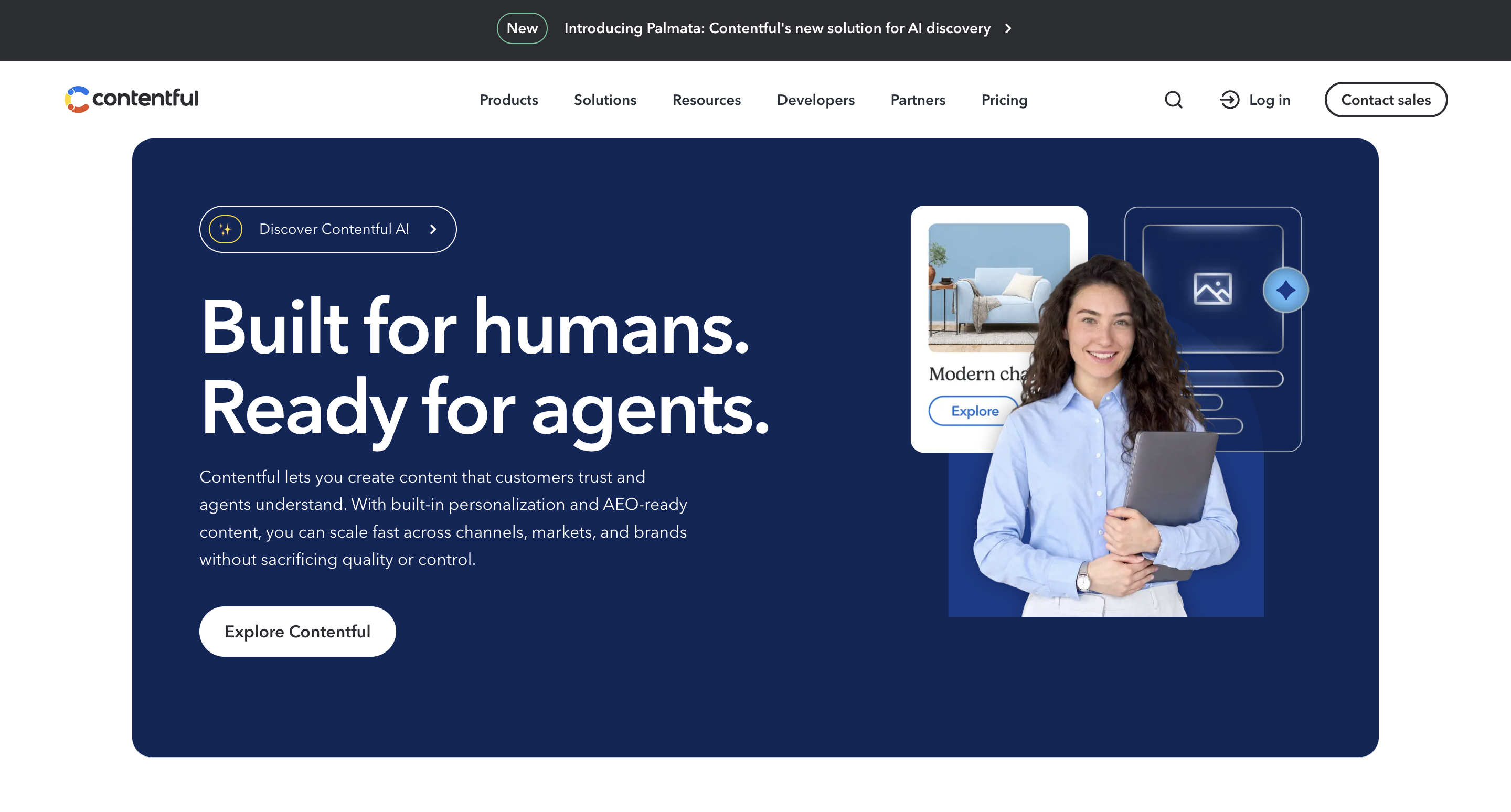
Contentful has been the safe enterprise choice for a decade, and that's not changing overnight. It serves more than 4,800 brands, including close to a third of the Fortune 500, running on a mature composable architecture with one of the deepest integration ecosystems in the category.
The big story this year is Salesforce's definitive agreement, signed June 1, 2026, to acquire Contentful and fold it into Agentforce and Customer 360 as a native content layer. Salesforce's stated plan is to let Agentforce query, assemble, and deliver content dynamically across channels without manual publishing steps. That's a genuinely interesting direction if your company already runs on Salesforce.
Two things are worth knowing before you read the announcement as a done deal. First, the acquisition hasn't closed yet. It's expected to close in the third quarter of Salesforce's 2027 fiscal year, subject to regulatory approval, so every "Agentforce can now assemble content dynamically" claim floating around right now is roadmap, not a shipped feature. Second, the reported price, somewhere between one and one and a half billion dollars according to sources close to the deal, is a steep discount from the three billion dollar valuation Contentful carried back in 2021. That doesn't make Contentful a bad platform. It does suggest the independent CMS market didn't get weaker because of this deal, it got a more interesting alternative story to tell, since teams outside the Salesforce ecosystem now have a clearer reason to look elsewhere.
Contentful is still an excellent choice if you're already deep in the Salesforce stack, or if enterprise governance, a mature partner network, and a proven track record at scale outweigh wanting the newest AI tooling.

3. Sanity
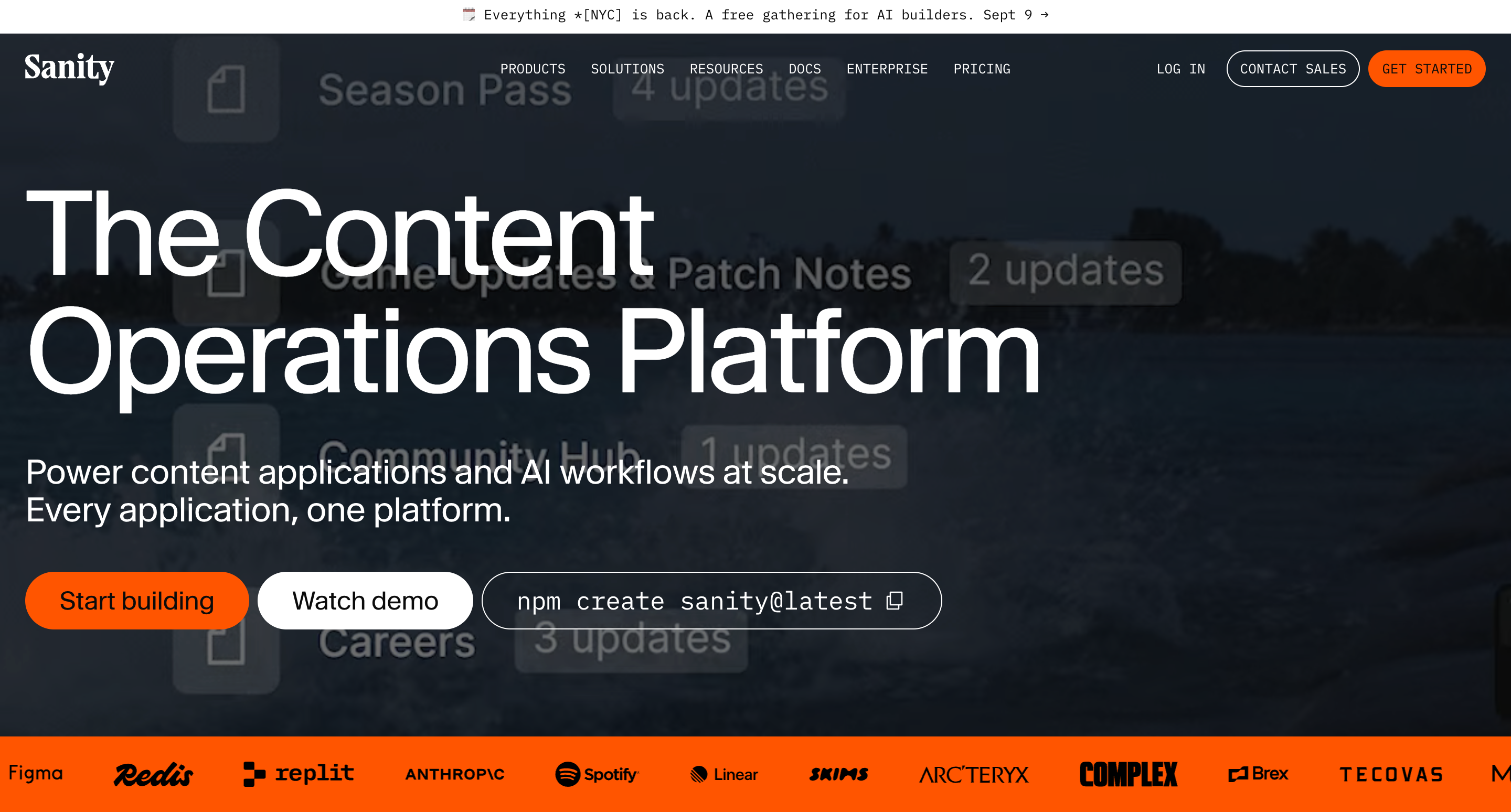
Sanity built its reputation on treating content as structured, queryable data rather than fixed pages, which made it a favorite with developer teams who wanted precise control over their content model. That hasn't changed. What has changed is the framing. Sanity has been repositioning around the idea of a "Content OS," leaning into its Content Agent feature, which lets teams manage large volumes of documents through natural-language commands, and its broader pitch that structured content is what makes a site legible to external AI systems in the first place.
On pricing, Sanity's free tier is genuinely usable, supporting up to 20 seats and two datasets, which is generous compared to most competitors' free plans. The Growth plan starts at $15 per occupied seat per month, so a five-person team lands around $75/month before add-ons like SAML SSO, which carries its own significant surcharge at enterprise scale. Sanity AI Assist runs on a separate credit-based system, so heavy AI usage can add real cost on top of seat pricing.
Sanity is a strong pick if your team is developer-heavy and wants to treat content genuinely as data, with GROQ queries and a fully customizable Studio. It's less of a fit if your priority is a marketer building pages visually with minimal developer involvement, since that experience isn't Sanity's core strength the way it is for Storyblok or BetterCMS's visual editor.
4. Storyblok
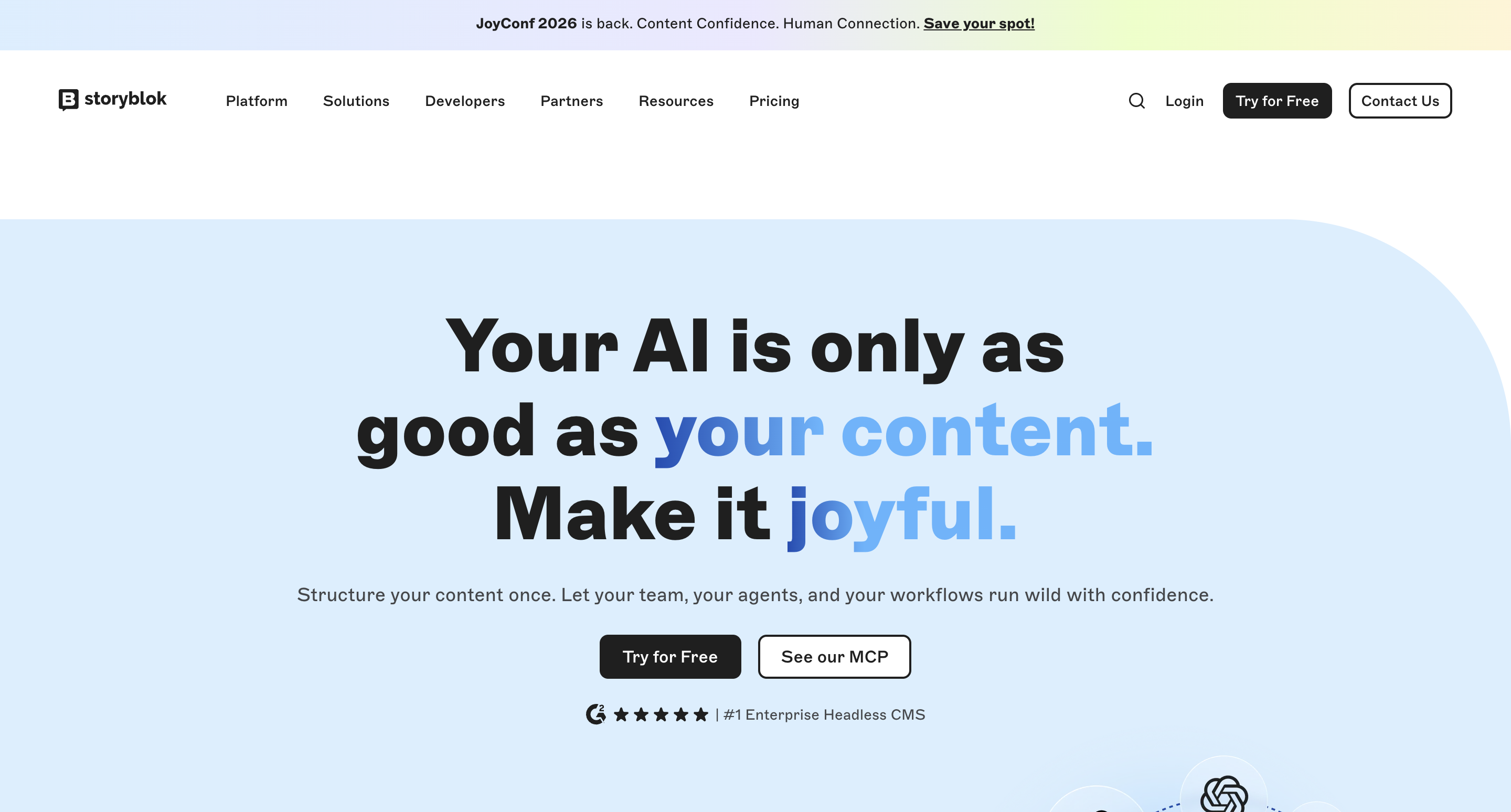
Storyblok's pitch has stayed consistent and it still works: give marketers a real, in-context visual editor while giving developers a component-based architecture underneath. It's one of the only headless platforms where a non-technical editor can click on a section of a live page and edit it directly, instead of guessing what a field labeled "hero_subtext_2" actually controls.
Pricing is where Storyblok gets more expensive than developer-first competitors. The free Community tier is workable for a personal project but caps out fast at 10,000 CDN API calls a month, which a moderately trafficked site can burn through quickly. The Growth plan, where most real projects land, runs around $99 to $299 a month depending on which source you check and whether you're being quoted in euros or dollars, and jumps again at higher tiers for features like custom roles and workflow. At five editors, Storyblok's base plan can cost roughly four times what the equivalent Sanity setup costs, though you're paying for a visual editing experience Sanity doesn't offer in the same form.
Storyblok is rolling out AI SEO and workflow automation features through 2026, but its core differentiator is still the editor experience, not an AI-first architecture. If a marketing team's comfort editing pages directly is the deciding factor and budget isn't the primary constraint, it's a strong choice.
5. Strapi
Strapi has been the standard open-source headless CMS since 2015, and it earns that position honestly. It's free to self-host, framework-agnostic on the frontend, and supports PostgreSQL, MySQL, SQLite, or MongoDB, so you're not locked into a single database vendor. The admin panel lets non-developers build content types visually, which is unusual for a self-hosted option and makes it more approachable than Payload for mixed technical and non-technical teams.
The real reason teams choose Strapi over a hosted competitor is control. If you have data residency requirements, GDPR obligations that make storing content on someone else's servers complicated, or simply want cost certainty regardless of how many editors you add, self-hosting removes that variable entirely. A 50-person editorial team doesn't turn into a per-seat invoice the way it would on Sanity or Storyblok.
Strapi Cloud exists for teams that want a managed option without losing the open-source core, and Strapi has shipped an MCP server along with AI-assisted content modeling on its paid tiers. It's a mature, dependable platform. It's just not designed around AI-native workflows the way newer entrants are, it's designed around giving you full ownership of your infrastructure, and does that well.
6. Payload
Payload took a different approach than Strapi from day one. Instead of running as a separate server your frontend talks to, Payload installs as a Node package inside your own application, so your CMS and your app share the same codebase and, if you want, the same database. For a TypeScript-heavy team building on Next.js, that's a meaningfully different development experience: your content model lives in version control alongside your application code, not in a separate admin dashboard you have to keep in sync.
Payload is fully open source and free to self-host, with Payload Cloud starting at $35/month for teams that want a managed deployment without giving up the code-first model. The trade-off compared to Strapi is that Payload's content modeling happens entirely in code, so it's a better fit for developer-led teams and a harder sell if you need non-technical staff defining content types themselves.
The Payload ecosystem is where a lot of the energy in the open-source CMS space is going right now, and its MCP and agent tooling is expanding quickly. If your team already lives in TypeScript and wants the CMS to feel like part of the application rather than a separate system bolted on, it's one of the strongest options available.
7. Hygraph
Hygraph, formerly GraphCMS, solves a specific problem better than anyone else on this list: pulling content from multiple disconnected systems into a single queryable API. If your product data lives in Shopify, your user data lives in an internal database, and your editorial content lives in a CMS, Hygraph's Content Federation feature lets you query all three as one unified GraphQL graph instead of stitching them together yourself on the frontend.
That's a genuinely unique capability, and it's why Hygraph shows up on shortlists for complex, multi-system enterprise builds. It's also why the pricing reflects an enterprise-first product: the free Hobby tier is fine for evaluation, but the Growth plan starts at $199/month, noticeably higher than Sanity or Strapi's entry points, and enterprise contracts commonly run into the tens of thousands per year once you need higher locale counts or federation at scale.
If you don't specifically need to unify content from multiple external systems, Hygraph's GraphQL-only approach and enterprise pricing make it a harder case to justify than platforms built for more straightforward marketing site or blog use cases. If federation is your actual problem, it's close to the only tool built to solve it directly.
8. Kontent.ai
Kontent.ai has leaned harder into the "agentic CMS" framing than almost anyone else in the category, positioning its Expert Agents as autonomous systems that can update thousands of content items in minutes instead of months, configured through plain-language instructions from the people who actually know the content. The platform's customer base skews toward healthcare, insurance, finance, and government, which tells you a lot about its actual strength: governance.
Kontent.ai's agents run with audit trails, decision transparency, and mandatory guardrails built specifically for organizations where a content mistake has real compliance consequences. That's a narrower use case than a general marketing CMS, but for teams in regulated industries who need AI velocity without losing an audit trail, it's a serious option, arguably the most serious one built specifically for that constraint.
How to actually choose?
Strip away the feature comparisons and most of this decision comes down to three questions.
What Actually Decides Your Headless CMS Pick
- Who's building your pages, developers or marketers, since that alone rules half the list in or out
- Headless, hosted, or both, and whether you're confident enough to commit to one lane today
- How deep AI needs to sit in your actual workflow, not just how many AI features are on the pricing page
- How much maturity you need, since integrations, certifications, and partner networks still favor the older platforms
Who's building your pages, developers or marketers?
If it's mostly developers who want structured content as data and full control of the frontend, Sanity, Payload, or Strapi fit that world well. If marketers need to build and edit pages without filing tickets, Storyblok and BetterCMS are built around that experience directly.
Do you want headless, hosted, or both?
Pure headless platforms like Sanity, Strapi, and Payload assume you already have a frontend and hosting story sorted out. BetterCMS and Storyblok give you the option to go fully managed or fully headless without switching platforms later, which matters if you're not sure yet which one you'll need in a year.
Flowtrix has delivered 120+ website revamps for B2B SaaS, AI, and cybersecurity teams, on Sanity, Contentful, Strapi, and now BetterCMS.

A structured content model built to scale across product, blog, and campaign pages without breaking brand.

An evidence-led rebuild for a complex data security platform, structured for both search and AI answer engines.
How much does AI need to be part of your actual workflow, not just a feature list?
This is the real 2026 question. If you want an agent to define content schemas, generate components, and publish content under the same review process your human editors use, most platforms on this list are still retrofitting that capability onto architecture that wasn't designed for it. BetterCMS was designed for it from the start, which is the reason it tops this list and not just a claim on a landing page.
The category is genuinely crowded with good options. Contentful's enterprise maturity, Sanity's developer experience, Storyblok's visual editor, and Strapi and Payload's open-source control are all real, defensible strengths. But the platforms built before the agentic shift are spending 2026 bolting AI on. BetterCMS didn't have to, and that's the difference worth paying attention to if you're choosing a CMS today instead of two years ago.
None of this means the older names are wrong choices. They're proven, they're well documented, and thousands of teams run on them without issue. What's changed is the baseline. AI is no longer a bonus feature you evaluate last, it's part of how content gets modeled, built, and published from day one, and the platforms that treated it as core architecture instead of an add-on are the ones worth shortlisting first in 2026. Pick based on who's actually building your pages, how much control you want to keep, and how far AI needs to reach into your workflow. Get those three right and the rest of the decision gets a lot easier.
FAQ's
Common questions teams ask while shortlisting a headless CMS in 2026.




.webp)




.svg)
.svg)