

Use to summarize this article


- No single tool audits everything anymore: technical SEO, AEO, Core Web Vitals, and accessibility are four separate disciplines, and most teams need two or three tools, not one.
- AI visibility got expensive fast: Ahrefs and Semrush both moved AI tracking behind paid add-ons in 2026 ($199 to $699/month and $99/month respectively), while SE Ranking and Moz include it from the entry tier.
- Google Search Console and Lighthouse are free and non-negotiable: every stack we build starts there, whatever else gets added on top.
- Screaming Frog, Sitebulb, and Lumar are the technical gold standard: at small, mid, and enterprise crawl scale respectively.
- Fixing what an audit finds is the other half of the job: structured data, one of the most common findings on any audit, needs to stay fixed automatically rather than getting re-flagged every quarter.
You used to run one crawl, export the broken links, fix the redirects, and call it an audit. That job doesn't exist anymore. In 2026 you are auditing technical SEO, answer engine optimization, Core Web Vitals, and accessibility, often in the same sprint, because AI assistants have become a real acquisition channel and compliance pressure keeps climbing.
So you open a browser tab, type "best site audit tool," and get seventeen names, four pricing models, and a dozen features you don't need. Most of those tools are good. Almost none of them do the whole job alone, and several of the ones that claimed to be free or bundled a year ago have quietly moved their best features behind paid add-ons since. The mistake we see most often is a team buying one expensive platform expecting it to cover technical SEO, AI visibility, and accessibility at once, then discovering six months later that it does one of those things well and the rest badly, or not at all.
We audit and rebuild websites for 120+ B2B SaaS, AI, and cybersecurity companies as a Webflow Enterprise Certified Partner, and every engagement starts with an audit. Not one tool's audit, a stack. This post is the shortlist we wish someone had handed us: 17 tools, grouped by the job they actually do, with current 2026 pricing and the one framework we use to decide which ones you need.
Why doesn't one audit tool cover your website anymore?
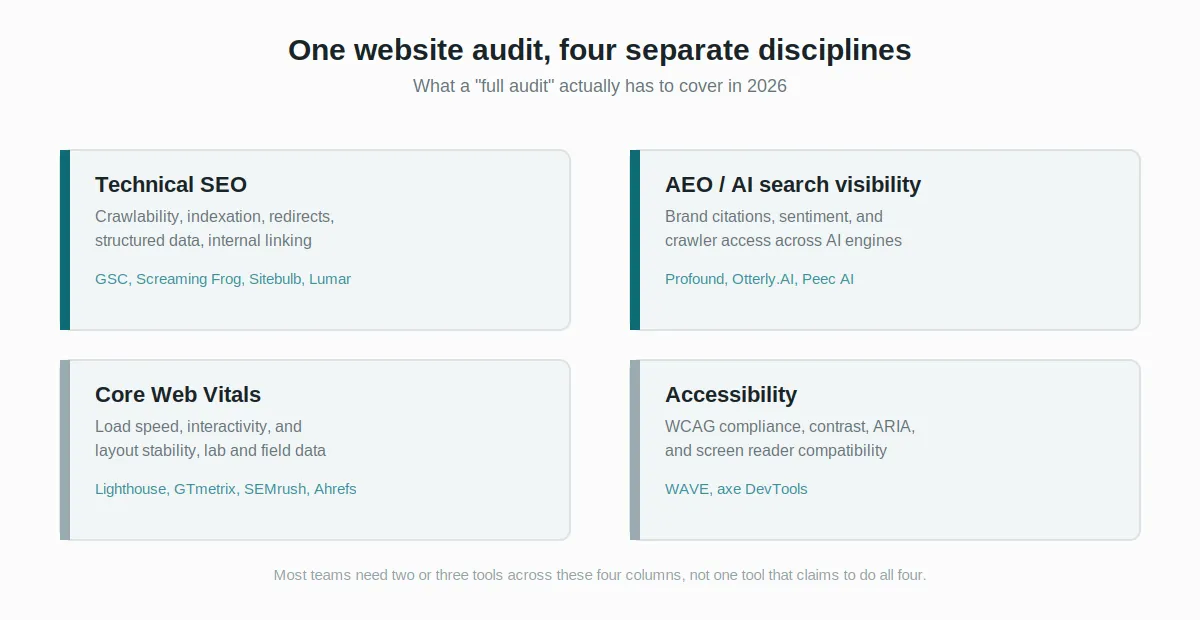
Five years ago, a crawler and a spreadsheet were the whole job. Today the job has split into four disciplines that barely overlap in tooling. Technical SEO covers crawlability, indexation, redirects, and structured data. Core Web Vitals covers load speed, interactivity, and layout stability, using both lab and real-user data. Accessibility covers WCAG compliance, contrast, and screen reader support, and it is no longer optional given rising ADA and European Accessibility Act enforcement. And AEO, answer engine optimization, covers whether ChatGPT, Perplexity, Gemini, and Google's AI Overviews can find, parse, and cite you at all.
None of these four disciplines are optional in a real audit anymore, and none of them are fully covered by any single tool on this list. That is the uncomfortable truth most vendor pages don't lead with, and it is also why the AEO layer has gotten expensive fast. Several of the big SEO suites started 2025 offering AI visibility as a free beta feature and ended it as a $99 to $699 per month add-on once the category proved it mattered.
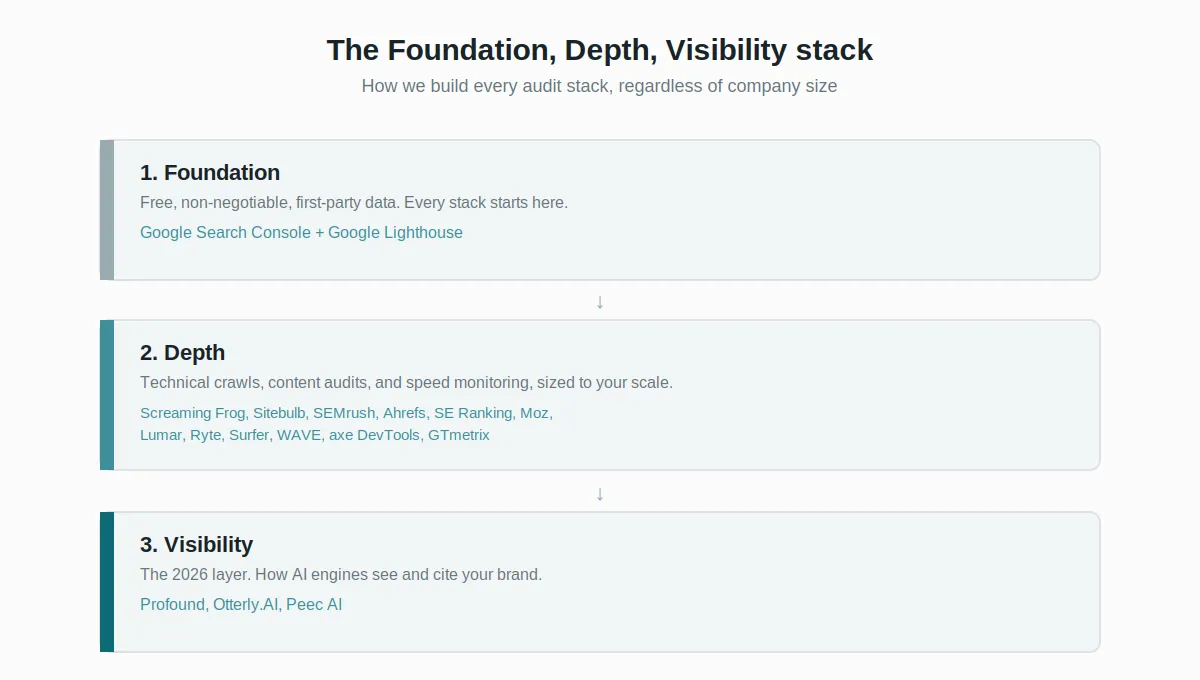
The Foundation, Depth, Visibility model
After running audits ahead of 120+ website rebuilds, we stopped thinking about tools individually and started thinking in layers. Every stack we recommend, whatever the client's size, follows the same three-layer shape.
Foundation is free and non-negotiable. It's first-party data straight from Google, and it anchors everything else. Depth is the technical crawling, content auditing, and speed monitoring layer, sized to how many pages you have and who on your team will actually operate the tool. Visibility is the newest layer and the one most stacks are still missing: whether AI engines can see, parse, and cite your site as a source, and it has become the fastest-moving, fastest-pricing layer of the three.
Foundation layer: the two tools every site needs
Google Search Console:
GSC is the non-negotiable starting point. It shows you exactly how Google indexes and ranks your site, query data, index coverage, Core Web Vitals field data, structured data validation, and manual action alerts, all first-party. It has picked up real AI-era upgrades recently too: an AI-powered configuration tool inside the Performance report that lets you type a plain-language request like "compare last 28 days to the previous period" and have GSC build the filters and date ranges for you, plus custom annotations you can pin directly to a performance chart to mark what changed and when, and branded query segmentation that shows how much of your traffic is people searching for you by name versus discovering you cold. Every site we build or migrate runs through GSC before we touch anything else. Its limit is the obvious one: it still tells you nothing about AI engine visibility on its own, which is exactly why it anchors a stack instead of being the whole stack.
Google Lighthouse:
Lighthouse is the free, official performance auditor built into Chrome DevTools and also available through PageSpeed Insights. One run scores performance, accessibility basics, SEO fundamentals, and best practices, including Core Web Vitals lab data. Its accessibility checks aren't actually its own, they run on axe-core, the same open-source rules engine that powers axe DevTools and has been downloaded more than 4 billion times, so a Lighthouse accessibility score and a quick axe scan will generally agree. We run it before and after every performance sprint, since mobile scores are where most B2B sites bleed conversions.
Depth layer: the crawlers and all-in-one suites
Screaming Frog SEO Spider:
The desktop crawler technical SEOs reach for first. It behaves like a search bot and surfaces titles, metadata, status codes, redirect chains, hreflang, schema, and internal link graphs across thousands of pages, with custom extraction on any element via CSS Path, XPath, or regex. The free version caps you at 500 URLs and blocks JavaScript rendering, scheduling, and saving, which makes it fine for a quick spot check but not for production audits. The paid license runs a flat £199 (about $279 USD) per year per user with no monthly fee and no crawl credits, which is unusual in a category that has otherwise gone almost entirely to metered cloud pricing, and recent versions have added direct OpenAI and Gemini API integration for AI-assisted analysis on top of the crawl data. It's fast and endlessly customizable, but the interface is dated and the learning curve is steep.
Sitebulb:
What we recommend when Screaming Frog feels too raw for the person who has to read the output. Sitebulb runs comparably deep crawls, with a built-in Chrome-based rendering engine so JavaScript-heavy React, Vue, and Next.js sites get crawled the way Googlebot actually sees them, and translates every finding through its "Hints" system, plain-language explanations of why an issue matters and what to fix first, plus interactive crawl maps that visualize orphan pages and link equity as a force-directed diagram. Desktop plans start at $18/month for Lite (10,000 URLs, 138 Hints) and $42/month for Pro (500,000 URLs, 315 Hints, scheduled audits), with Cloud plans running from $245/month for teams that need browser-based crawling or real-time collaboration. There's no permanent free tier, only a 14-day trial, and the cloud jump is steep, but reports here are genuinely shareable with non-SEO stakeholders in a way raw crawl exports aren't.
SEMrush Site Audit:
The audit module inside the broadest SEO suite on the market. It crawls your site, scores overall health, and ranks issues by severity. The AI Visibility Toolkit that tracks brand mentions across ChatGPT, Gemini, Perplexity, and Google's AI surfaces is real and does the job, but as of 2026 it is a $99/month per-domain add-on rather than something bundled free into the base plan, unless you buy into Semrush One, which packages SEO and AI visibility together starting at $199/month for Starter. The core SEO suite alone runs from $139.95/month for Pro. It's expensive at full capability and can get sluggish on very large sites.
Ahrefs Site Audit:
Ahrefs pairs a thorough cloud crawler with the industry's deepest backlink index, and issues come with clear fix guidance in one of the cleanest UIs in the category. Its AI visibility layer, Brand Radar, went through the same shift as Semrush's: it started as a free beta and is now a paid add-on, $199/month per AI platform index or $699/month for all six (Google AI Overviews, Google AI Mode, ChatGPT, Perplexity, Gemini, and Copilot), stacked on top of a base Lite plan at $129/month. That puts full AI-visibility coverage on Ahrefs closer to $828 to $1,148 a month once you're paying for both. It's a strong technical auditor on its own; treat the AI layer as a separate line-item decision.
SE Ranking Website Audit:
The value pick, and increasingly the value pick specifically because it hasn't gated AI visibility behind a separate purchase the way Semrush and Ahrefs have. SE Ranking folds GEO and AI-search tracking (Google AI Overviews, AI Mode, ChatGPT, Perplexity) into its core plans from the entry tier, runs 115+ technical checks, and covers up to 250,000 audit pages a month on its Core plan at roughly $103/month billed annually. Growth, at around $223/month annually, extends that to 2 million pages and 15 GEO domains. It scales to enterprise page counts on higher tiers and offers white-label reporting for agencies. It gives mid-market teams and agencies most of what the big suites offer at a meaningfully lower price, with less analytical depth than Ahrefs or SEMrush on the traditional SEO side.
Moz Pro Site Crawl:
The most approachable of the classic suites. Moz has ceded ground to Ahrefs and SEMrush on raw data depth, but its issue explanations are written for marketers rather than engineers, and Domain Authority remains a widely understood benchmark for stakeholder reporting. Site Crawl runs on Moz's own crawler, Rogerbot, and the Standard plan at $99/month ($79/month billed annually) now bundles AI visibility tracking alongside the classic crawl, keyword, and rank-tracking tools, a genuinely newer addition to the lower tiers than you'd expect from a legacy suite.
Lumar:
The enterprise crawler, built for sites with millions of URLs and the multi-person SEO teams that manage them. Its cloud crawler runs at up to 450 URLs per second, connects directly to Google Search Console so you can prioritize the 50,000 crawl errors that actually affected pages driving real traffic last month instead of all 50,000 equally, and its accessibility module tests against WCAG 2.2 across Levels A, AA, and AAA, a genuine differentiator since most SEO crawlers ignore accessibility entirely. It's used by teams at Adobe, eBay, and Microsoft. Pricing is custom and enterprise-only, typically landing anywhere from roughly $12,000 to well over $100,000 a year depending on crawl volume and which modules (Analyze, Monitor, Protect, Impact) you need. Below enterprise scale it's overkill. At that scale it's the shortlist.
Ryte:
A quality-assurance platform that grew out of a technical crawler. Ryte audits technical SEO alongside content quality, performance, and compliance, framing the site as a governed asset rather than just a marketing channel, with entry pricing around $99/month and custom quotes above that. Now owned by SEMrush, which brings investment along with some long-term positioning questions about how it will sit next to Semrush's own Site Audit product.
Surfer SEO Content Audit:
Not a crawler, a page-level content optimizer. Surfer scans hundreds of ranking signals from the pages already ranking for your target keyword and scores how well a specific page is built to compete on structure, terms, and length. The Essential plan runs $99/month ($79/month annually) and includes 30 Content Editor articles and 100 page audits a month, with Scale at $219/month adding a dedicated Content Audit tool that flags published pages losing rank and worth a refresh. Surfer has also added its own AI Visibility Tracker as an add-on, roughly $95 to $99/month for 25 tracked prompts across ChatGPT and Perplexity, though independent testing has raised some questions about the accuracy of its snapshot-based methodology. It earns a slot in the stack for content teams optimizing at volume, but it belongs alongside a technical tool, never instead of one.

Visibility layer: does anyone's AI engine actually see you?
Profound:
The category leader in AI search visibility, and the one that raised a $96 million Series C at a $1 billion valuation in February 2026, led by Lightspeed with Sequoia backing from an earlier round. Profound tracks how your brand appears across 10 AI engines including ChatGPT, Perplexity, Gemini, Copilot, and both Google AI Overviews and Google AI Mode, with citation monitoring, sentiment, competitive heatmaps, and Agent Analytics that shows how AI crawlers actually behave against your site. Pricing has come down from where it used to sit: Starter is $99/month, Growth is $399/month and covers 3 engines and roughly 100 prompts, and full multi-engine coverage moves into custom Enterprise pricing.
Otterly.AI:
The marketing-team-friendly AI search monitor. Otterly tracks brand and competitor visibility across ChatGPT, Perplexity, Google AI Overviews, and Copilot on its base plans, with Gemini and Google AI Mode available as add-ons, and runs a GEO content audit that tells you whether AI crawlers can actually access and parse your content, with a fix checklist attached. Pricing runs from around $29/month on the Lite plan (100 prompts) up to $989/month on Pro for teams tracking at real scale. It's the accessible entry point into AEO for teams without an enterprise budget.
Peec AI:
The agency pick for AI visibility, built around one genuinely rare feature: unlimited seats on every plan, brand or agency. Peec runs daily prompts, lets you choose 3 AI engines from a pool of 7 on its base plans (extra engines run roughly €20 to €30 a month each), and stands out for sentiment and citation-source analysis, showing which Reddit threads, YouTube videos, and blogs AI engines are actually pulling your brand's answers from. Starter pricing sits around $95 to $100/month, scaling to roughly $245/month for Pro and $495/month for Advanced. It also offers EU data residency, which matters for European teams. Unlimited seats on every tier makes it unusually friendly for agencies tracking multiple client brands under one login.
Compliance layer: performance and accessibility over time
WAVE by WebAIM:
The free starting point for accessibility, built by WebAIM, a non-profit at Utah State University, and trusted since 2001. WAVE renders your page with visual overlays marking every WCAG 2.1 A and AA issue, contrast failures, missing alt text, broken ARIA, structural problems, exactly where it occurs on the page, and it runs locally in your browser with no data sent back to WebAIM's servers. Like any automated scanner it only catches an estimated 20 to 40 percent of real-world WCAG issues, the rest need a human tester, but with ADA and European Accessibility Act enforcement both tightening, this is the tool to run today if you have never run one.
axe DevTools:
The developer-grade accessibility tester by Deque, built on the open-source axe-core engine that has been downloaded more than 4 billion times and quietly powers the accessibility checks inside Google Lighthouse, Pa11y, and most other scanners on the market. axe DevTools carries a zero false-positive policy, meaning every issue it flags is confirmed rather than a maybe, which is why it's among the most-installed accessibility extensions in Chrome. Independent documentation puts its automated detection rate at around 57 percent of WCAG issues, the highest of the free automated tools, with paid Pro tiers adding guided remediation and CI/CD integration for teams that want accessibility checks running on every deploy.
GTmetrix:
The speed historian. GTmetrix actually runs on the Google Lighthouse engine under the hood, then adds the monitoring layer Lighthouse doesn't have: scheduled tests from 26 or more global locations, waterfall charts, video playback of the page load, and historical graphs showing exactly when performance regressed so you can correlate it with a deploy. Entry paid plans start around $5 to $6/month, making it one of the cheapest tools on this entire list, with a usable free tier for occasional checks.
The missing layer: turning findings into fixes
Here's the pattern we see constantly. A team runs three audit tools, gets three reports, and the findings sit in a shared drive because fixing them requires developer time nobody has budgeted.
Structured data is usually the biggest single category on that pile, and it's also the backbone of AEO. That's the exact gap the Flowtrix Schema App closes, keeping schema markup automatically current on Webflow sites so that entire category of finding stops recurring every quarter. For everything else, AI-assisted execution has changed the economics of remediation, and metadata sweeps that used to take a sprint can now get done in an afternoon.
How do you choose the right stack in 30 minutes?
Start with the goal, not the tool. Diagnosing a traffic drop, prepping a migration, scoping an AEO program, and proving accessibility compliance all point to different tool combinations, not the same one.
Inventory before you buy. Most teams already have GSC, GA4, and a suite seat they're underusing. Find the gaps before adding a new subscription, and check whether AI visibility is already bundled somewhere you're paying for it (SE Ranking, Moz) before buying it again as a separate line item (Semrush, Ahrefs).
Match the tool to the operator, every time. And add AEO now, not later. A stack with no AI visibility layer in 2026 is auditing yesterday's web, and the category has gotten expensive enough, fast enough, that shopping the entry-level tiers first (Otterly.AI, Peec AI, or a bundled option like SE Ranking) before jumping to the $700-plus enterprise add-ons is worth the extra hour.
The mid-market stack we deploy most often with clients is GSC plus Lighthouse for foundation, Ahrefs plus Surfer for depth, Otterly.AI for visibility, and the Flowtrix Schema App closing the structured data gap automatically. It's Google's first-party data, technical depth, AI visibility, and content scoring, without paying for three overlapping suites.
Flowtrix has delivered 120+ revamps for B2B SaaS, AI, and cybersecurity teams, and every one starts with the audit stack above.

An evidence-led rebuild for a cybersecurity data platform, starting with a full technical and structured data audit.

Fuxam's all-in-one education platform rebuilt around what its technical audit surfaced, from schema gaps to Core Web Vitals.
There is no single best site audit tool in 2026. There's a best stack for where you are, and it changes with your scale, your team's skills, and whether AI visibility has become a real channel for you yet. Pick the layers, not the logo, and the tool choice gets a lot easier.




.webp)



.svg)
.svg)