

Use to summarize this article


SEO (search engine optimization) helps your pages rank in Google's results so people click through. GEO (generative engine optimization) helps your brand get named and cited inside AI answers from ChatGPT, Google AI Overviews, Perplexity and Gemini. Both stand on the same base: pages that are easy to crawl, fast and clearly written. GEO adds one more job, making your facts easy to quote and your name easy to find across the web.
If you only remember one line from this post, make it this one: GEO isn't a new game. It's the same game with a second scoreboard.
Below you'll find what the 2026 data actually says, where the two overlap, the few places they really split, five myths you can skip, and a simple way to decide what to work on first.

- The short answer: SEO gets your pages ranked. GEO gets your brand named inside AI answers. GEO builds on SEO, it doesn't replace it.
- What changed: The top Google result now gets about 58% fewer clicks when an AI Overview shows up, based on Ahrefs data across 300,000 keywords.
- What didn't: Google still sends about 190 times more traffic to websites than ChatGPT does, and it says AI Overviews need no special optimization.
- Where GEO differs: Brand mentions, quotable facts and cited sources matter more than backlinks and keywords.
- Where to start: Use the four-question flowchart to see whether your next hour belongs to SEO or GEO.
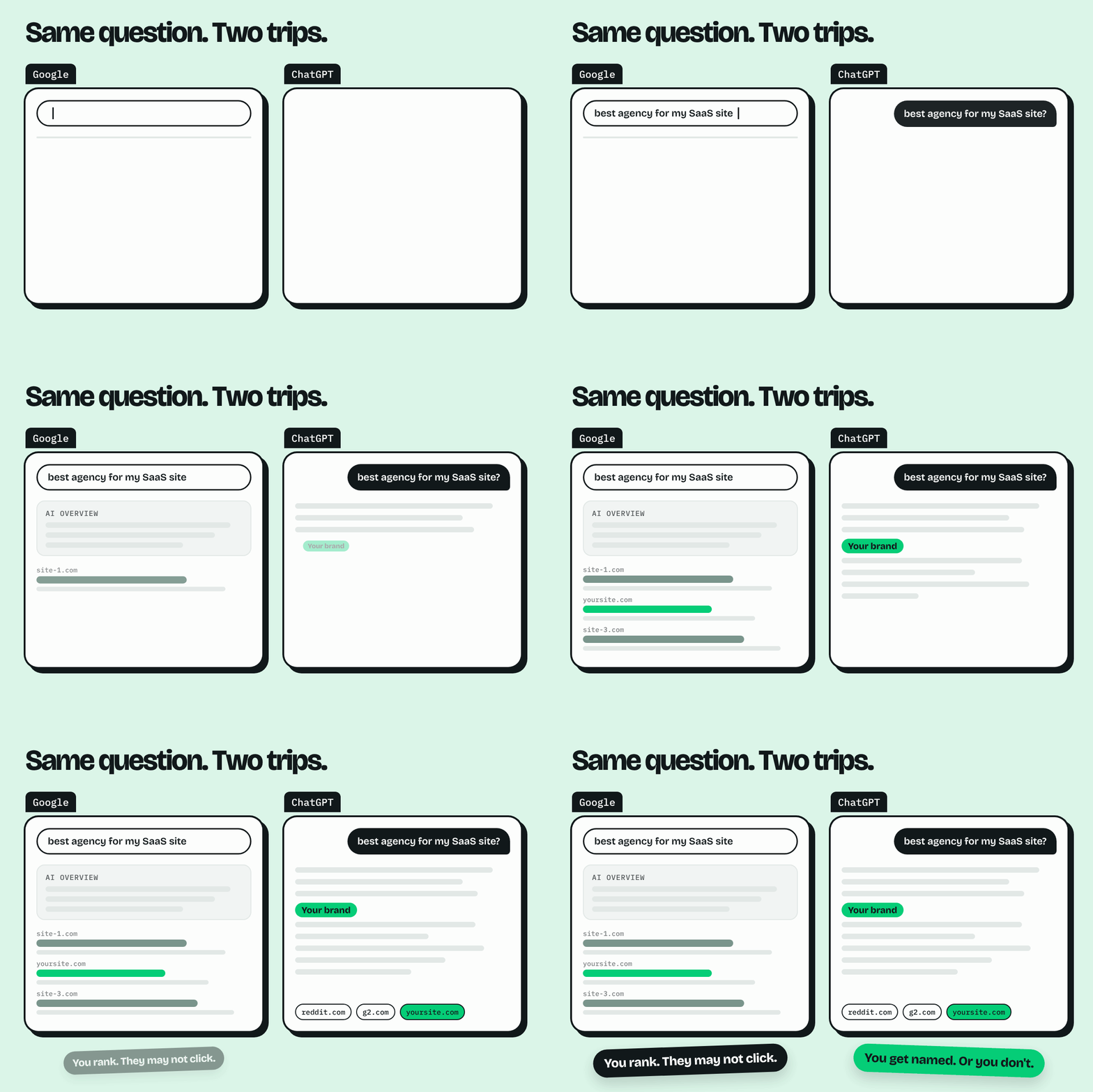
Same question, two trips
Picture a marketing lead looking for a website agency. On Monday she types her question into Google. On Tuesday she asks ChatGPT the same thing. Same question, very different trip.
| On Google | In ChatGPT | |
|---|---|---|
| Where the answer lives | An AI Overview at the top, then a list of links | A written answer in the chat |
| What she sees first | A short summary, then ten blue links | A few brand names with reasons |
| How she reaches you | She clicks your link | She sees your name, then searches for you or clicks a source |
| What wins | A high ranking and a title worth clicking | Being named, described correctly and cited |
| What you measure | Rankings, clicks, CTR | Mentions, citations, AI referral visits |
That last row is the real change. On Google, the win is a visit. In an AI answer, the win is being named, often before anyone visits your site at all.
What the 2026 numbers say
Plenty of stats float around on this topic. These are the ones with a clear source and a clear method:
| What the research found | Source |
|---|---|
| The top Google result gets about 58% fewer clicks when an AI Overview appears (300,000 keywords, December 2023 vs December 2025) | Ahrefs |
| People clicked a result on 8% of visits with an AI summary, compared with 15% without one. Only 1% clicked a link inside the summary | Pew Research Center |
| ChatGPT handles roughly 12% of Google's search volume | Ahrefs |
| Google sends about 40% of all traffic to websites. ChatGPT sends 0.21% | Ahrefs |
| At Ahrefs, AI search brought 0.5% of visits but 12.1% of signups | Ahrefs |
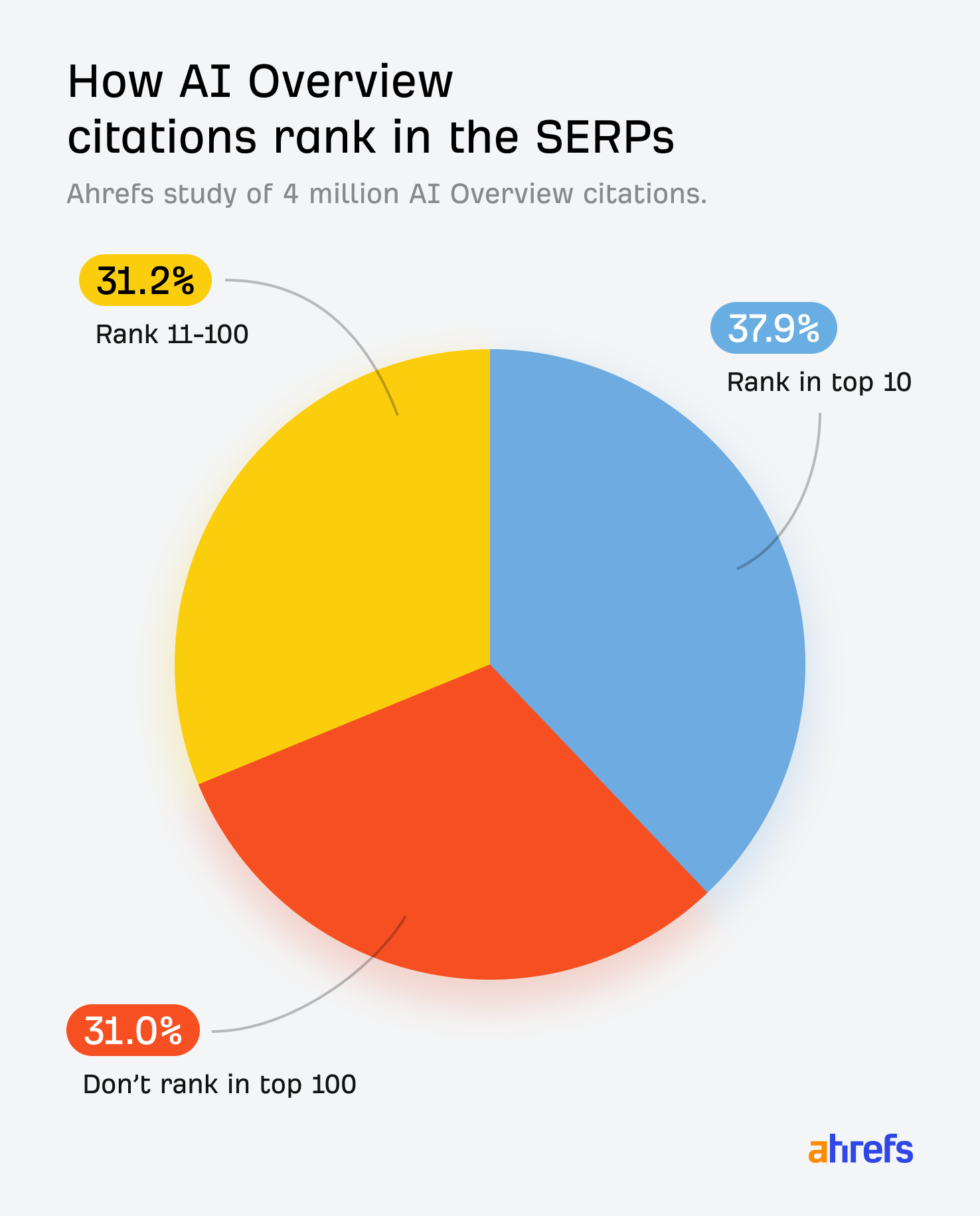
| Only about 38% of AI Overview citations come from pages in Google's top 10, down from about 76% in mid-2025 | Ahrefs |
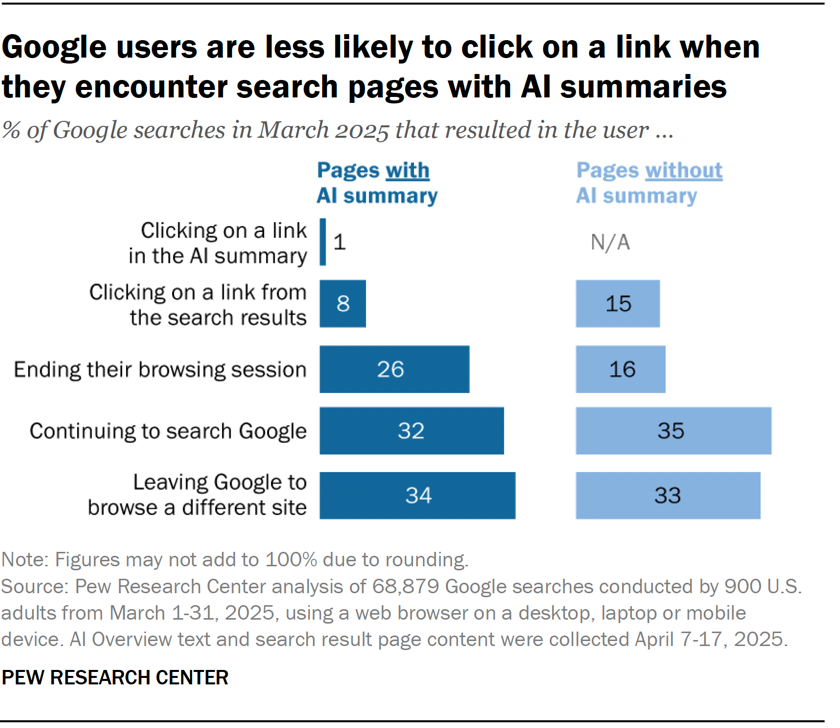
Put those together and the picture is clear. Google is still the biggest source of visits by a long way, but fewer searches end in a click. AI tools send far fewer visitors, and the ones they send are often ready to buy. You need to show up in both places.
Where SEO and GEO overlap
Here's the part most GEO pitches skip. Google's own documentation for AI Overviews and AI Mode says:
"There are no additional requirements to appear in AI Overviews or AI Mode, nor other special optimizations necessary."
Google Search Central
A page has to be indexed and eligible to show a snippet. That's it. So if Google can't crawl a page, it can't cite it either. The basics you already do for SEO are the entry ticket for GEO.
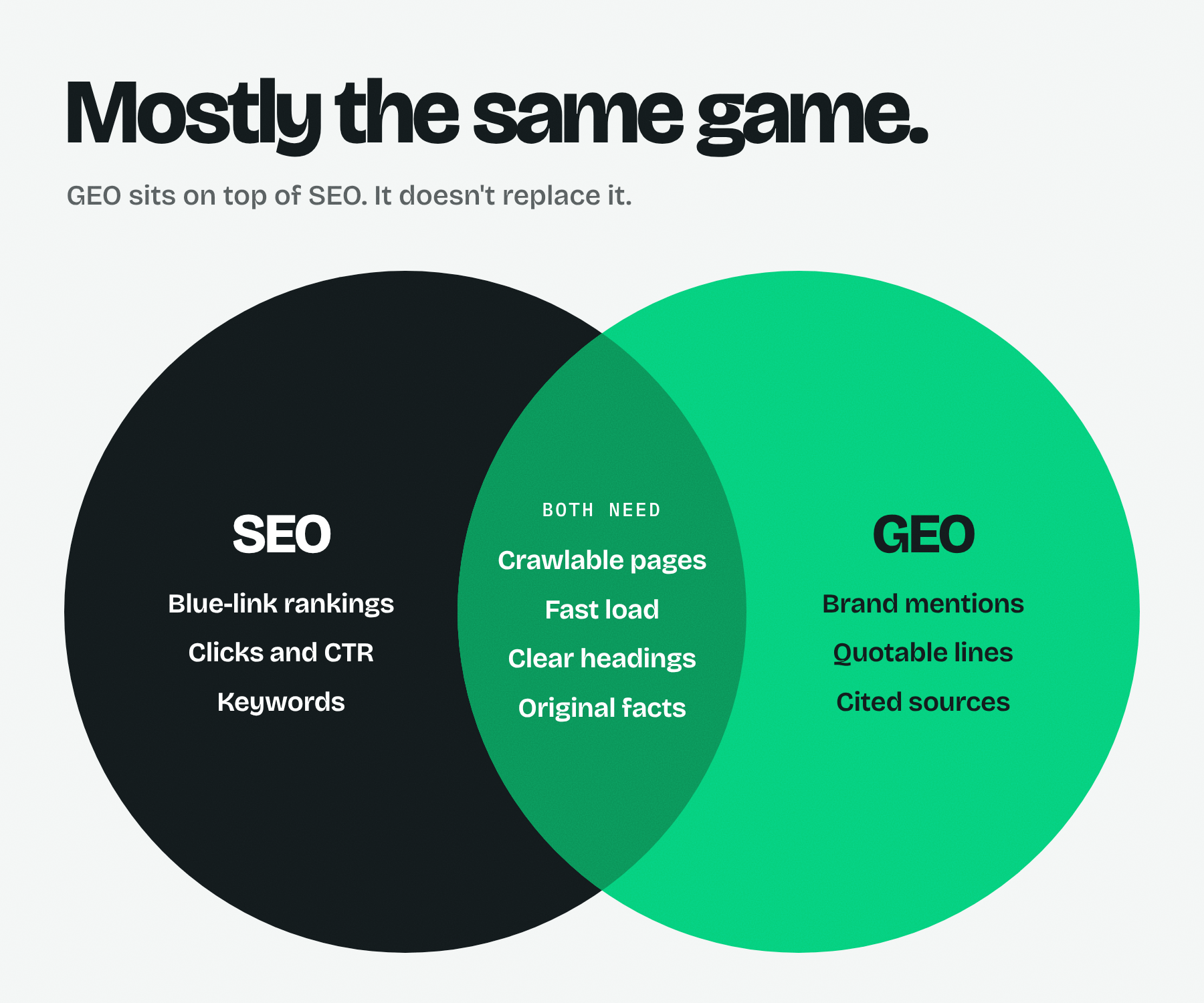
The shared core looks like this:
- Crawlable pages: Nothing important hidden behind scripts, logins or broken links.
- Fast load: Slow pages lose people before they read, whether they came from Google or a chatbot.
- Clear headings: Each section answers one question, so a search engine or an AI tool can lift it cleanly.
- Original facts: Numbers, examples and opinions nobody else has. These are what get ranked and quoted.
Where they split
The overlap is big, but it isn't total. These are the questions each one asks about your site:
| SEO asks | GEO asks |
|---|---|
| What keywords do we rank for? | Which questions are we named in? |
| How many sites link to us? | How often is our brand mentioned, linked or not? |
| Is this page optimized for one keyword? | Can one paragraph be quoted on its own and still make sense? |
| Did they click? | Did the answer mention us, and did it describe us correctly? |
| Are we in the top three? | Are we among the sources, even from page two? |
Two pieces of research explain why the GEO column looks the way it does.
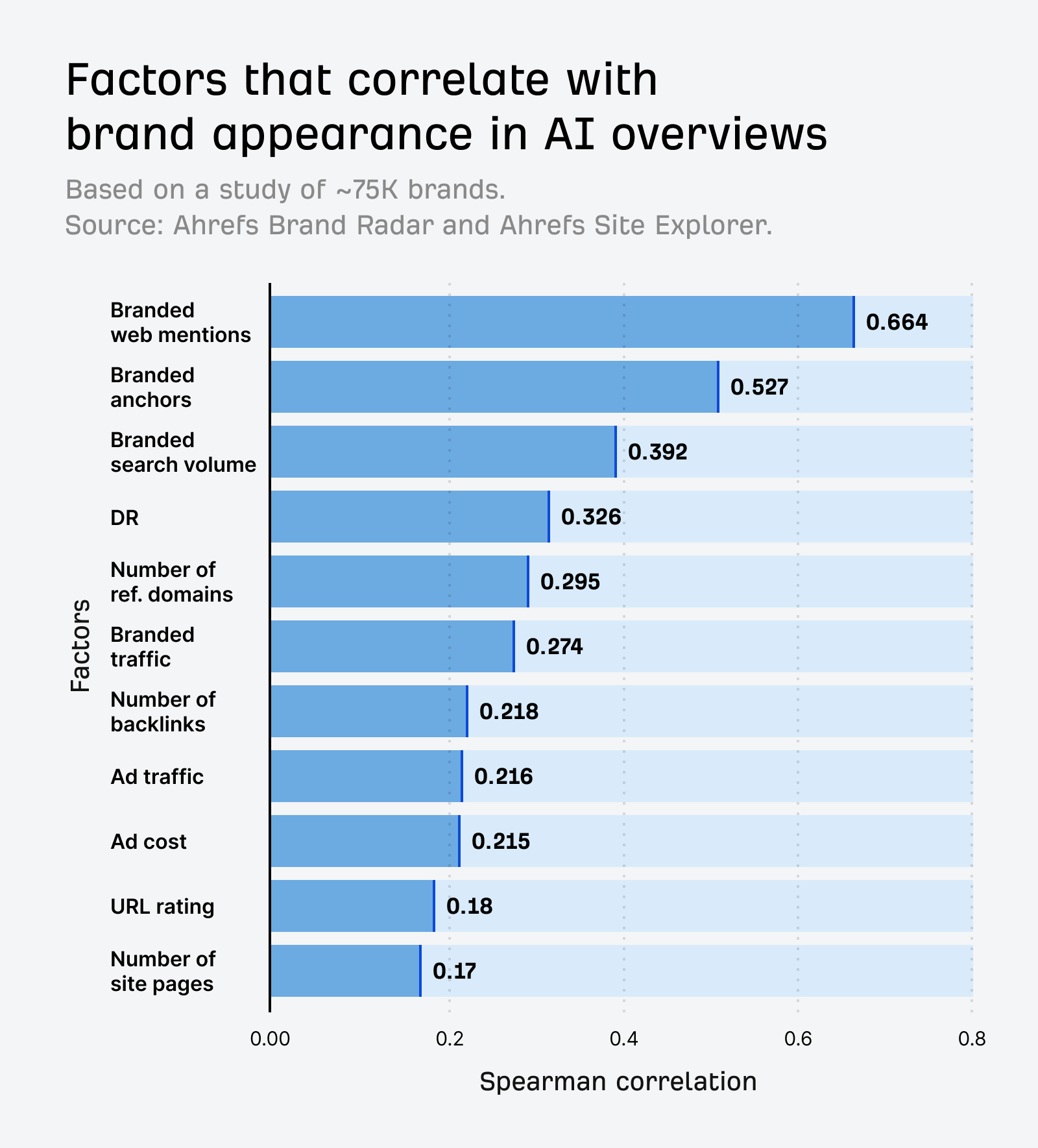
Mentions beat links. Ahrefs studied 75,000 brands and found that branded web mentions had a 0.664 correlation with showing up in AI Overviews. Backlinks came in at 0.218. A brand people talk about on review sites, forums, podcasts and in the press gets named more, even without a link.
Facts beat keywords. The paper that gave GEO its name tested how different edits changed a page's visibility in AI answers. It was written by researchers from Princeton and others, and presented at KDD 2024. Here's what moved the needle:
| What they changed on the page | Effect on visibility in AI answers |
|---|---|
| Added quotes from real people | Up about 41% |
| Added statistics | Up about 30% |
| Cited sources | Up about 27% |
| Made the writing clearer and easier to read | Up about 15% to 30% |
| Stuffed in more keywords | No real gain, sometimes worse |
The best news is for smaller sites. Pages ranked fifth in search saw the biggest lift: citing sources raised their visibility by 115%. You don't need to be first on Google to be quoted. You need to be the clearest, best-sourced page in the set. (Read the paper)

Five GEO myths you can skip
A lot of GEO advice is guesswork sold as a system. Here's what the evidence actually supports:
| You've probably heard | What's actually true |
|---|---|
| "You need an llms.txt file to show up in AI answers." | Google says you don't need AI text files or new machine-readable files to appear in its AI features. |
| "There's a special schema for GEO." | Google says no special schema.org markup is needed. Normal structured data still helps search engines understand your pages. |
| "SEO is dead." | Google still sends about 190 times more traffic to websites than ChatGPT. |
| "Add more keywords so AI picks you." | In the GEO study, keyword stuffing didn't help visibility in AI answers. |
| "Only top-ranked pages get cited." | About 62% of AI Overview citations come from pages outside Google's top 10. |

So which do you work on first?
Not every site needs the same thing next. Answer these four questions in order. The first "no" tells you where your next hour should go.
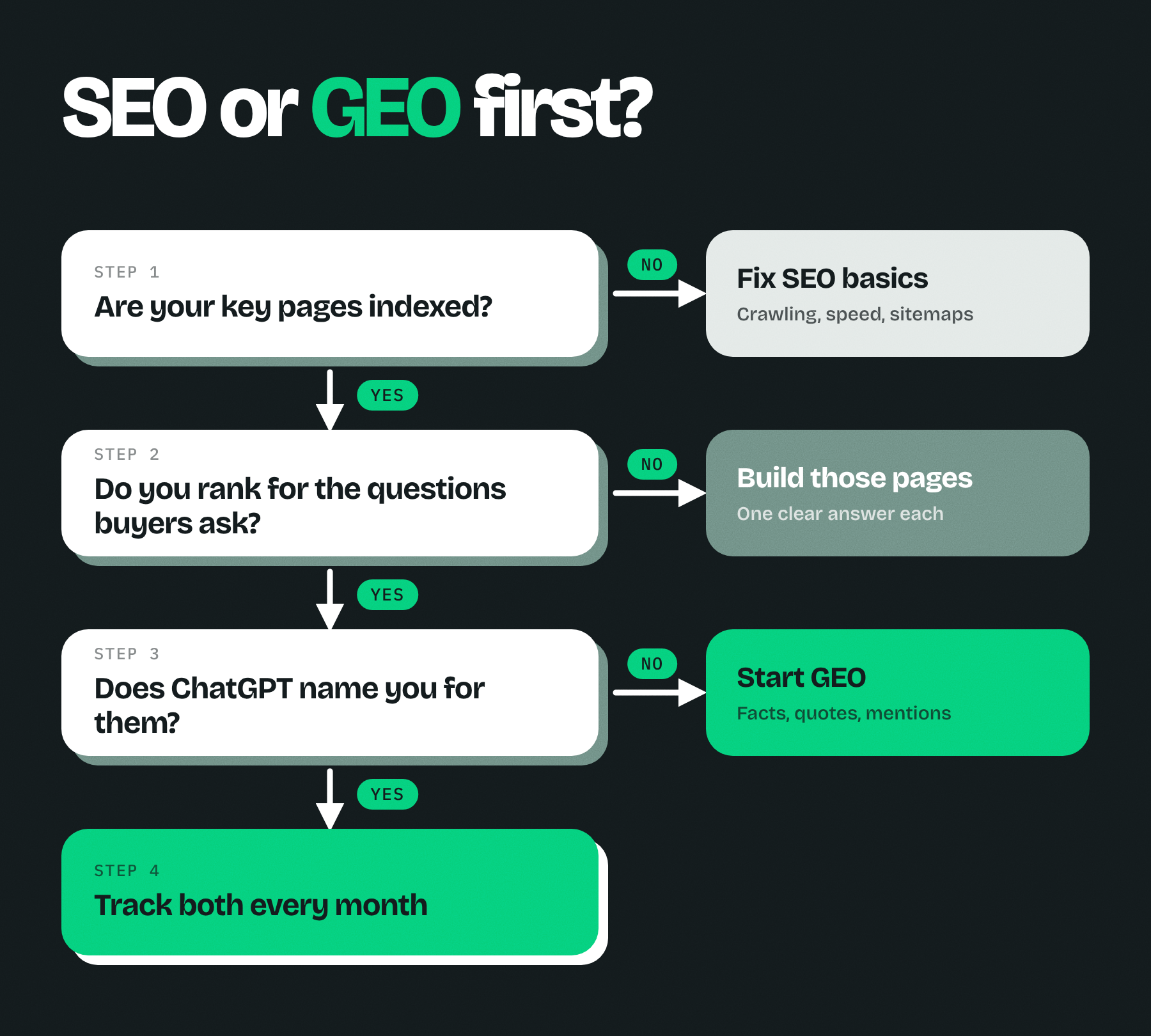
If your first "no" comes at question one or two, that's good news. Getting pages indexed and writing one clear page per buyer question is most of the GEO work, even if nobody calls it GEO.
A 30-day starter plan
- Week 1, check the basics: Open the Pages report in Google Search Console and fix anything important that isn't indexed.
- Week 2, find your questions: Write down the 20 questions buyers ask before they buy. Run them in Google, ChatGPT, Gemini and Perplexity, and note who gets named.
- Week 3, rewrite five pages: Answer the question in the first two sentences. Add one number with a source and one quote from a real person.
- Week 4, get talked about: Ask happy clients for reviews on G2 or Clutch, answer real questions on Reddit and LinkedIn, and pitch one piece of original data to a newsletter or podcast.
- Every month after: Run the same 20 questions again and track what changed.
How to track both
If organic clicks dip while leads hold steady, that's often AI answers doing part of the work. You'll only see it if you track both sides:
| SEO metric | GEO metric | Where to find it |
|---|---|---|
| Keyword rankings | How often your brand is named for your buyer questions | Search Console, plus monthly prompt checks or a tool like Ahrefs Brand Radar |
| Organic clicks | Referral visits from chatgpt.com, perplexity.ai and gemini.google.com | GA4, under traffic acquisition |
| Backlinks | Brand mentions, linked or not | Ahrefs, Semrush or Google Alerts |
| Click-through rate | Growth in people searching your brand name | Search Console, filtered to branded queries |
| Leads from organic search | Leads who say they found you through an AI tool | A "How did you hear about us?" field on your demo form |
Free website audit
Is your site ready for AI search?
Get a scored breakdown of your site's clarity, structure and technical health, the same things Google and AI tools look at. Results in about a minute.
85/100
Overall score
What we've seen on client sites
We don't publish AI citation counts for clients, because they change from one day to the next. What we can show is what happened to search traffic after we rebuilt these sites on a clean, crawlable structure:
Wayground, formerly Quizizz, is an AI-powered platform for teachers with $61M in funding. Here's how we handled its rebrand and rebuild:
Where Flowtrix fits
Most of what decides SEO and GEO results is set when the site is built: how pages are structured, how fast they load, whether the schema is right, and whether each page answers a real buyer question.
Flowtrix makes websites and brands ready for enterprise buyers. We've delivered 100+ projects for B2B SaaS, AI and cybersecurity companies, and we build every page so Google can rank it and AI tools can quote it. If you're comparing partners, our lists of the top GEO agencies and top AEO agencies are a good place to start.
The bottom line
SEO still brings the visits. GEO decides whether you're in the answer before the visit happens. You don't need two teams or two strategies. You need one solid base and a second scoreboard.
Get your pages indexed and fast. Answer real buyer questions clearly. Add facts worth quoting, and give people reasons to talk about you. Want help with any of it? Talk to Flowtrix, or browse our case studies.
Flowtrix has delivered 100+ projects for B2B SaaS, AI and cybersecurity teams, with every page built so search engines can crawl it and AI tools can quote it.


FAQ's
Quick answers to what teams ask when they're splitting time between SEO and GEO.