



Use to summarize this article


- 3 tests for citation: ChatGPT favors pages that are retrievable, extractable and corroborated by other credible sources.
- Answer-first content: Put a self-contained 40-60 word answer with one verifiable fact directly under every question-style heading.
- Crawler access: Allow OAI-SearchBot in robots.txt, serve key copy without JavaScript and submit your sitemap to Bing Webmaster Tools.
- Consistent entity data: Use one canonical company description across LinkedIn, Crunchbase and G2, backed by Organization schema.
- Share of Model: Run 20-30 buyer-intent prompts three times each, then track mentions monthly against competitors alongside AI referral traffic in GA4.
When a buyer asks ChatGPT for the best provider in your category and your name isn’t in the answer, a page-one ranking on Google doesn’t help you at that moment. They probably won’t even open their search page anymore because they already have the list.
This guide helps you understand what changes when the reader is an AI system. It covers how ChatGPT picks sources, the 3 content pillars that make pages citable, a 5-step guide you can execute this week, and how to measure the results.
How does ChatGPT choose which sources to cite?
When ChatGPT searches the web, it retrieves pages from search indexes and crawlers, then tends to favor sources that answer the question directly, contain verifiable facts, and are corroborated elsewhere.
Practically this means, you need to work on crawlable pages, answer-first structure, clear entity data and consistent brand mentions on third-party sites.
OpenAI doesn’t publish a ranking formula. Based on its available public documentation and our consistent prompt testing, here are the 3 tests a tests a page has to pass:
- Retrievable: Can the crawler reach and render the page?
- Extractable: Can a model lift a clean, self-contained answer from the page?
- Corroborated / Verifiable: Do other credible sources say the same thing about you?
The 3 pillars of AI SEO & GEO for ChatGPT optimization
Here are the core pillars of AI SEO and GEO (Generative Engine Optimization) that you need to understand and implement to get cited by ChatGPT:
Pillar 1: Write fact-based, citable content
AI models are cautious about what they repeat. They favor passages that sound objective and can be checked. As per various researches, adding statistics, quotations and cited sources notably improves visibility while keyword stuffing leads to poor performance.
This means you need to replace vague claims with verifiable facts, written in a neutral third-person voice.
For example: “Flowtrix has completed over 130 Webflow Enterprise projects, resulting in an average 35% growth in organic engagement for SaaS clients.” will get better results than “We are the best Webflow agency in the world.”
Here are 3 rules you need to remember:
- Every number needs a named source or your own dataset
- Every statistic needs a date, and
- If you can’t substantiate a claim, remove it, because an unsupported narrative is the first thing an AI model will skip.
If your content workflows depend on AI, make sure your teams know how to use AI content safely without affecting content density.

Pillar 2: Structure every section answer-first
An answer block is a self-contained response of 40-60 words placed directly under a heading that states the question. It leads with the answer, includes one specific fact, and makes sense without the surrounding text, so an AI system can extract and cite it as written.
Use this pattern on your key pages:
- Write the heading as the question a buyer would actually type or speak
- Put the direct answer in the first sentence. Add context after it
- Include one verifiable fact, such as a number, a date or a named source
- More than “it,” “this” and “they”, use the noun, so the passage stands alone
- Keep it to 40-60 words, then expand below it for readers who want depth
Here’s a sample:
- Before: “Technical stuff matters a lot in the AI era, and many companies overlook the fundamentals when thinking about how bots interact with their sites.”
- After: “To appear in ChatGPT search results, allow OpenAI’s OAI-SearchBot in your robots.txt file. Blocking it removes your pages from ChatGPT’s search index, regardless of how well they are written.”
The second version can be quoted by an AI tool without any editing. The first cannot be quoted at all.
Flowtrix rebuilt the website for Databahn, an AI-powered platform, so that visitors could understand its features, benefits and workflow through a clear, structured experience. After the revamp, the site reached a 35% conversion rate. The same principle applies to your own pages: a visitor, or an AI system, should be able to understand what you do from a single section.
Pillar 3: Make your site crawlable for AI agents
OpenAI uses three user agents: OAI-SearchBot for ChatGPT search results, GPTBot for model training, and ChatGPT-User for pages fetched at a user’s request. To appear in ChatGPT search, allow OAI-SearchBot. Blocking GPTBot only opts you out of training, so decide that separately.
User-agent: OAI-SearchBot
Allow: /
User-agent: ChatGPT-User
Allow: /
Here are 3 more requirements that you must consider:
- Server-rendered content: If your key copy only appears after JavaScript runs, many crawlers will never see it. Test by viewing the page source or fetching the URL with curl. A clean, logical HTML structure is a core part of how we approach Webflow development for B2B sites.
- Structured data: Use JSON-LD for Organization, Article, Person (authors) and FAQPage. To be accurate about the evidence: there is no public confirmation that ChatGPT reads schema directly when deciding what to cite. Schema still clarifies your pages and entities for the search indexes AI tools draw from, and it’s inexpensive to implement. Our Schema tool generates and validates it. Our Schema tool generates and validates JSON-LD for Organization, Article, Person and FAQPage.
- Speed and stability: Agents fetch pages on tight timeouts, so slow or error-prone pages are less likely to be used.
ChatGPT optimization: step-by-step guide
Once you’ve understood the core pillars of AI SEO and GEO, here’s a 5-step guide to ChatGPT optimization that you can start executing:
Step 1: Make your site eligible
Check robots.txt for rules that block OAI-SearchBot, submit your sitemap in Bing Webmaster Tools, enable IndexNow, and confirm key pages render without JavaScript.
ChatGPT search is widely reported to draw on a mix of OpenAI’s own crawler and third-party search providers, including Bing, so Bing indexing is a low-cost safeguard.
Check: The pages appear in Bing’s index, and a curl request returns your main copy in the HTML.
Step 2: Rewrite your top 10 pages in answer-first structure
Pick 10 pages that already rank on page one or two of Google for commercial or informational queries.
For each section, add an answer block under a question-style heading, then add one sourced statistic and a short FAQ.
Make sure you start with pages that drive the pipeline, not the ones that are easiest to edit.
Check: Every H2 on those pages should open with a 40-60 word answer that makes sense on its own.
Rewriting ten pages is only practical if your team can update them quickly. For Amazon Signage, an enterprise SaaS company, Flowtrix built 20+ pages on Webflow, and content updates became 10x faster. That speed is what makes it realistic to refresh answer blocks, statistics and dates regularly.
Step 3: Define your entity consistently
AI models rely on entities, meaning people, companies and products, and they build confidence when independent sources agree.
Write one canonical description of your company (what you do, who you serve, where you’re based, when you were founded) and use it everywhere.
Here’s what you need to do:
- Update LinkedIn, Crunchbase, G2 and any category directories with the same description and facts
- Add Organization schema with sameAs links to those profiles
- Pursue a Wikipedia or Wikidata entry only if you meet notability criteria. If you don’t, invest in credible press coverage and industry mentions instead
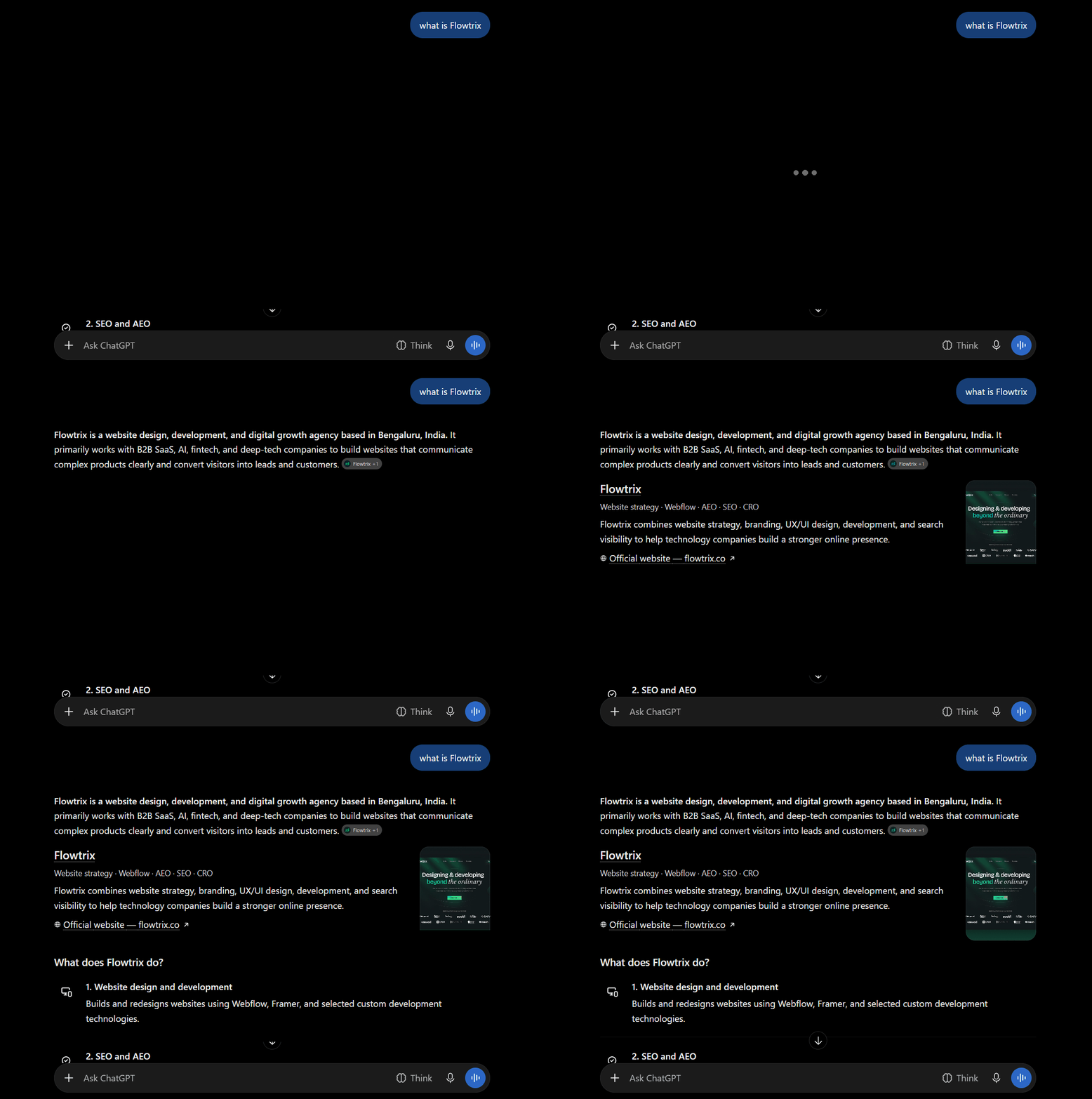
Check: Ask ChatGPT, “What does [your company] do?” The answer should match your canonical description. If it says information is unclear, you have an authority gap to close.
Step 4: Publish balanced comparison and alternative pages
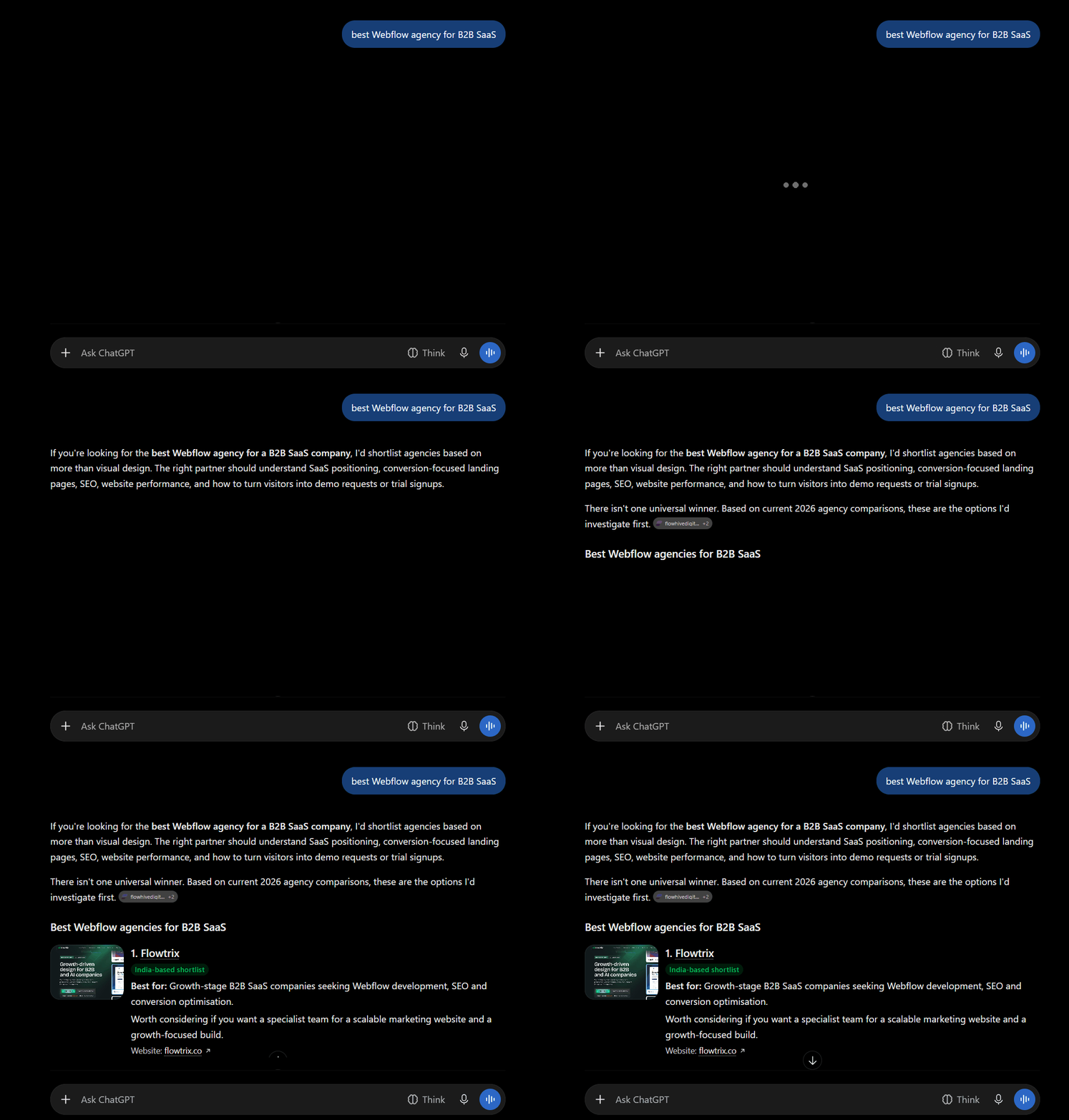
ChatGPT is frequently asked “X vs Y” and “best tools for Z” questions, so comparison content maps directly to how buyers prompt. Models tend to trust sources that give a balanced view over purely promotional pages.
Build comparison pages with explicit criteria, a table, honest strengths of competitors, and clear guidance on who each option suits. Date-stamp any pricing or feature claims and refresh them regularly.
Check: The page answers “which should I choose if…” for at least three distinct buyer situations.
Step 5: Earn mentions in community channels
AI search tools frequently surface community discussions, and OpenAI announced a content partnership with Reddit in 2024. How you’re discussed on Reddit and Quora is therefore part of your visibility.
Participate as a disclosed, genuine contributor. Answer questions in your area of expertise, state your affiliation, link only where it directly helps, and follow each community’s rules.
Remember, undisclosed promotion is removed by moderators and can damage the brand sentiment that AI tools later reflect.
Check: Whether your contributions earn upvotes and replies rather than removals, and your brand appears in threads you didn’t start.

How to measure your ChatGPT visibility with Share of Model?
Share of Model is the percentage of AI responses to a set of relevant prompts that mention your brand.
To calculate it, run 20-30 buyer-intent prompts across ChatGPT, Perplexity, Claude and Gemini, repeat each 3 times, and divide responses that mention your brand by total responses.
Track it monthly against 2 or 3 competitors.
Here’s the exact method you can use:
- Build a prompt set of about 25: Mix category prompts (“best [category] platforms for B2B SaaS”), comparison prompts (“[you] vs [competitor]”), problem-led prompts (“how do I [problem your product solves]”) and one reputation prompt (“What is [brand] known for?”).
- Run each prompt 3 times per tool: Use fresh sessions and, where possible, logged-out or memory-off settings, because answers vary between runs and personalization skews results.
- Log the details: Record the tool, model, date, whether you were mentioned, whether your URL was cited, your position in any list, and the sentiment.
- Calculate monthly: Mentions divided by total responses give your Share of Model. Track the same prompts every month so the trend is comparable.
- Benchmark against competitors: There is no universal good number. A steady month-over-month rise against named competitors is the signal.
Track AI referral traffic in GA4
- In GA4, open Reports, then Acquisition, then Traffic acquisition, and set the dimension to Session source/medium.
- Filter for chatgpt.com, perplexity.ai, claude.ai and gemini.google.com.
- Save these as a custom channel group named “AI Search” so you can compare their sessions and conversions against organic search each month.
This is also where the “AI visitors are worth more” claim becomes verifiable for your own site.
If AI visitors do convert better, our work on conversion rate optimization helps you capture that value.
To our knowledge, OpenAI does not currently offer a Search Console-style report for ChatGPT, so GA4 referral data, Bing Webmaster Tools and manual prompt testing are your only practical proxies.
Flowtrix’s approach to AI-ready websites (AI SEO) vs. traditional SEO
At Flowtrix, we build sites that don't just look good for humans, they are "machine legible." Here’s how:
Get AI-ready with Flowtrix
AI search rewards what good SEO always has: pages that answer the question clearly and back it with evidence.
To be cited, your site should be crawlable, answer the question directly, state checkable facts, and match what the rest of the web says about your brand.
None of that needs a rebuild, but all of it needs to be in place before a buyer asks ChatGPT for a shortlist.
Flowtrix does this work for B2B SaaS and AI companies, from technical eligibility and schema to answer-first content and citation tracking, so your site is built to be found, quoted and trusted by people and AI tools alike.












.svg)

.svg)



%201.svg)


.svg)
.svg)