



Use to summarize this article


- GEO is the practice of optimizing content so AI models like GPT-4, Claude, and Gemini cite your brand as the definitive answer to user queries.
- The three pillars of GEO are Extractability (can the AI read it), Factuality (does the AI trust it), and Authority (is the brand the expert).
- Technical foundations like clean HTML, schema markup, and unblocked AI crawlers determine whether your content is even visible to generative engines.
- Off-site signals from Reddit, G2, and guest posts on high-authority domains create a "citation loop" that boosts AI confidence in your brand.
- New metrics like Share of Model, Citation Volume, and Branded Search Lift replace traditional rankings as the leading indicators of GEO success.
In the last decade, the mantra for digital growth was simple: "Rank on page one of Google." But the landscape has undergone a seismic shift. We are moving from the era of the Search Engine to the era of the Generative Engine.
Today, buyers aren't just clicking links; they are asking ChatGPT for software recommendations, using Perplexity to research market trends, and reading Google’s AI Overviews to get instant answers. If your brand isn’t cited in these AI generated responses, you are effectively invisible to a new generation of "zero click" searchers.
At Flowtrix, we recognize that traditional SEO is no longer enough. To win in 2026 and beyond, you must master Generative Engine Optimization (GEO). This 2,500 word guide will walk you through the frameworks, technical requirements, and content strategies needed to ensure your brand becomes the primary source for the world's most powerful AI models.
Part 1: Understanding the GEO Paradigm Shift
What is Generative Engine Optimization?
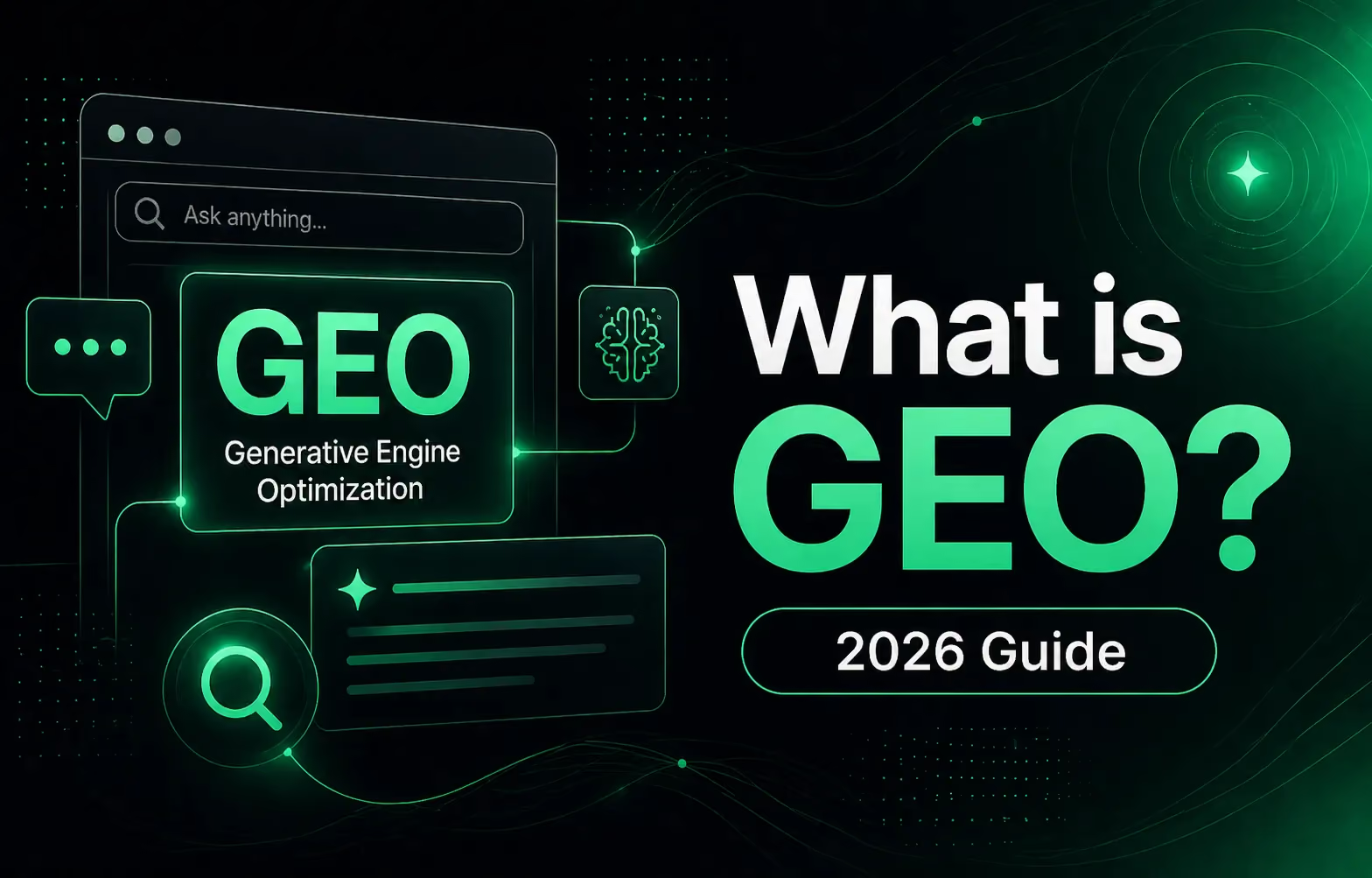
Generative Engine Optimization (GEO) is the process of optimizing digital content so that Large Language Models (LLMs) like GPT 4, Claude, Gemini, and Llama can easily find, extract, and cite your information as the definitive answer to a user’s query.
While traditional SEO focuses on visibility (getting a link in a list), GEO focuses on citation and authority (becoming the data source the AI trusts).
Why B2B SaaS Needs GEO Now
For a company like Flowtrix, the stakes are uniquely high. B2B buyers are researchers by nature. Before they ever book a demo, they perform extensive "shadow research."
- The Zero Click Journey: 60% of searches now end without a click. If the AI provides the answer using your data but doesn't mention your name, you’ve lost the branding opportunity.
- The Trust Gap: Users trust AI "recommendations" because they feel objective. Being cited by an AI engine as a top tier solution provides a level of third party validation that traditional ads cannot buy.
Part 2: The Core Framework of GEO
To implement GEO successfully, you must optimize across three distinct layers: Extractability, Factuality, and Authority.
1. Extractability (The "Can the AI Read It?" Layer)
AI engines don't "browse" your site; they "ingest" it. If your content is hidden behind complex JavaScript, heavy animations, or gated forms, the AI will ignore it.
- The Solution: Prioritize clean HTML, server side rendering, and a clear content hierarchy.
2. Factuality (The "Does the AI Trust It?" Layer)
LLMs are trained to avoid "hallucinations." They look for "hard facts" statistics, named methodologies, and verifiable data points.
- The Solution: Every blog post should contain at least 3–5 unique data points or proprietary insights that can be cross referenced.
3. Authority (The "Is the Brand the Expert?" Layer)
AI models use a version of Google’s E E A T (Experience, Expertise, Authoritativeness, and Trustworthiness). They look for signals across the web social proof, community mentions, and historical consistency to decide if your brand is a "reliable entity."

Part 3: Phase by Phase Implementation Roadmap
Phase 1: Research and AI Visibility Audit
Before writing content, you must understand your "Share of Model" (SoM).
Step 1: The "Blind Test" Audit
Ask the major engines (ChatGPT, Perplexity, Gemini) the following questions:
- "Who are the leaders in [Your Category]?"
- "How do I solve [Problem your product solves]?"
- "What are the pros and cons of using [Your Product Name]?"
Analyze the gaps: If your competitors are mentioned and you aren't, look at their sources. Are they being cited from their own blog, a Reddit thread, or a G2 review?
Step 2: Semantic Keyword Mapping
Stop thinking in terms of "keywords" and start thinking in "clusters" and "intents."
- Old Way: "Project management software"
- GEO Way: "How to automate sprint planning for remote engineering teams using AI"
Phase 2: Content Architecture for the "Answer First" Era
AI engines prioritize content that is easy to parse. To optimize your blog articles, follow the Flowtrix GEO Content Template:
1. The 40 Word Rule (The Executive Summary)
Every major section (H2) should begin with a direct, 40–60 word answer to the implied question.
- Example: If your heading is "What is Generative Engine Optimization?", the first sentence should be a definitive statement, not a narrative hook. This allows the AI to "snip" that text directly into its response.
2. The "Wikipedia" Structure
Organize your articles like a reference manual:
- Definition: What is it?
- Mechanism: How does it work?
- Evidence: Data, charts, and tables.
- Implementation: Step by step instructions.
3. Factual Density & The "Statistics Moat"
Research from 2025 shows that articles with 15+ data points receive 50% more AI citations than those with fewer than five.
- Action: Transform your case studies into "Hard Fact Bundles." Instead of saying "Our tool helped a client grow," say "Our tool resulted in a 42.3% increase in MoM lead velocity for a Series B SaaS client."
Phase 3: Technical GEO (The Developer's Playbook)
Your technical foundation determines whether an AI bot even "sees" your brilliance.
1. Advanced Schema Markup: Speaking "Machine"
Schema.org is the dictionary of the web. For GEO, you need more than just "Blog Posting" schema.
- FAQ Schema: Every blog post should have a hidden (or visible) FAQ schema that maps common conversational questions to your direct answers.
- Organization & Person Schema: Link your content to real people (authors) and your organization to build the "Trust" signal.
- SoftwareApplication Schema: If you are a SaaS, ensure your features, pricing, and integrations are explicitly defined in structured data.
2. Optimization for "Crawler Friendliness"
- Allow Listing Bots: Ensure your robots.txt file isn't blocking OAI SearchBot (ChatGPT) or PerplexityBot.
- Speed and SSR: AI engines often have "timeout" limits when fetching live web data. If your page takes 5 seconds to hydrate via JavaScript, the AI will move to a faster competitor. Ensure your critical "answer content" is available in the initial HTML payload.
3. Freshness Protocols
AI models have a "recency bias." Perplexity, in particular, favors content updated within the last 6 months.
- The Flowtrix Strategy: Implement a "Dynamic Content Refresh" cycle. Every quarter, update the statistics and "Last Modified" dates of your top 20 high intent pages.
Part 4: Distribution & "Signal Boosting" Beyond Your Domain
AI models don't just learn from your website; they learn from the web at large. This is where GEO overlaps with Digital PR and Community Management.
1. The Reddit & Forum Signal
Studies show that nearly 40% of Perplexity’s citations come from community platforms like Reddit.
- Strategy: Have your team (or influencers) participate in niche subreddits. When a user asks for a recommendation and three people mention your brand with a link to a specific helpful guide on your site, the AI registers a "Consensus Signal."
2. Third Party Validation (The Citation Loop)
AI engines cross reference facts. If your website says you are "The #1 AI Automation Tool," but G2 and Capterra don't mention it, the AI will treat your claim as low confidence.
- Action: Ensure your brand "NAP" (Name, Address, Phone/Profile) is identical across all directories. Secure guest posts on high authority industry domains (e.g., TechCrunch, HubSpot Blog) to create "backlink citations" that AI models use to verify your expertise.
Part 5: Measuring GEO Success (The New Metrics)
Traditional SEO metrics (Rankings, Organic Traffic) are becoming "lagging indicators." To measure GEO, you need to track "leading indicators."
- Share of Model (SoM): What percentage of the time does ChatGPT or Gemini mention your brand when asked about your niche?
- Citation Volume: How many unique links from your site are being used as "sources" in Perplexity or Google AI Overviews?
- Branded Search Lift: As your AI visibility increases, your branded search volume (people searching for "Flowtrix") should rise, as users see you cited and want to find you directly.
| Metric | Traditional SEO | GEO | What It Measures |
|---|---|---|---|
| SERP Ranking | Primary | Lagging | Position in traditional search results |
| Share of Model | Not tracked | Primary | How often AI engines cite your brand |
| Citation Volume | Not tracked | Primary | Number of your links used as AI sources |
| Branded Search Lift | Secondary | Leading | Growth in direct brand name searches |
| Organic Traffic | Primary | Lagging | Clicks from traditional search results |
Part 6: Case Study – The "GEO First" Blog Post
Let’s look at how we would write a blog post about "AI Integration for CRM" under the GEO framework.
Traditional SEO Title: How to Integrate AI into Your CRM GEO Title: The 2026 Guide to AI CRM Integration: 5 Proven Frameworks for B2B Efficiency
- Header (H1): The 2026 Guide to AI CRM Integration.
- Opening Paragraph: A 50 word definition of AI CRM integration, citing a stat from Gartner or McKinsey about the 30% productivity gain.
- H2: Why AI Integration Matters for SaaS? Includes a comparison table of "Manual vs. AI Driven Data Entry."
- H2: The Step by Step Technical Framework. Uses a numbered list with bolded action verbs.
- Conclusion: Summarizes the "key takeaway" in one sentence for easy extraction.
Part 7: Conclusion – The Future of Search is Conversational
At Flowtrix, we don't just build for today; we build for what’s next. Generative Engine Optimization is not a "hack" or a temporary trend. It is a fundamental shift in how information is organized and consumed.
By focusing on Extractability, Factuality, and Authority, you move your brand from being a "result" to being a "source." You stop chasing the algorithm and start feeding the intelligence.
The time to implement GEO is now. Start by auditing your current AI visibility, restructuring your "hero" content for better extraction, and ensuring your technical foundation is bot friendly.
Want to lead your industry in the AI search era? At Flowtrix, we specialize in building digital presences that don't just rank they dominate the generative landscape. Contact us today to learn how we can future proof your growth strategy.
GEO Checklist for Marketing Managers
- Test top 10 keywords in Perplexity and ChatGPT
- Add a "Direct Answer" summary to every blog post
- Include 3+ original statistics in every hero article
- Verify robots.txt allows AI search crawlers
- Implement FAQ and Organization schema on core pages
- Ensure brand mentions in Reddit and LinkedIn discussions


FAQ's











.svg)

.svg)



%201.svg)


.svg)
.svg)