


Use to summarize this article


- Your seed homepage is a hypothesis. Your Series A homepage should be evidence. Most founders never make the switch.
- Messaging climbs three rungs: Recruit, Reflect, Prove. Each one needs a different hero, structure, and proof.
- The most expensive mistake is rewriting for every customer win instead of when the pattern across customers becomes clear.
- Update on signal, not on a calendar. Four specific signals tell you it is time to rewrite.
- A Series A homepage should be the most accurate thing you have ever published about who you serve, not the most polished.
There is a version of your homepage that got you your seed round, and it was probably good. Broad market, a founding team people wanted to bet on, a product vision that felt inevitable, and just enough traction to prove you were not making it all up. It was honest about what you had and ambitious about where you were headed. It worked.
Then you spent a year building, selling, and getting things wrong in useful ways. Some of the customers you were sure would love the product did not renew. A few you never targeted turned into your best accounts. The use case you built for is not quite the use case people are paying for. The person you thought signed the contract turned out to be the champion, and the real signer was someone you only met on the third call.
You have been finding product-market fit. Slowly, messily, correctly. And your homepage still says exactly what it said the morning after the seed wire cleared.
This is the most common and most expensive messaging gap in early-stage B2B SaaS. Not because the old homepage is badly written, but because it is no longer true. The company moved and the website did not. At Flowtrix we revamp B2B SaaS, AI, and cybersecurity websites for exactly this moment, and the pattern below is what we see again and again with companies moving from seed to Series A.
Why does your homepage always lag the business by 6 to 12 months?
Before the framework, it helps to name why this gap shows up in almost every company, including the well-run ones.
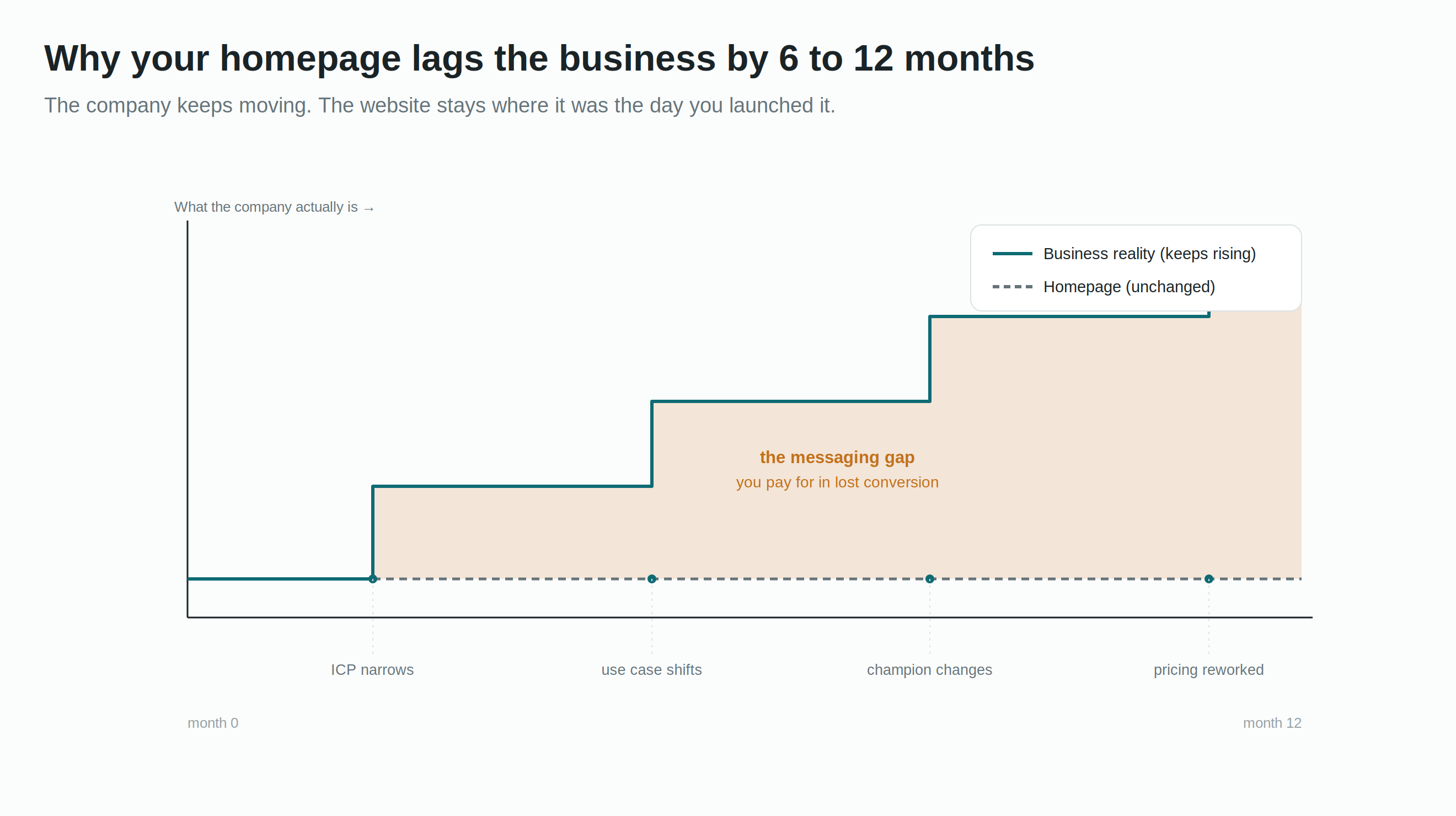
You are too close to see it. From inside the building, PMF feels like a string of tiny adjustments. A small pivot in who you target. A repositioned use case. A redefined value metric. None of these feels big enough to justify rewriting the site. Stack twelve months of them together and you are a meaningfully different company, but no single change ever triggered the rewrite.
The website also loses every priority fight. Between seed and Series A you are building product, closing deals, making your first hires, and managing a board, often in the same afternoon. The site sits at the bottom of every sprint and gets touched last, if at all.
Then there is superstition. Once a homepage has converted a handful of customers, founders get nervous about touching it. Changing the headline feels like tempting fate. So instead of rethinking it, you bolt things on. A new feature callout here, a fresh logo there, until the page is a pile of additions with no spine.
And PMF itself is fuzzy. The 40% test gives you a number. It does not tell you what that number means for your headline. Most founders feel the signal. Almost none of them know, on instinct, what the homepage should say on the other side of it. The rest of this article makes that part explicit.
The Recruit, Reflect, Prove model
After revamping 120+ B2B websites, most of them for companies moving from seed toward Series A and beyond, we kept seeing the same three-stage arc. We named it so it is easy to place yourself on it.
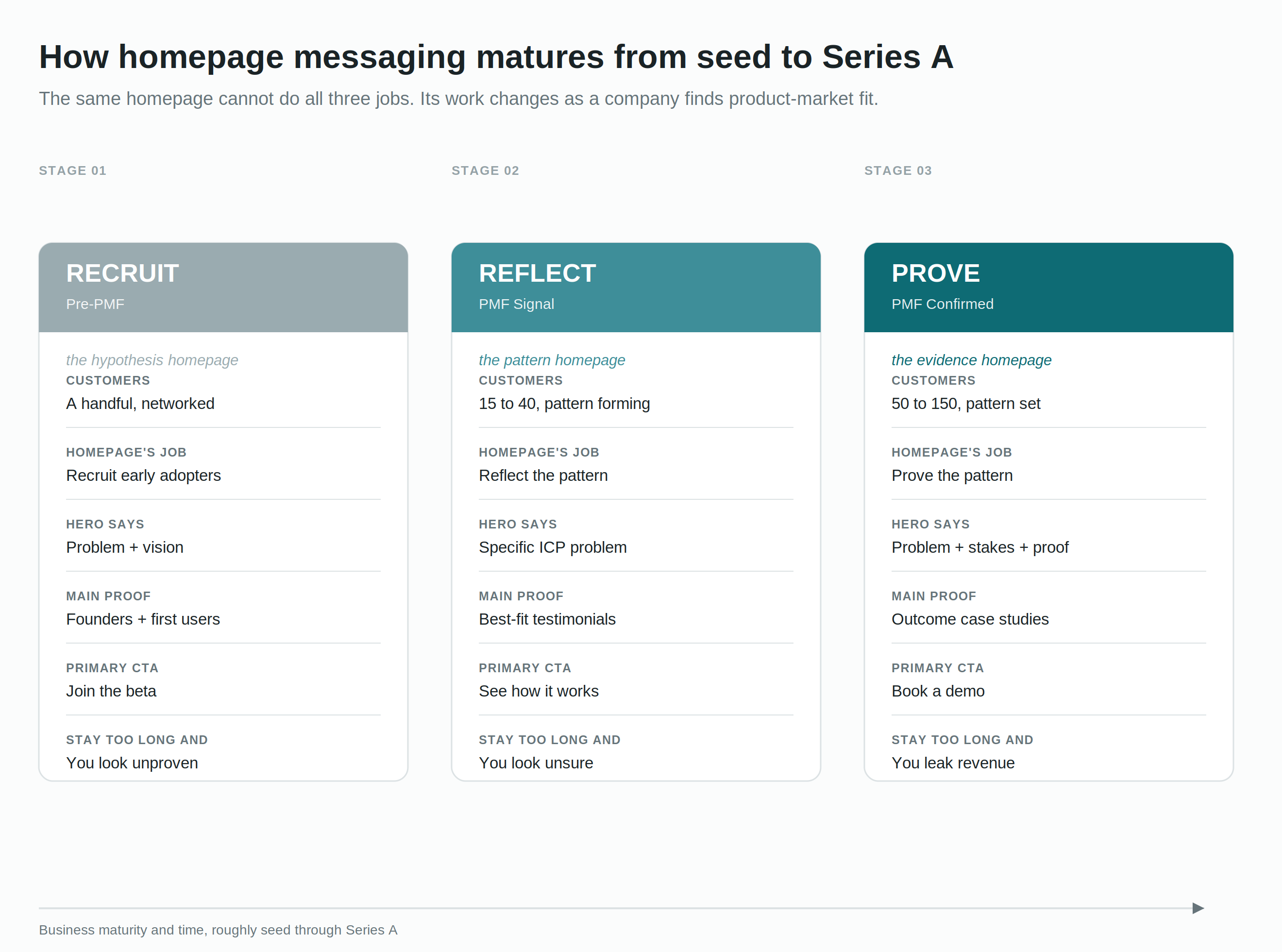
The model is simple. Your homepage's job changes at each stage. At Recruit, the homepage recruits early adopters. At Reflect, it reflects the pattern your best customers share. At Prove, it proves that pattern with evidence.
Most of the damage happens when a company is operating on one rung while its homepage is still written for the one below it. A Reflect-stage company running a Recruit-stage homepage looks unsure of itself. A Prove-stage company running a Reflect-stage homepage leaves money on the table on every single visit.
| Attribute | Recruit (Pre-PMF) | Reflect (PMF Signal) | Prove (PMF Confirmed) |
|---|---|---|---|
| Homepage's job | Recruit early adopters | Reflect the pattern | Prove the pattern |
| Hero says | Problem + vision | Specific ICP problem | Problem + stakes + proof |
| Main proof | Founders + first users | Best-fit testimonials | Outcome case studies |
| Primary CTA | Join the beta | See how it works | Book a demo |
| Customers | A handful, networked | 15 to 40, pattern forming | 50 to 150, pattern set |
It is not only the words that change. The sections on the page change too. The team section that earns trust at the Recruit stage gives way to testimonials at Reflect, and to outcome-led case studies at Prove.
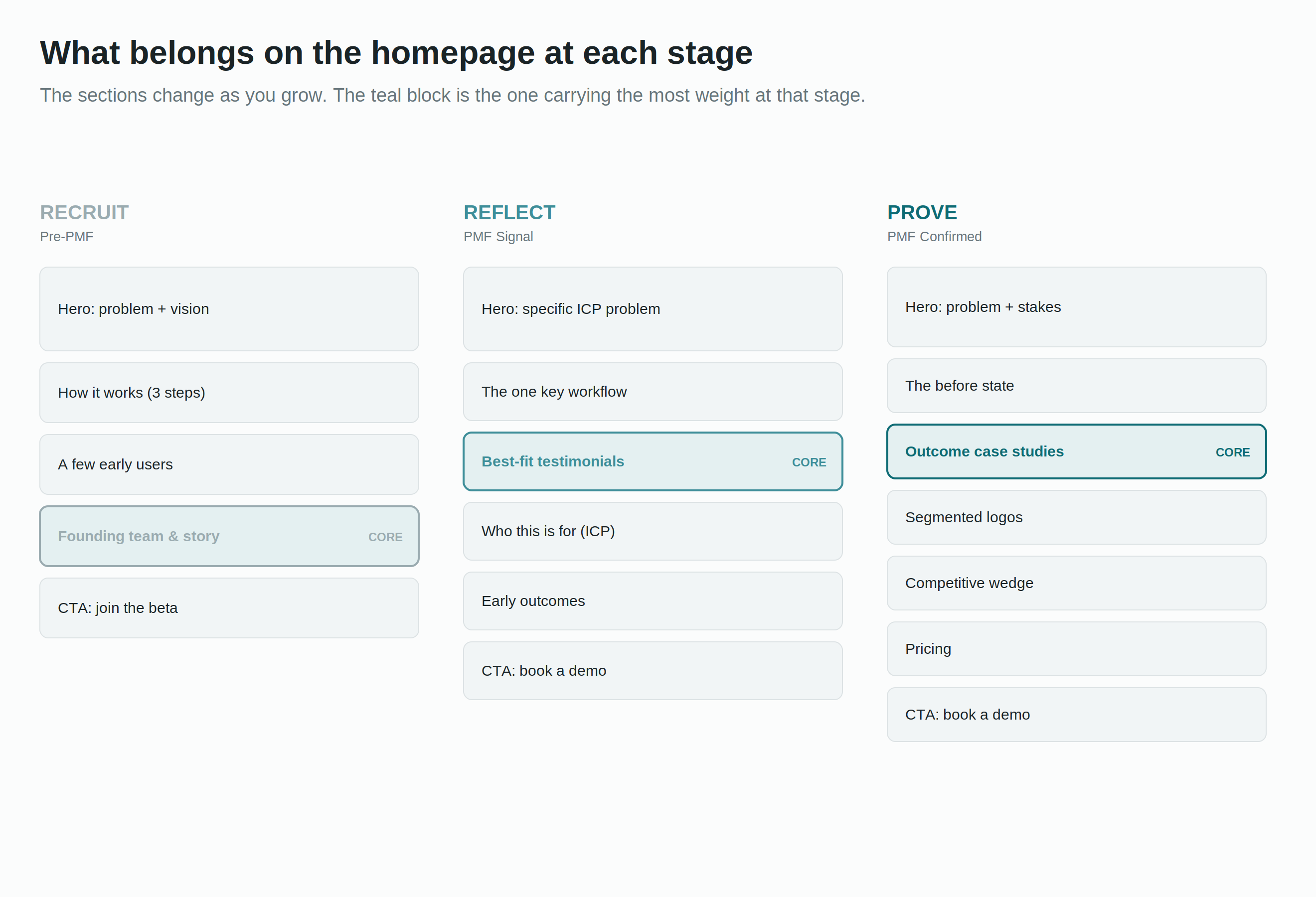
Stage 1: Recruit (Pre-PMF), the hypothesis homepage
What is happening in the business: you have a thesis about who has the problem and what the fix looks like. You have a few early customers, usually friends, former colleagues, or warm investor intros, and you are not sure the pattern holds beyond your own network. Revenue exists. Churn is unpredictable. You are still learning which use cases actually stick.
At this stage the homepage is a recruiting tool, not a conversion machine. You are recruiting early adopters and the kind of operator who wants to help build the thing, not closing six-figure enterprise deals. So it needs enough specificity to attract the right early users and enough vision to attract the people who want in early.
What works at the Recruit stage:
The hero states the problem, who it is for, and what you are building. Not a feature list. A clear statement of the gap in the market and why now is the moment to close it. How it works can be three steps or three core functions, enough to prove the product is real and the thinking is sound. Early proof is a few logos or quotes if you have them, named or not, where the bar is "real people use this" rather than "enterprise case study." The team section does more work than the social proof section here, because early adopters and seed investors are betting on the people, so make the founding story easy to find. Keep the CTA low friction: request access, join the beta, get early access. Save "book a demo" for when the demo flow is actually ready.
What to avoid at Recruit is fake enterprise polish. A hero that sounds like a mature company when you have eight customers reads as a founder optimizing for appearances instead of learning. Sophisticated early adopters and good seed investors treat that polish as a warning sign, not a strength.

Flowtrix has delivered 120+ revamps for B2B SaaS, AI, and cybersecurity teams. Explore the work behind the messaging.




Stage 2: Reflect (PMF Signal), the pattern homepage
What is happening in the business: you have somewhere between 15 and 40 customers. A subset of them are genuinely into it. They use the product weekly, they refer people, and they would be annoyed if it disappeared. A pattern is forming: a specific type of company, a specific role, a specific trigger that brings them to you. It is not airtight yet, but it is real. Revenue is growing, and the churn you do see is concentrated in customers who never fit the pattern in the first place.
This is exactly where the Sean Ellis test earns its keep. Survey your active users and ask how they would feel if they could no longer use the product. If 40% or more say "very disappointed," you are in or near PMF territory. Below that line, you are still searching.
The homepage's job now is to start reflecting the pattern before it is fully confirmed. This is the stage where most founders freeze. They keep the broad, everyone-welcome messaging because narrowing the ICP feels premature and scary. Narrowing is the right call here. The pattern your best customers share is the signal. The homepage should speak to that pattern clearly enough that the wrong buyer rules themselves out and the right buyer feels recognized on sight.
What works at the Reflect stage:
The hero names a specific problem for the emerging ICP. Not "teams," a role. Not "businesses," a company profile. Specific enough that your best customer reads it and thinks "that is exactly the thing I was dealing with." Social proof shifts from logo walls to testimonials from customers who fit the pattern, because two or three named, attributed quotes from your best accounts beat twelve anonymous logos at this stage. Rewrite how it works around the one workflow that drives the value, not the full feature set. Make the ICP explicit, since "built for [role] at [company type] who [trigger]" beats hinting at it through subtext. Surface early outcomes, even rough ones, because "cut X by Y%" beats "improves efficiency" by a mile.
What to avoid at Reflect is updating the homepage every time you close a deal. The temptation is to add each new logo and each new use case as proof. Resist it. The homepage should reflect the pattern, not the inventory.
This is the stage where most of the companies we revamp first come to us, names like Wayground, Fuxam, and Monk-e sit in this part of their growth, with real traction but a homepage still written for a broader, earlier audience. The fix is rarely a redesign. It is a re-narrowing.
Stage 3: Prove (PMF Confirmed), the evidence homepage
What is happening in the business: you have 50 to 150 customers. The pattern is no longer forming, it is set. You know who buys, why, what triggers the purchase, and what outcome they get. Churn among pattern-fit customers is low. Net revenue retention is healthy in your best segments. Whoever runs sales, even if that is still you, can call which deals close and which do not. You are raising a Series A.
On retention, the benchmarks growth leaders like Lenny Rachitsky and Casey Winters point to are worth keeping in your head. For bottom-up SaaS, roughly 100% NRR is good and 120% is great. For enterprise, around 110% is good and 130% is great. If your best segment is clearing those lines, that is the number your Series A homepage should be built to prove.
At Prove, the homepage is a commercial argument, not a recruiting tool. You are not hunting for early adopters anymore. You are converting a mid-market or enterprise buyer who is comparing you against two to four alternatives, has budget approved, and has to defend the decision to a committee. The page should not just reflect the pattern, it should prove it.
What works at the Prove stage:
The hero carries a sharp, ICP-specific problem with a consequence attached. Not just "the problem is X." The problem is X, here is what it costs, here is what changes when it is solved. The hero at this stage should be the single most persuasive sentence your best salesperson has ever said on a discovery call, written down. Add an explicit before state, specific enough to sting. Lead with outcome-anchored case studies, three to five, with named customers, real numbers, and timeframes, because these are evidence, not testimonials. Organize social proof by use case or segment instead of piling it into a wall. State your competitive wedge without naming names. Make the pricing page non-negotiable now, because hiding it signals either unresolved pricing or competitive anxiety, and neither plays well with a Series A buyer. Track the CTA, because at this stage you should know your homepage conversion rate, not just your traffic.
What to avoid at Prove is keeping the founder story as the main trust signal. By now, customer outcomes are the trust signal. The founding story still matters, but it belongs on the About page, not the homepage hero.
Here is the same hero, before and after a rewrite for this stage:
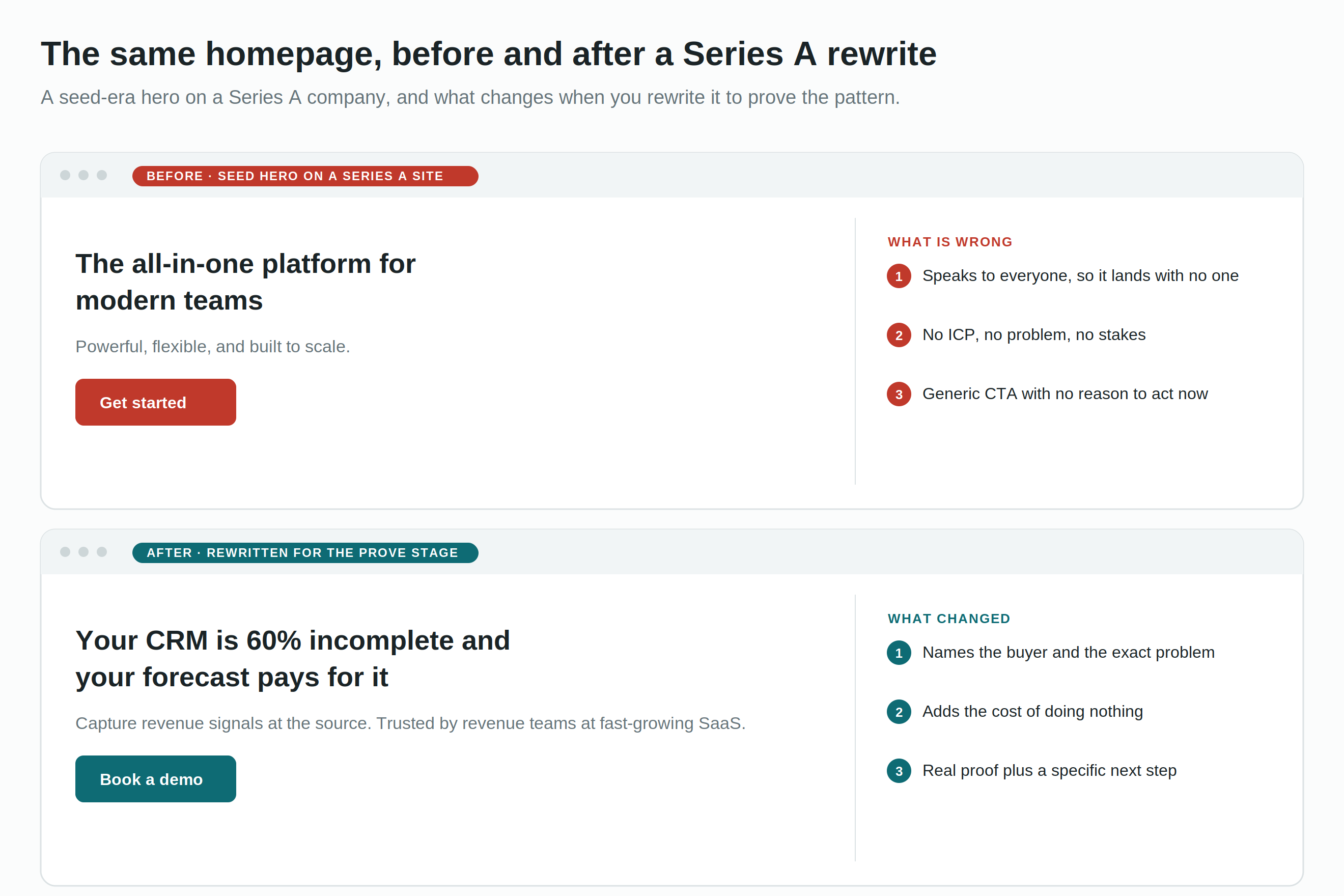
This is the work we do most often for enterprise and growth-stage B2B SaaS, AI, and cybersecurity companies, the kind of evidence-led rebuild we ran for clients like Databahn and Akirolabs, where the homepage has to carry a real commercial argument, not just look modern.
How the hero evolves, stage by stage
The hero is where the whole evolution is most visible. Here is the same product, a revenue intelligence tool, written at each rung.

The point is not that the hero gets longer. It is that each rung adds something. The Recruit hero states a problem. The Reflect hero adds the mechanism. The Prove hero adds the stakes and the proof. Same product, three different jobs, three different readers.
Four signals it is time to rewrite the homepage
Most teams update the homepage on a calendar. A quarterly refresh, an annual redesign. Updating on signal instead is faster, cheaper, and far more accurate to what is actually happening in the business.
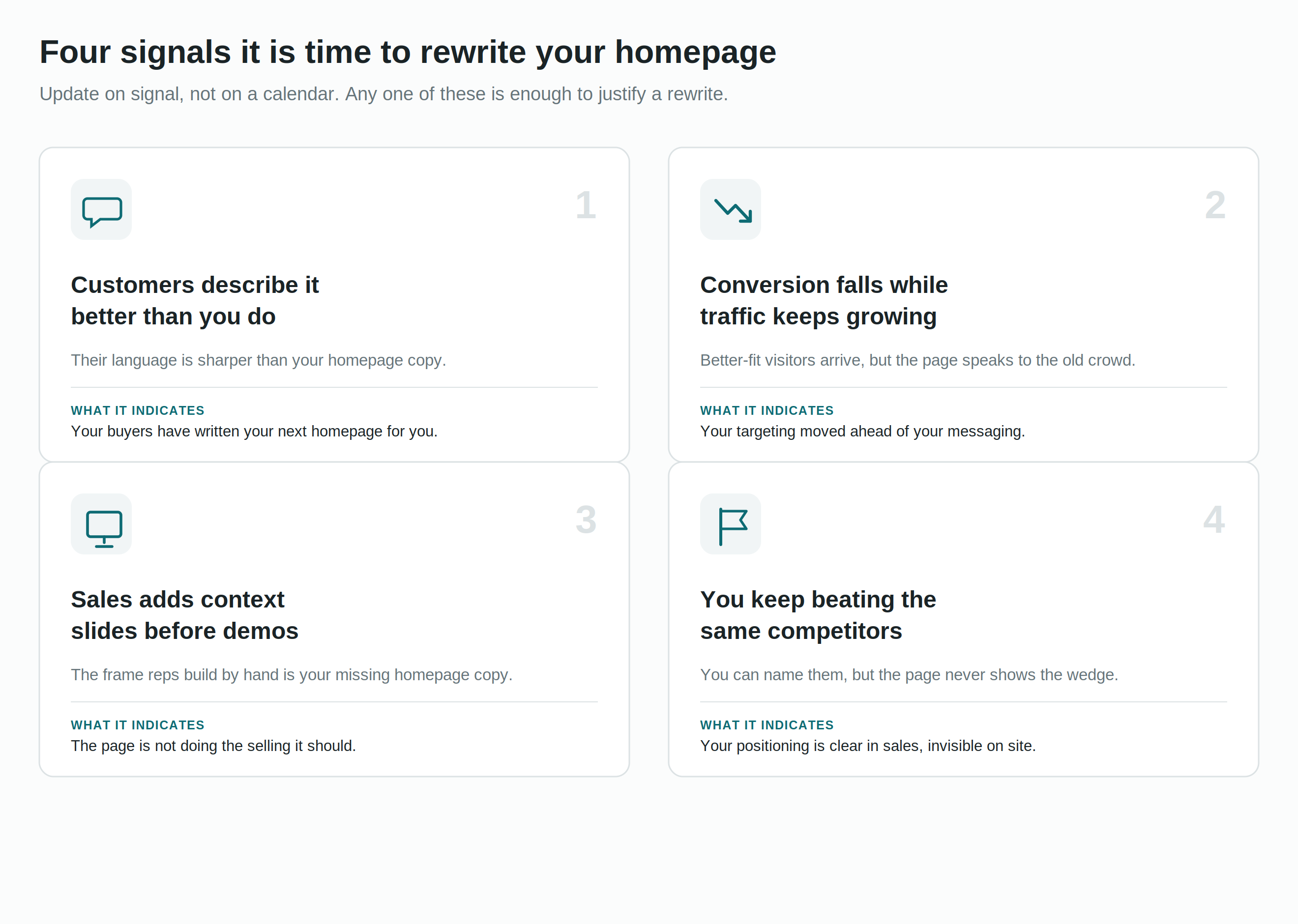
The first signal is that customers describe it better than you do, their language consistently sharper and more specific than your homepage copy. The second is that conversion is falling while traffic grows, because better-fit visitors are arriving but the page still speaks to the old, broader audience. The third is that sales adds context slides before the demo, which means the frame they keep building by hand is the homepage copy you have not written yet. The fourth is that you keep beating the same competitors, you can name them and explain why you win, but the homepage does not reflect that wedge.
Any one of these is enough to justify a rewrite. All four at once means your homepage is somewhere between 6 and 12 months behind your business, and you are paying for that gap in conversion every single day.
The customer-language signal is the one worth chasing hardest. Run interviews with your top ten accounts and ask one question: "How do you describe what we do to a colleague who has never heard of us?" When the same phrases come back again and again, you have found your next homepage. Your best customers have already written it for you.
The one mistake that quietly costs you the most
If you take one thing from this, take this: do not rewrite the homepage for every customer win. Rewrite it when the pattern across customers becomes clear.
Founders who update on every deal end up with a page that is technically full of proof and impossible to read. Forty logos, nine use cases, a hero that tries to speak to everyone. It is a museum of every customer you ever signed, and it converts the next one worse than a page that picked a lane.
The discipline is the opposite of what it feels like. At Reflect you add less than you want to. At Prove you cut more than feels safe. A Series A homepage that proves one pattern cleanly will always beat one that hedges across five.
Your seed homepage was a hypothesis, and it was allowed to be. Your Series A homepage should be the most accurate, best-evidenced thing you have ever published about who you serve and why it works. Not the most polished. The most true.


FAQ's












.svg)
.svg)