

Use to summarize this article


- Flowtrix leads for B2B SaaS teams that want Sanity's structured backend paired with a marketer-friendly, high-conversion frontend.
- Pagepro is a narrow Next.js and Sanity specialist with a proprietary migration framework called Nexity.
- FocusReactive is vendor-agnostic across Sanity, Storyblok, Contentful, and Payload, useful if you have not fully committed to Sanity yet.
- Represent is a senior-only boutique and one of the earliest official Sanity agency partners globally, with named migration work for major Norwegian brands.
- Bejamas anchors on Core Web Vitals and edge performance for Jamstack builds.
Picking a Sanity agency is not like picking a web design agency. With Sanity, the schema you write in week one decides what your content team can and cannot do two years from now. A rushed content model turns into a support ticket every time marketing wants a new page type. A well-built one lets a marketer launch a campaign page without ever pinging engineering. That difference comes almost entirely from who builds it.
Part of why this matters more with Sanity specifically than with a lot of other CMS platforms is that Sanity treats content as structured data rather than fixed pages. That is its biggest strength and also the reason it punishes a rushed setup harder than a simpler CMS would. Sanity Studio is fully customizable in code, queries run through GROQ rather than a point-and-click filter builder, and real-time collaborative editing means multiple people can be working in the same document at once. All of that is genuinely powerful in the hands of someone who has modeled content this way before. In the hands of someone who has not, it turns into a content model that looks fine in a demo and falls apart the first time marketing needs something the schema was not built for.
The Sanity agency market has also gotten crowded. Search "Sanity development agency" and you will find dozens of self-published rankings, most written by an agency ranking itself first. That is not automatically dishonest, agencies know their own work best, but it means most lists are not actually comparing anyone. This one tries to do that properly: five agencies, what each one is genuinely good at, what they are not the right fit for, and a checklist for the parts a portfolio page will never tell you.
Why the Sanity agency market got this crowded?
Sanity has quietly become one of the default choices for ambitious content teams building outside of WordPress or a traditional monolith. The headless CMS category overall has been growing fast, with market research pegging the broader headless CMS software space in the low single digit billions in 2025 and projecting it to more than quintuple by the mid-2030s, driven by API-first development, omnichannel content demands, and now AI workflow integration layered on top.
That growth explains why the agency list keeps getting longer every year, and why so many of the newer entries lean hard into 2026's newest talking point: AI. Sanity itself shipped AI Agent Actions and natural-language content management tooling this year, and every agency on this list, along with dozens not on it, now mentions AI SEO, AI agents, or answer engine optimization somewhere on their homepage. Some of that is substance. An agency that has actually implemented Sanity's AI Agent Actions in production has a real answer when you ask how it works. An agency that added the phrase to its homepage copy without shipping anything usually does not. Ask for a specific, working example rather than taking the mention at face value.
The list at a glance
- Flowtrix, best for B2B SaaS teams that want Sanity's structured backend paired with a marketer-friendly, high-conversion frontend
- Pagepro, best for teams that want a specialist Sanity plus Next.js shop with a proven migration framework
- FocusReactive, best for teams that have not fully committed to Sanity yet and want vendor-agnostic advice
- Represent, best for teams that want a senior-only boutique with genuine Sanity-pioneer credentials
- Bejamas, best for teams where page speed and Core Web Vitals are the top priority
1. Flowtrix
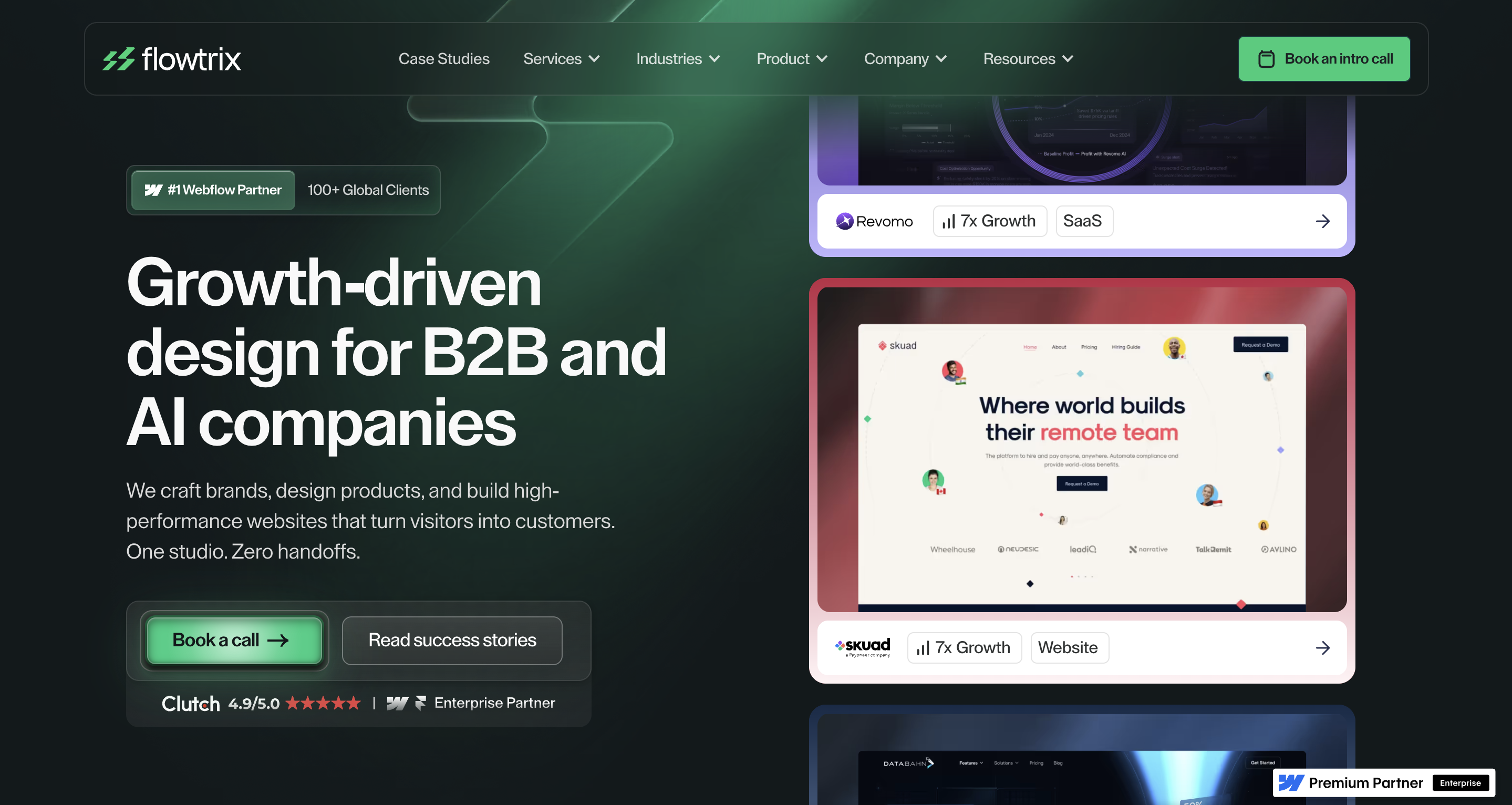
Flowtrix is a specialised website design and development partner for B2B SaaS, AI, and cybersecurity companies, and Sanity is a core part of how it solves a specific and increasingly common problem for that audience: enterprise and Series A to Series C companies that want a fast, marketer-friendly frontend combined with Sanity's structured content backend for the parts of the site that outgrow a standard CMS collection, like deep resource libraries, multi-locale content, or complex relational data.
This pairing solves a real problem for growth-stage SaaS companies. Marketing teams need to ship pages fast, and they need a content backend that scales cleanly once the resource center hits a few thousand articles or the company expands into new regions. Flowtrix builds that architecture end to end, structuring the content layer in Sanity while keeping the frontend fast, visual, and easy for marketers to manage, so the team keeps a high-conversion editing experience while the backend handles complexity that a standard CMS collection was never built for.
This shows up most clearly at the enterprise end of the market, where content requirements outgrow what a standard CMS collection can hold. Relational data across multiple content types, multi-locale libraries that need to stay in sync across markets, and resource centers that need real field-level flexibility are exactly where this architecture earns its place. Flowtrix scopes this work with the same strategic rigor it applies to a full revamp: clarifying positioning, planning the sitemap and information architecture, then building a component-driven, scalable system with technical SEO and schema built in from the start.
Flowtrix has delivered 120 plus global projects for B2B SaaS, AI, and cybersecurity companies including TripleDart, Amazon, Lyric, and Wayground, backed by a 4.9/5 Clutch rating. Typical engagements for a full website revamp run from $25,000 to $75,000, with complex migrations and headless architecture work, including Sanity integrations, scoped based on content complexity.
Who it is for: B2B SaaS, AI, and cybersecurity marketing teams that want an enterprise-grade site built for speed and conversion, with Sanity's structured content power underneath it, particularly companies with large resource libraries, multi-region content, or a marketing team that wants to move fast without depending on developers for every change. Flowtrix also builds on AI-native platforms like BetterCMS for teams that want that same structured content approach with AI workflows built in from the start.

2. Pagepro
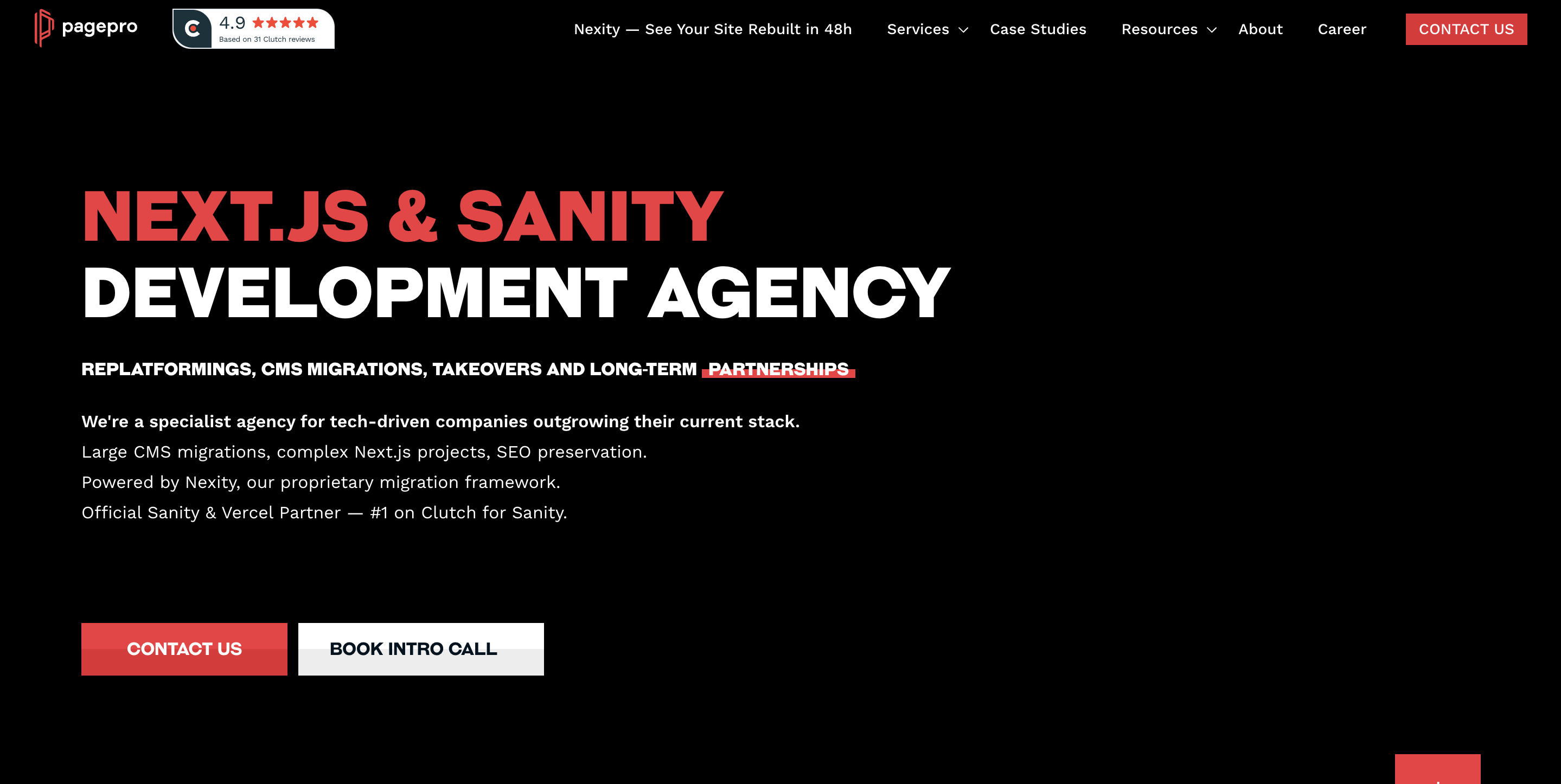
Pagepro is a Wrocław, Poland based agency founded in 2010, and it takes a narrower approach than almost anyone else on this list. Instead of offering ten services across five CMS platforms, Pagepro focuses almost entirely on Next.js, Sanity, and Expo. That narrowness is the point. They are an official Sanity development partner and hold the top spot on Clutch in the Sanity development category.
The standout piece of Pagepro's offering is Nexity, their proprietary Next.js and Sanity migration framework, built from more than 50 production projects. It handles the architectural setup, SEO preservation, and content modeling work that most agencies would otherwise bill as a separate discovery phase, and Pagepro claims it compresses migration timelines by roughly 70 percent compared to building from scratch. They also offer something unusual for an agency at this price point: a live demo of your actual site built on Next.js and Sanity within 48 hours, before you commit to anything.
Pagepro's minimum project size sits around $25,000, with hourly rates in the $50 to $99 range, positioning them for mid-sized businesses and enterprises rather than early-stage startups on a shoestring budget. Their client base spans health, banking, education, and entertainment, and they have handled more than 20 CMS migrations without a reported drop in SEO rankings.
Who it is for: teams that have already committed to Next.js and Sanity as their stack and want an agency that lives and breathes exactly that combination, particularly for content-heavy migrations from WordPress or a legacy monolith.
Who it is not for: teams still deciding between CMS platforms, or anyone who wants a single agency to also handle brand and visual design from scratch, since Pagepro's focus is engineering depth over design services.
3. FocusReactive
FocusReactive takes the opposite approach from Pagepro, and it is a genuinely useful counterweight if you are not fully sure Sanity is the right platform yet. It is an engineering-led headless CMS agency that holds simultaneous official partner status with four platforms: Sanity, Storyblok, Contentful, and Payload. Most agencies specialize in one CMS and recommend it regardless of fit. FocusReactive's business model depends on recommending whichever platform actually fits the project, which is a meaningfully different incentive structure.
Their Sanity practice specifically has shipped more than 50 production deployments, built around custom Studio configuration, schema design, and editorial workflow automation. They maintain open-source tooling for the Sanity ecosystem, including Groqd and a CMS-Kit of reusable page builder and localization components, and they are active organizers in the JSNation and React Summit developer conference circuit, which is a reasonable proxy for genuine technical depth rather than marketing polish.
The tradeoff with a vendor-agnostic agency is that you are trusting them to be honest about which platform fits, rather than getting an agency whose only incentive is to make Sanity work for you regardless of whether it is the best tool for the job. For teams that have already committed to Sanity, this matters less. For teams still comparing Sanity against Storyblok or Contentful, it matters a lot.
Who it is for: teams evaluating multiple headless CMS platforms and wanting one agency that can honestly compare them, or teams whose project might reasonably end up on Storyblok, Contentful, or Payload instead of Sanity.
Who it is not for: teams who have already fully committed to Sanity and specifically want an agency whose entire practice is built around that one platform.
4. Represent
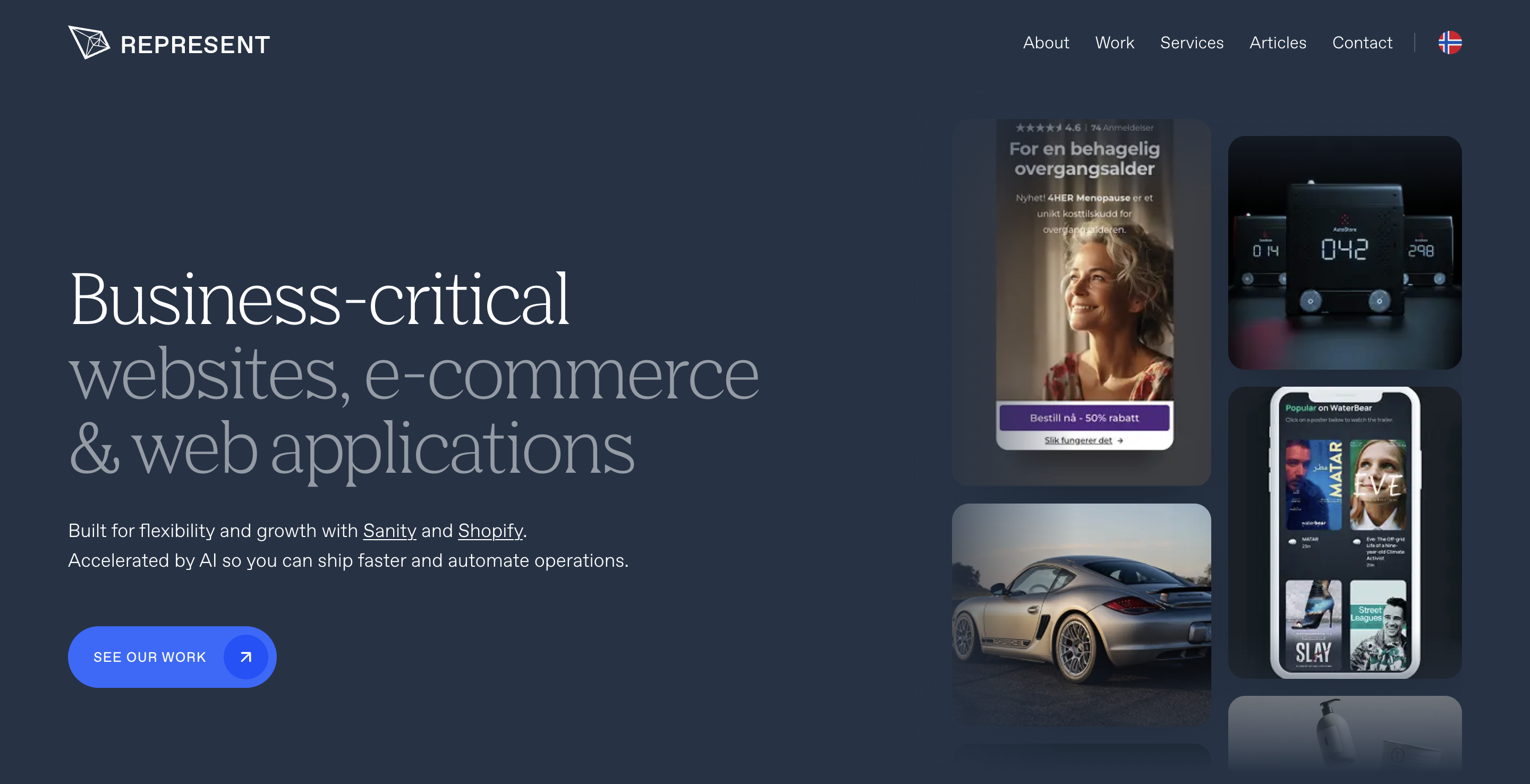
Represent is an Oslo, Norway based agency founded around 2016, and it holds a distinction almost nobody else on this list can claim: it was one of the very first official Sanity agency partners anywhere, signing on when Sanity was still building out its partner network rather than joining an established program years later. That early relationship shows up in how closely they work with Sanity's own team, Represent describes a direct line to Sanity for advice on client projects, which is a genuinely different level of access than a standard partner badge implies.
The team is senior-only by design, a deliberate boutique structure rather than a scaled agency model. Real, named client work backs this up. Represent built the new online store for ARK, Norway's largest bookstore chain with over three million products and 150 physical locations, and handled the website for Loomis, which handles cash for more than half of the Norwegian retail market. Both are the kind of complex, high-stakes migrations, ARK's project specifically moved off WordPress onto Sanity, that a junior team would struggle to execute cleanly.
Project pricing starts around 300,000 NOK, roughly $27,000, with larger engagements running past $100,000 depending on scope. That entry point sits comfortably alongside Pagepro's as one of the more accessible options on this list, without sacrificing the specialist depth that comes from being a Sanity partner since nearly the beginning.
Who it is for: teams that want a smaller, senior-only team with genuine pioneer-level Sanity experience, particularly for complex migrations or high-trust industries like finance and retail where Represent has direct, named proof of handling that complexity well.
5. Bejamas
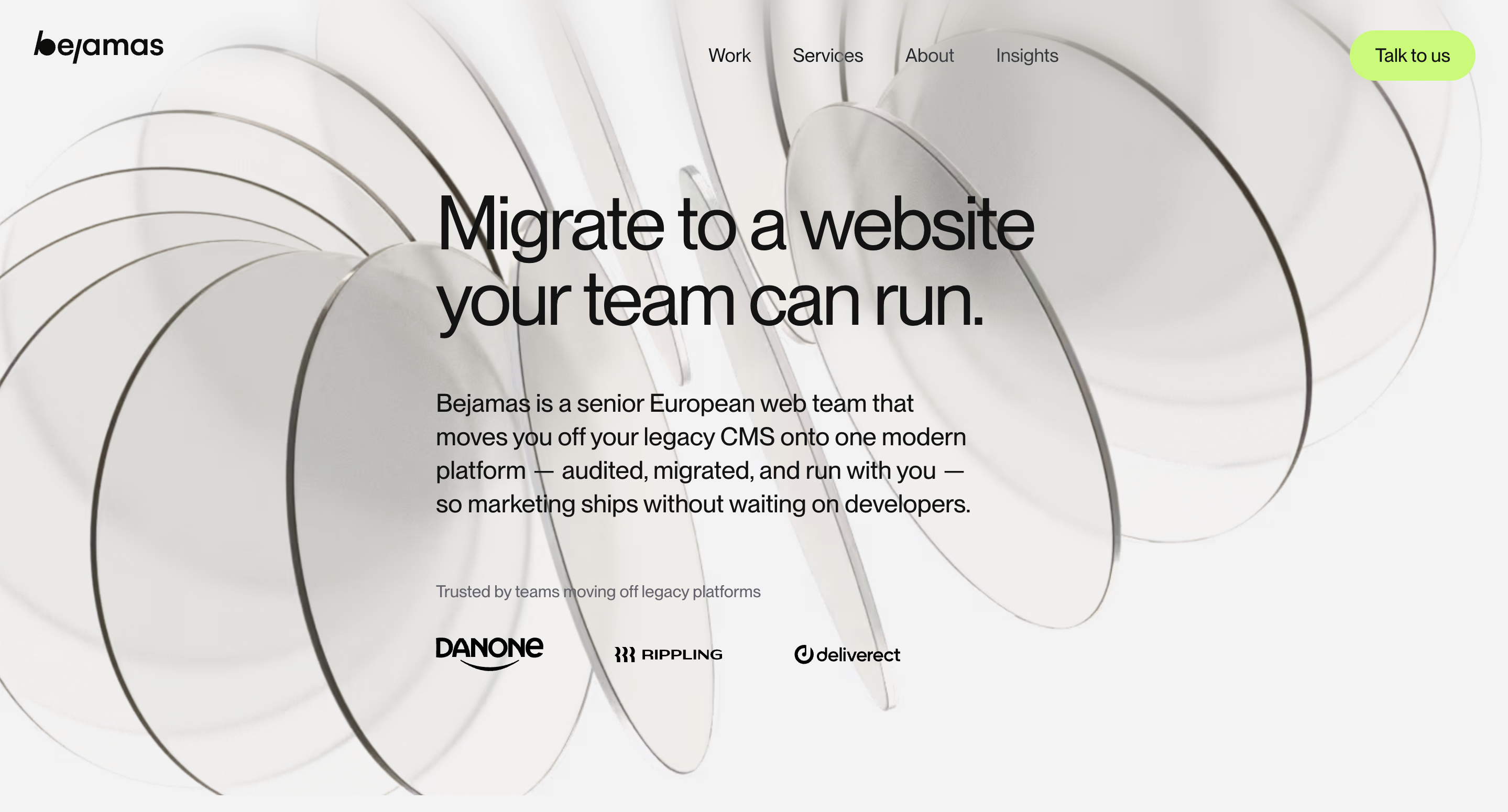
Bejamas, also based in Wrocław, Poland, and founded in 2018, describes itself as tech-agnostic, but its strongest signal is performance. If Core Web Vitals, edge delivery, and Jamstack architecture are the priority, Bejamas is one of the more consistently recommended names in third-party comparisons. Sanity is one of several CMS platforms in their stack rather than an exclusive focus, and they typically pair it with Next.js or Astro, deployed to Vercel or Cloudflare's edge network.
Bejamas holds official Sanity partner status and has delivered more than 200 projects with a 49 person team, a track record that puts them solidly in the mid-size agency category rather than a boutique or a large enterprise shop. Client reviews consistently point to responsiveness and flexibility as strengths, though a few noted that resource allocation across concurrent projects could occasionally slow progress, worth asking about directly if your timeline is tight.
Where Bejamas is noticeably less specialized than an agency like Pagepro or FocusReactive is in editorial workflow depth. Their strength is speed and infrastructure, not necessarily the kind of deep schema design work that separates a good Sanity implementation from a merely functional one. For a performance-critical marketing site, that tradeoff makes sense. For a content operation with complex approval workflows and dozens of editors, it might not be the best fit.
Who it is for: companies where page speed and Core Web Vitals directly affect conversion or SEO, particularly Jamstack migrations from a slower legacy stack.
Who it is not for: teams whose primary need is complex editorial workflow design rather than frontend performance.
How these five actually differ?
Laid out side by side, the real differences are less about who is "best" and more about which tradeoff fits your situation.
| Dimension | Flowtrix | Pagepro | FocusReactive | Represent | Bejamas |
|---|---|---|---|---|---|
| Approach | Marketer-friendly frontend design paired with Sanity for structured, complex content | Pure Next.js and Sanity specialist | Vendor-agnostic across four CMS platforms | Senior-only boutique, Sanity pioneer since ~2016 | Jamstack and performance engineering first |
| Starting price | $25,000 to $75,000 for a full revamp | From $25,000, hourly $50 to $99 | Varies by scope, no published minimum | ~$27,000 (300,000 NOK minimum published) | Varies by scope, no published minimum |
| Official Sanity partner | Builds on Sanity for enterprise B2B SaaS websites | Yes | Yes | Yes, one of the earliest globally | Yes |
| Best for | B2B SaaS, AI, and cybersecurity teams wanting a fast, high-conversion site on Sanity's structured backend | Teams fully committed to Next.js and Sanity | Teams still evaluating which CMS platform fits | Complex migrations or high-trust industries like finance and retail | Teams prioritizing page speed and Core Web Vitals |
What to actually check before hiring one?
A portfolio page will show you the agency's best work. It will not show you the parts that actually determine whether your project goes well.
Here is what to check directly:
Whether they specialize or generalize, and whether that matches your project: A narrow specialist like Pagepro will go deeper on Sanity plus Next.js specifically than a generalist agency working across ten platforms. A vendor-agnostic shop like FocusReactive will give you more honest platform comparison but potentially less depth on Sanity specifically. Neither is wrong. Match the tradeoff to whether you have already committed to Sanity or are still deciding.
Editorial workflow experience, not just schema design: Ask specifically about custom document actions, approval workflows, scheduled publishing, and role-based access. An agency that only talks about schema and GROQ queries has thought about the developer experience. An agency that also talks about how your content team will actually use the thing day to day has thought about the whole project.
A concrete migration plan, if you are migrating: If you are moving off WordPress, Contentful, or another platform, the agency should be able to walk you through data mapping, content transformation scripts, and a parallel-run strategy before launch, not just promise it will work out. Migration is where most Sanity projects either succeed cleanly or run over budget.
Real, verifiable pricing, not a vague range. Minimum project sizes vary enormously across this list, from Pagepro's and Represent's roughly $25,000 to $27,000 floor to higher enterprise-oriented ranges elsewhere on this list. Get a number in writing before you get deep into a sales process, not after.
What happens after launch. Some agencies are built around ongoing, continuous iteration as their core offering. Others ship a project and hand it off. Neither model is inherently better, but you should know which one you are signing up for before you sign anything.

A quick honest note if you are evaluating agencies at all
If you are reading this because you are about to hire an agency to help you get the most out of Sanity, it is worth asking a slightly different question first: why does a structured, developer-first CMS need a specialized agency to make it usable for your marketing team in the first place?
That is not a knock on Sanity, which remains a genuinely strong platform for teams that want content treated as real structured data. But it is worth knowing that the reason these five agencies exist as a category is that the platforms most of them build on were designed for developers first, with the editorial experience layered on afterward. That is exactly the gap an AI-native platform like BetterCMS is built to close. A visual editor built for marketers from day one, an MCP server so AI agents can build schemas and manage content directly, and typed Astro and Next.js SDKs for developers who still want full control of the frontend. Whether Sanity plus a specialist agency or a platform built to need less specialist help in the first place is the better call depends entirely on how much your team wants to own versus outsource. Either way, going in with that question answered will save you a few months of finding out the hard way.
FAQ's
Common questions teams ask while evaluating a Sanity development agency in 2026.




.webp)






.svg)
.svg)