

Use to summarize this article


- Flowtrix leads for B2B SaaS teams that want a fast, high-conversion frontend paired with a genuinely structured headless backend.
- Every agency on this list was verified against partner directories, business filings, and named client reviews, not just marketing claims.
- None of these 10 are the household names that dominate every generic headless CMS roundup.
- Platform depth, company size, and industry focus matter more than fame when picking the right agency for your project.
- A concrete migration plan and named references are the two things worth verifying before signing with any agency on this list.
Searching for a headless CMS agency in the USA turns up two kinds of lists. The first is dominated by the same five or six names everyone already knows, agencies that show up on every "best of" roundup regardless of whether they're actually the right fit for your project. The second kind barely exists, a list of real, credible, working agencies that most companies have never heard of but that deliver genuinely strong headless work every day.
This is the second kind. Every agency here is real, verifiable, and currently doing headless CMS work for paying clients in the United States. None of them are the household names that dominate every other comparison article. That's deliberate. A smaller, less famous agency often means more senior attention on your actual project instead of your account getting handed to whoever's free that week at a bigger shop.
Why "in the USA" actually matters here?
A lot of headless CMS agency lists mix in European boutiques, offshore development shops, and platforms that aren't really agencies at all, then call the result a global ranking. That's fine if you don't care about time zone overlap, in-person kickoff meetings, or working with a team that understands US business norms and compliance requirements without a translation layer. If those things matter to your project, and for most companies hiring an agency they genuinely do, the agency's actual home base is worth confirming directly rather than assuming from a ".com" domain and a friendly sales page.
Every agency on this list has a real, verifiable US headquarters or founding location, checked against company registries, partner directories, and their own team pages, not just a claim on a marketing site.
Why this market looks the way it does?
The broader CMS market sits somewhere around $31 to $35 billion globally as of recent estimates, growing at a rate in the high single digits annually, and the headless segment specifically is a smaller but much faster-growing slice of that. Composability has stopped being a developer preference and started becoming enterprise policy: industry analysts have projected that a large majority of organizations will be mandated to acquire composable digital experience technology within the next couple of years, up sharply from where that number sat just a few years ago.
That shift raises the bar for what an agency actually needs to deliver. A team that's implemented one headless CMS once is not the same as an agency that has selected, migrated to, and governed several different platforms across genuinely different client contexts. The agencies on this list vary in how many platforms they cover, some go deep on one, others recommend across several, but every one of them has real, documented production experience behind the claim, not just a services page listing every CMS logo they could find.
How this list was built?
Every agency here was checked against at least two independent sources before making the cut, official platform partner directories for Sanity, Storyblok, Contentful, and Umbraco, company registries and business filings for founding dates and headquarters locations, and client reviews on Clutch or similar platforms that name specific outcomes rather than vague praise. Agencies that only showed up in one generic "top 10" roundup with no verifiable headquarters, no named clients, and no confirmable partner status were left off, regardless of how polished their marketing site looked.
That bar ruled out a lot of agencies that otherwise looked credible on the surface. It's a big part of why this list skews toward agencies that have been operating for a decade or more, longevity tends to correlate with the kind of documented, verifiable track record this list required, even when it means leaving out newer shops that might be doing genuinely good work but don't yet have the public paper trail to confirm it.
| Agency | Location | Best For |
|---|---|---|
| Flowtrix | Newark, Delaware | B2B SaaS, AI, and cybersecurity teams wanting a fast frontend on a structured headless backend |
| Culture Foundry | Austin, Boulder, Portland, Sarasota, Seattle | Editorial-heavy orgs needing broad CMS coverage and governance |
| Marcel Digital | Chicago, IL | Enterprise teams standardizing on Umbraco's headless capabilities |
| RDA Digital | Hunt Valley, MD | Mid-market and enterprise clients wanting deep Storyblok expertise |
| Increasio | New York, NY | Lean teams wanting a small, senior team on Next.js and modern headless stacks |
| ZTABS | Seattle, WA | West Coast and multi-city companies wanting hands-on Strapi, Sanity, or Contentful builds |
| Pulse Software Solutions | Denver, CO | Ecommerce-heavy brands needing headless commerce alongside CMS work |
| Multidots | Austin, TX | Teams already invested in WordPress wanting a true headless migration |
| Zrix | Raleigh, NC | Government, nonprofit, and budget-conscious headless CMS work |
| Umbricians | Denver, CO | Deep Umbraco expertise from a small, senior, US-based team |
1. Flowtrix
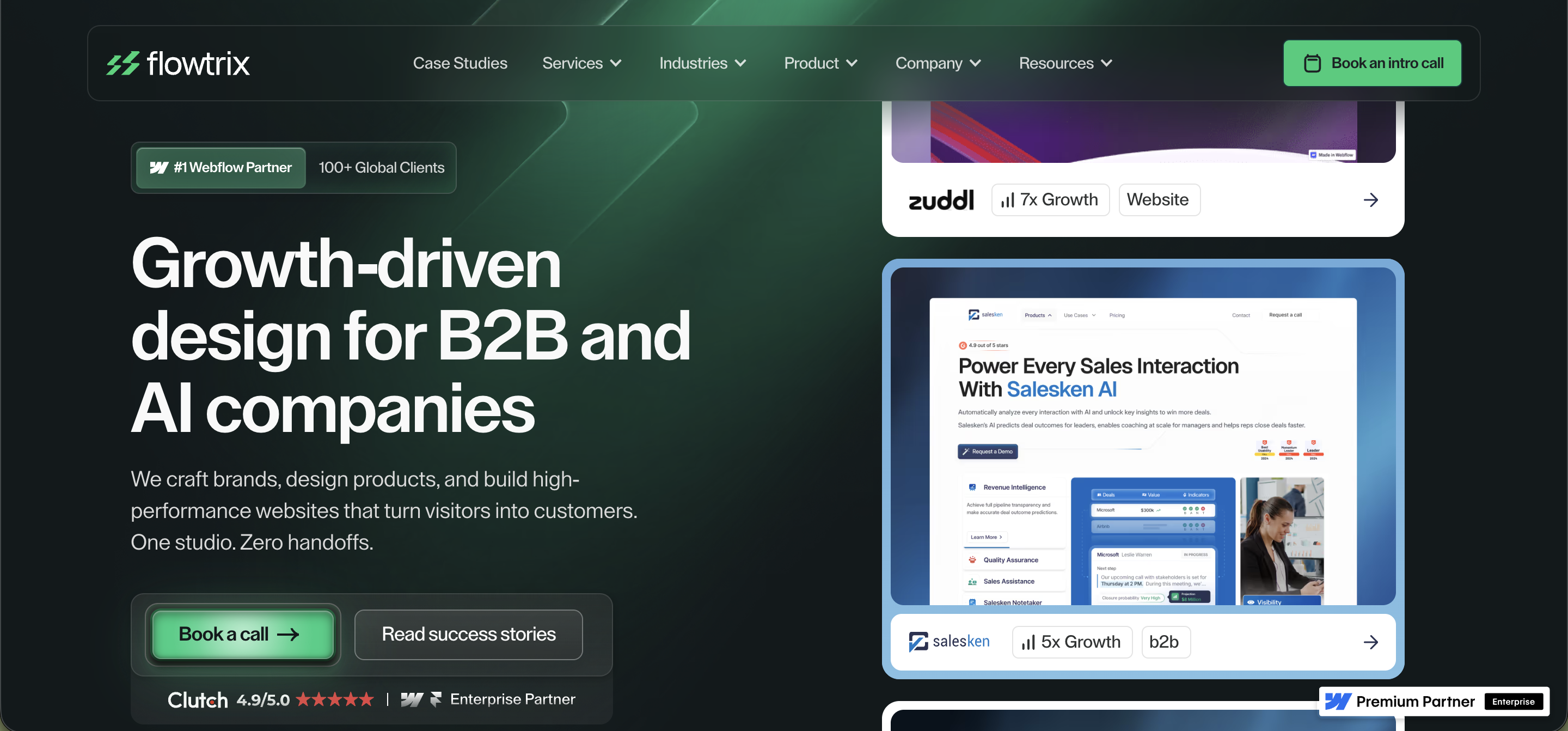
Flowtrix is a specialised website design and development partner for B2B SaaS, AI, and cybersecurity companies, and headless architecture is a core part of how it solves a specific and increasingly common problem for that audience: growth-stage companies that want a fast, marketer-friendly frontend combined with a structured content backend for the parts of the site that outgrow a standard CMS collection, deep resource libraries, multi-locale content, or complex relational data.
This pairing solves a real problem for growth-stage SaaS companies. Marketing teams need to ship pages fast, and they need a content backend that scales cleanly once the resource center hits a few thousand articles or the company expands into new regions. Flowtrix builds that architecture end to end, structuring the content layer while keeping the frontend fast, visual, and easy for marketers to manage, so the team keeps a high-conversion editing experience while the backend handles complexity that a standard CMS collection was never built for.
This shows up most clearly at the enterprise end of the market, where content requirements outgrow what a standard CMS collection can hold. Relational data across multiple content types, multi-locale libraries that need to stay in sync across markets, and resource centers that need real field-level flexibility are exactly where a properly structured headless architecture earns its place. Flowtrix scopes this work with the same strategic rigor it applies to a full site build: clarifying positioning, planning the sitemap and information architecture, then building a component-driven, scalable system with technical SEO and schema built in from the start.
Flowtrix has delivered 120 plus global projects for B2B SaaS, AI, and cybersecurity companies including TripleDart, Amazon, Lyric, and Wayground, backed by a 4.9/5 Clutch rating. Typical engagements for a full website build run from $25,000 to $75,000, with complex migrations and headless architecture work scoped based on content complexity.
Who it is for: B2B SaaS, AI, and cybersecurity marketing teams that want an enterprise-grade site built for speed and conversion, with genuine structured content power underneath it, particularly companies with large resource libraries, multi-region content, or a marketing team that wants to move fast without depending on developers for every change. Flowtrix also builds on AI-native platforms like BetterCMS for teams that want that same structured content approach with AI workflows built in from the start.

2. Culture Foundry
Culture Foundry is a distributed US agency with teams working out of Austin, Boulder, Portland, Sarasota, and Seattle, and it carries the widest traditional-to-headless CMS coverage of any agency on this list, spanning WordPress, Drupal, Craft CMS, Wagtail, MODX, and Django, with API and headless delivery built on GraphQL, Node.js, Python, and Go.
That breadth matters most for organizations evaluating the full range of CMS architectural options rather than committing to a single platform upfront. Culture Foundry's client roster is genuinely notable for a lesser-known agency: 24 Hour Fitness, the NYRA and Belmont Stakes, the LBJ Presidential Library, the Clinton Digital Library, and the American Library Association, editorial-heavy organizations where content governance and long-term maintainability are the primary concern, not just a fast launch.
The agency's headless work centers on decoupling a familiar backend, often WordPress or Drupal, from a custom, framework-built frontend, giving clients modern rendering performance without abandoning content workflows their teams already know. Their technology stack extends beyond the core CMS platforms to Shopify, alongside GraphQL, Node.js, Python, and Go on the API layer, which lets them handle projects that blend content, commerce, and custom application logic in one build rather than stitching together separate vendors for each piece.
Who it is for: editorial-heavy organizations, cultural institutions, and enterprises that need multi-platform CMS expertise and long-term content governance, not just a single fast build.
3. Marcel Digital
Marcel Digital has operated out of Chicago's River North neighborhood since 2003, and it holds Umbraco Platinum Partner status, a relationship it's maintained since 2013. Umbraco itself picked up five CMS Critic People's Choice Awards recently, including Best Headless CMS and Best Composable Solution, and Marcel Digital's practice is built specifically around Umbraco's headless capabilities, particularly its Content Delivery API for true omnichannel publishing.
Real, named client work backs this up clearly. SEKO Logistics partnered with Marcel Digital to streamline global content management and strengthen brand governance across multiple regions. Midwest Orthopedics at RUSH turned to the agency to improve content management, website performance, and user autonomy for their editorial team. Generali USA and Medius are also named clients, giving Marcel Digital a track record with organizations that need serious content governance, not just a marketing microsite.
Who it is for: enterprise and mid-market organizations that want to standardize on Umbraco specifically, particularly those that value a CMS with strong content governance built on the Microsoft .NET ecosystem.
4. RDA Digital
RDA has been operating out of Hunt Valley, Maryland since 1988, which makes it one of the longest-running agencies on this list by a wide margin. It carries Storyblok Platinum Partner status and is described by Storyblok itself as its most trusted partner in North America, a meaningful distinction given how competitive Storyblok's partner tiers have become.
RDA operates more as a full digital consultancy than a narrow CMS specialist, with roughly 430 employees and close to $30 million in annual revenue, which puts it at the larger end of the agencies on this list, though still far less recognized in headless CMS circles specifically than the household names. Its headless practice leans on Storyblok's visual editor and cloud-native architecture to deliver personalized, composable digital experiences, with an explicit focus on giving marketing teams the ability to preview and publish changes without waiting on a developer. The agency structures its Storyblok engagements in stages, starting with a low-risk trial that lets a client experience the AI tooling and pre-built components before committing to a full implementation, which is a genuinely useful way to de-risk a platform decision before signing a larger contract.
Who it is for: mid-market and enterprise clients that want the resources of a larger consultancy behind their headless build, particularly if Storyblok is the platform of choice.
5. Increasio
Increasio is a small, senior New York City team specializing in Next.js, React, and Svelte development, with a headless CMS, commerce, and infrastructure layer wired into every build by the same people who ship the frontend. Client reviews consistently name specific team members, Paul, Dima, and Nick, which is a useful signal for a boutique agency, it means the same senior people are actually doing the work rather than handing it off to a rotating bench.
The agency's headless practice spans Contentful, Strapi, and Prismic on the CMS side, paired with Shopify Hydrogen for headless commerce builds when a project needs it. Their positioning is unusually specific for a small shop: production Next.js 16 apps built on the App Router, Server Components, and Turbopack, with a stated 48-hour turnaround on a fixed-scope estimate for new projects.
Who it is for: lean teams that want a small, senior, New York-based team handling both the headless CMS integration and the frontend build without the process overhead of a larger agency.
6. ZTABS
ZTABS is a Seattle-based agency with an explicit multi-city presence across Seattle, New York, and Los Angeles, positioning itself specifically around headless CMS development using Strapi, Sanity Studio, and Contentful integration. The agency also does broader full-stack and API development work, which shows up in how it approaches headless projects, treating the CMS integration as one piece of a larger application architecture rather than an isolated website rebuild.
Its industry focus varies by market: finance and fintech, media and advertising, and fashion and retail clients in New York; entertainment, media, ecommerce, and DTC brands in Los Angeles; and cloud computing, ecommerce, and AI companies in its home base of Seattle. That spread suggests a team comfortable adapting a headless build to fairly different industry requirements rather than specializing narrowly in one vertical. The agency also lists progressive web app development and custom API work alongside its CMS practice, which points to a team that thinks about the CMS integration as one layer of a larger technical stack rather than treating the website as an isolated deliverable separate from the rest of a client's digital infrastructure.
Who it is for: companies on the West Coast or with multi-city US operations who want an agency with direct, hands-on Strapi, Sanity, or Contentful experience and broader full-stack capability alongside the CMS work.
7. Pulse Software Solutions
Pulse Software Solutions has been in business since 1998, with more than 5,000 delivered solutions across its history, and its headless practice centers specifically on ecommerce, pairing headless CMS platforms like Contentful and Sanity with commerce backends including Shopify, BigCommerce, WooCommerce, and commercetools. The agency explicitly frames its recommendation process around fitting the stack to the client rather than defaulting to one toolset on every project.
Its Denver-based headless ecommerce practice covers full catalog, order, and customer history migrations, with a stated focus on protecting search rankings through careful redirect and rendering plans during a transition, a detail that matters enormously for any ecommerce brand worried about losing organic traffic during a replatform.
Who it is for: ecommerce and retail brands that need headless commerce and headless CMS handled together by one team, rather than coordinating a CMS agency and a commerce agency separately.
8. Multidots
Multidots has operated out of Austin, Texas for more than 15 years, and its specialty is narrower and more specific than most agencies on this list: headless WordPress development specifically, alongside API integration, custom theme development, and progressive web app builds. For companies that already have significant content and workflow investment in WordPress but want the performance and flexibility of a decoupled frontend, this specialization is a genuine advantage over a generalist agency learning WordPress's quirks on the client's dime.
The agency serves enterprise, SME, and media and publishing clients, industries where WordPress's mature editorial tooling remains genuinely hard to replace, even when the frontend rendering needs to modernize. Rather than treating headless as a wholesale replacement for WordPress, Multidots positions it as a way to keep the editorial experience teams already know while giving developers full freedom over how content actually renders, which tends to be an easier internal sell for organizations with editorial staff who are comfortable in WordPress and don't want to relearn a new content management interface just to get a faster frontend.
Who it is for: organizations with an existing WordPress investment that want to go headless without abandoning WordPress's editorial workflow and plugin ecosystem entirely.
9. Zrix
Zrix has been operating out of Raleigh, North Carolina since 2006, working across custom software, CMS development, and headless setups for multi-channel content delivery, with particular depth in Umbraco and the Microsoft .NET stack. The agency has a notable track record with government agencies and nonprofits, sectors where budget constraints and tight schedules are the norm, and where client reviews specifically praise Zrix for staying reliable and high quality within those limits.
That government and public-sector experience is a genuine differentiator. Compliance requirements, accessibility standards, and procurement processes in that world are meaningfully different from a typical commercial build, and an agency with a real track record there brings something most headless CMS specialists never encounter. Working within tight public-sector budgets while still delivering a genuinely headless, decoupled architecture is a harder balancing act than it sounds, since the temptation for a lot of agencies is to cut corners on the frontend build when the budget is fixed and modest.
Who it is for: government agencies, nonprofits, and budget-conscious organizations that need reliable headless CMS work without enterprise-tier pricing.
10. Umbricians
Umbricians is a Denver-based Umbraco Gold Partner with a small, senior team spread across a wide informal US footprint, the agency lists team member coverage reaching cities from Seattle to Boston to Miami, suggesting a genuinely distributed, US-based team rather than a single-office shop pretending otherwise. Their client work spans non-profits, mortgage lenders, talent acquisition, property management, law firms, and financial institutions, industries that tend to prize a CMS vendor's stability and long-term support over flashy new features, which lines up well with Umbraco's own reputation as a dependable, well-governed platform rather than the newest name in the category.
As a smaller, more tightly focused shop than some of the larger names on this list, Umbricians is a good example of an agency that has built deep expertise in one platform's headless capabilities rather than spreading thin across many. That focus tends to pay off in faster problem-solving when something platform-specific goes wrong, since the team isn't context-switching between five different CMS ecosystems on any given week.
Who it is for: teams that specifically want Umbraco's headless capabilities from a small, senior, genuinely US-distributed team rather than a large multi-platform shop.
What to check before you hire any of them?
A few things are worth verifying directly, regardless of which agency on this list you're considering.
Before You Hire a Headless CMS Agency
- Confirm the platform partnership is current, checked against the platform's own partner directory
- Ask for a named reference in your specific industry, not just a case study page
- Get a concrete migration plan if you're switching platforms
- Ask directly how senior the team is on your specific engagement
- Get real, written pricing before a deep sales process begins
Confirm the platform partnership is current, not historical: Partner tiers with Sanity, Storyblok, Contentful, and Umbraco all get reviewed and can change. Check the platform's own partner directory rather than trusting a badge on an agency's homepage that may not have been updated recently.
Ask for a named reference in your specific industry: Every agency on this list has real client names attached to specific outcomes. Ask for one you can actually call, not just a case study page.
Get a concrete migration plan if you're switching platforms: Data mapping, content transformation, and a parallel-run strategy before launch separate agencies that have done this many times from ones learning on your project.
Ask directly how much of the team is senior versus junior on your specific engagement: Smaller agencies like Increasio and ZTABS tend to have less separation between who sells the project and who builds it. Larger ones like RDA Digital and Culture Foundry may staff a project team that includes more junior members, which isn't necessarily bad, but you should know going in.
Get real, written pricing before a deep sales process: Project minimums on this list range from Flowtrix's $25,000 floor to considerably higher for a full consultancy engagement at RDA Digital. Get a number early rather than after multiple discovery calls.
Red flags worth watching for
A few warning signs are worth taking seriously during the agency selection process, regardless of which name on this list you're evaluating.
A platform logo wall with no depth behind any single one: An agency listing ten CMS platforms it "works with" but unable to name a specific production project on more than one or two of them is extending its own familiarity at your expense, not making an honest recommendation. Ask which platforms they've actually shipped, not just installed.
No willingness to recommend against their own specialty: A Storyblok-focused agency that never once suggests a client might be better served by Contentful, or an Umbraco shop that never mentions a headless-first alternative, is optimizing for their own comfort zone rather than your actual content needs. The strongest agencies on this list, Flowtrix and Culture Foundry among them, are explicit about matching the platform to the project rather than the reverse.
Vague answers about who's actually doing the work: If an agency can't clearly explain which team members will be on your specific project, and how senior they are, that's worth pressing on before signing anything, especially at a larger consultancy where sales conversations and delivery teams are often different people entirely.

No real migration plan if you're switching platforms: A vague promise that "it'll work out" is not a migration plan. A real one includes content mapping, transformation scripts, a redirect strategy, and a parallel-run period before cutover, and any agency doing this work regularly should be able to walk you through it without hesitation.
The bottom line
The biggest names in headless CMS development get recommended constantly precisely because they're the names everyone already knows, not necessarily because they're the best fit for every project. Every agency on this list is doing real, verifiable headless CMS work for paying US clients right now, most of them with a decade or more of track record, just without the marketing budget to dominate every comparison article you'll find. Matching your industry, your platform preference, and your team size needs against the right one on this list will usually get you a better outcome than defaulting to whichever name shows up first in a generic search.
If you're still narrowing things down, start with the agencies whose named client work looks closest to your own situation, industry, company size, and platform, rather than starting from a generic feature comparison. A government agency evaluating Zrix's public-sector track record is asking a more useful question than comparing Zrix's feature list against RDA Digital's, since those two agencies were never really competing for the same project in the first place.
FAQ's
Common questions teams ask when hiring a headless CMS agency in the USA.








.svg)

.svg)



%201.svg)


.svg)
.svg)