



Use to summarize this article


- Diagnose before you fix: Work out whether engines can't reach you, reach you but find no clear answer, or find an answer nobody else corroborates, then fix them in that order.
- Allow the right crawlers: Let the search-index bots (OAI-SearchBot, Claude-SearchBot, PerplexityBot) and user fetchers in, and treat training crawlers like GPTBot and ClaudeBot as a separate licensing decision.
- Cover the fan-out: AI engines split one buyer prompt into sub-questions, so you need passages that answer pricing, integrations, reviews, alternatives and migration, not just the head question.
- Earn third-party proof: Mentions on review sites, "best of" roundups, communities and video are what turn a citation into a recommendation.
- Measure with a scorecard: Track mention, citation, recommendation and accuracy rates per engine every month, with each prompt run at least three times.
How do you show up in AI answers? First work out which problem you have: engines can’t reach you, they reach you but find no clear answer, or they find an answer that nobody else corroborates. Fix them in that order.
Check crawler access by bot type, cover the follow-up questions behind each buyer prompt, and earn mentions on the review sites, roundups and communities each engine already cites. Then track mentions, citations and accuracy every month.
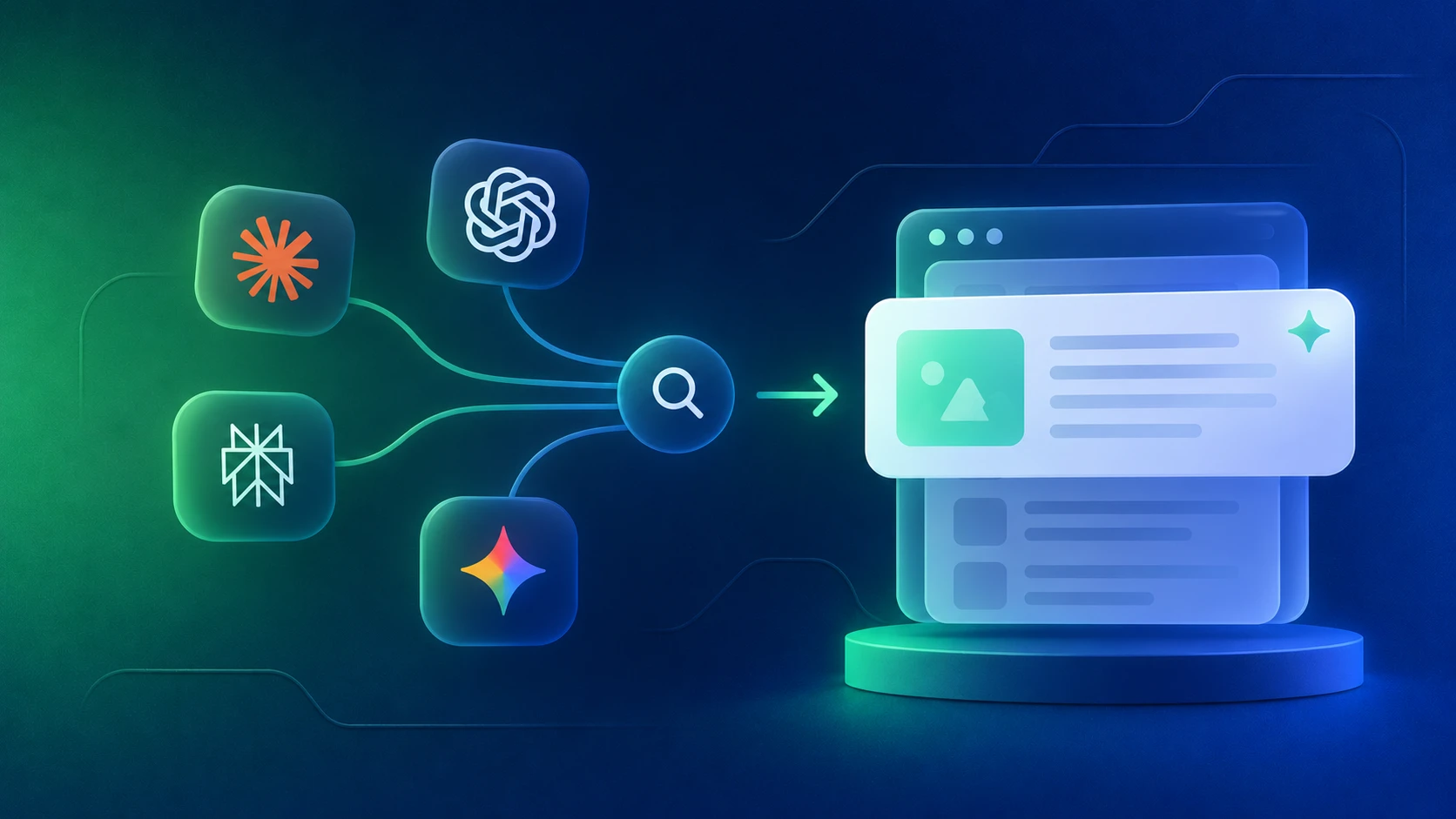
Ask the same buyer question in four AI tools and you will often get four different shortlists. Your company might be the first name in Perplexity, missing from ChatGPT, described by Claude with last year’s pricing, and mentioned in the third paragraph of a Google AI Overview. Each of those results points to a different fix, and almost none of them is solved by publishing another blog post.
In this blog we explain how these AI engines differ, how to work out why you’re missing from a particular answer, how to find the outside sources that decide your category, and the best order for doing the work.
In what ways can you show up in AI answers?
Showing up in AI answers usually means these three things:
- A mention: Your brand name appears in the answer
- A citation: Your page appears as a linked source, or
- A recommendation: The engine names you as the best fit for the asker’s situation
They may not come up together. A brand can be cited constantly for a how-to guide and never recommended, because recommendation depends on comparison content, reviews and third-party mentions, not on the guide.
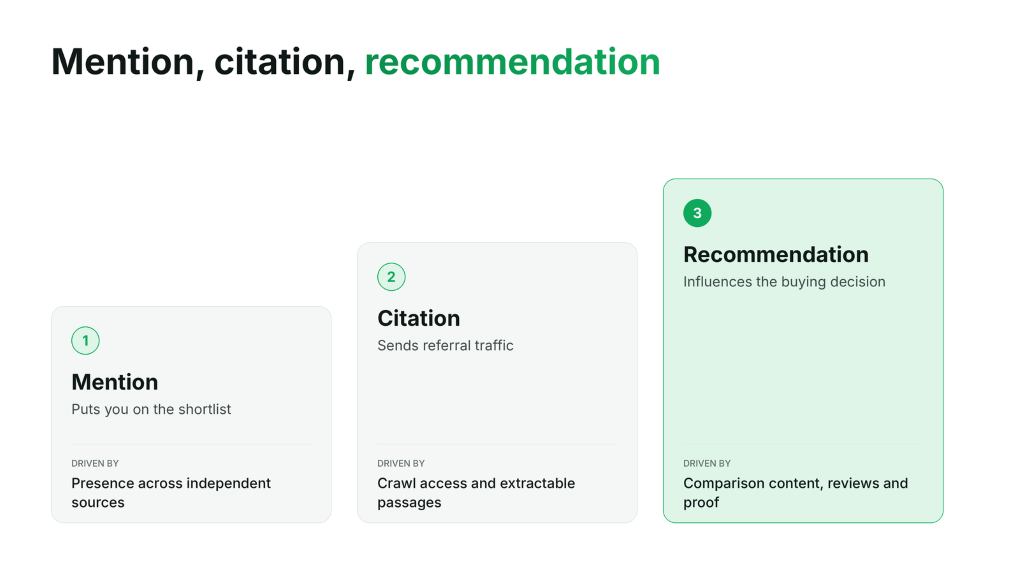
The difference between these mentions is important because each outcome has a different business value and a different cause as shown in the table below.
Note: If your cited pages are all informational and your recommendation rate is close to zero, the problem is missing proof, not content volume.
How does an AI engine build an answer?
Most AI answers combine three inputs:
- What the model learned in training (memory)
- Pages and passages retrieved live from search indexes (retrieval), and
- A set of sub-searches the system generates from your question (query fan-out)
Retrieval and fan-out are the most helpful because memory changes slowly and mostly through how widely and consistently independent sources describe you.
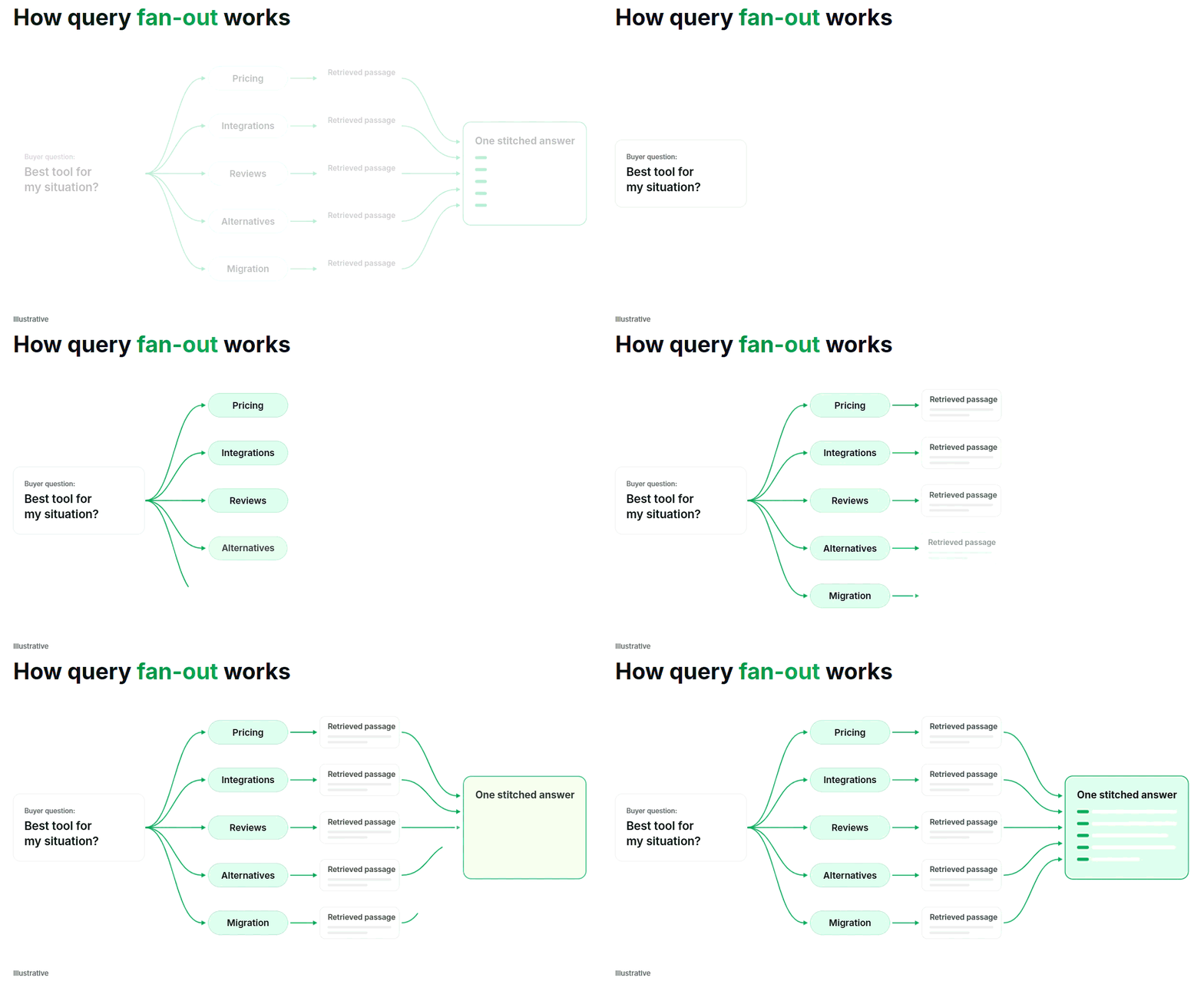
Query fan-out deserves more attention than it gets. Google has described the technique for AI Mode, and the behavior of other assistants is consistent with it: instead of running your exact question as one search, the system splits it into related sub-questions, retrieves for each, and stitches the results together.
Here are two possible consequences of it:
- The question you typed isn’t the query that was run: A buyer asking for the best tool for their situation triggers searches about pricing, integrations, reviews, alternatives and migration. If you only have a page for the head question, you’re competing for one slice of the answer.
- Retrieval works on passages: The engine lifts a paragraph, a table row or a list, not your whole page. A section that can’t stand alone is hard to use.
Claude can answer entirely from memory when search is off or when it judges the question doesn’t need it. For Claude, a long-run reputation across the web does more work than any single page you optimize.

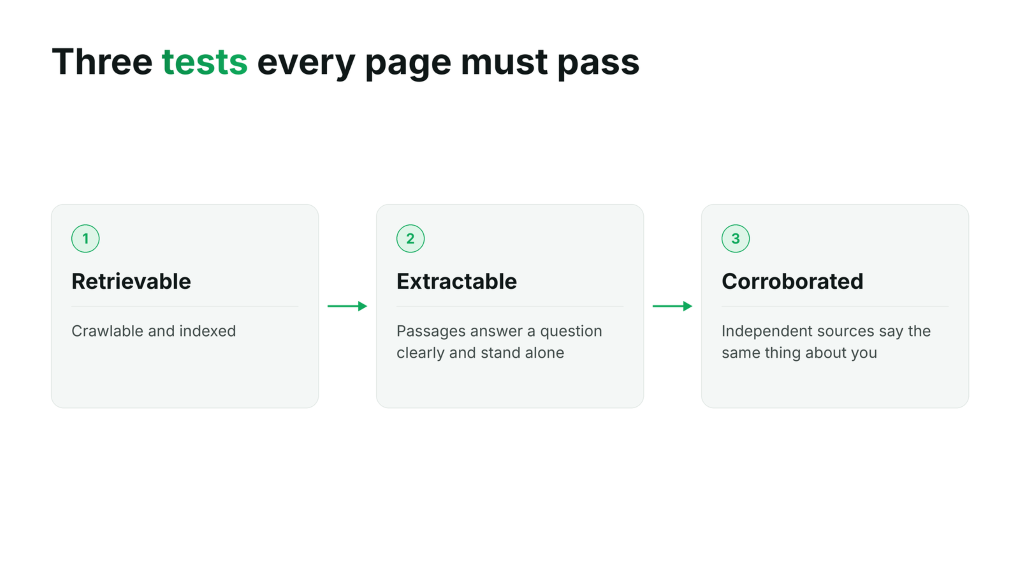
Three tests apply to every page on every engine: The content has to be retrievable (crawlable and indexed), extractable (its passages answer a question clearly and stand alone) and corroborated (independent sources say the same thing about you).
What changes from engine to engine is who runs the retrieval and which sources they trust.
How do ChatGPT, Gemini, Claude and Perplexity differ?
The four engines differ mainly in where live information comes from and how visible their sources are.
- Google’s AI Overviews, AI Mode and Gemini draw on Google’s index
- ChatGPT combines OpenAI’s own crawler with search partners
- Perplexity runs its own index plus live retrieval and cites on nearly every answer
- Claude uses web search when it is enabled, but often answers from memory, so reputation matters more there
The table below explains this further.
Perplexity shows its sources every time, which makes retrieval problems visible within minutes. Google’s index feeds the largest audience and underpins several AI surfaces, so most of what improves your standing there also helps elsewhere.
Which AI crawlers should you allow?
Every major AI vendor now runs three kinds of bot: a training crawler, a search-index crawler and a user-triggered fetcher
- For visibility, allow the search-index bots (OAI-SearchBot, Claude-SearchBot, PerplexityBot) and, where you can, the user fetchers
- Training crawlers such as GPTBot and ClaudeBot are a separate licensing decision
- Googlebot governs Search and AI Overview eligibility, and Google-Extended does not
The table below makes this clearer.
While you work on making your website ready for AI agents, here are some more points you should know:
- Blocking a search bot comes with a cost: Anthropic’s own documentation says blocking Claude-SearchBot can reduce your visibility in Claude’s search results. The same logic applies to the other vendors’ search bots.
- robots.txt is not a complete control for user-triggered fetchers: If a page is fetched because a person asked about it, the vendor may treat that differently from a scheduled crawl. If you need hard restrictions, they live at the firewall, and you should weigh the visibility you’ll lose.
- Read your logs tier-wise: If the search-index bots never show up, you have a discovery or blocking problem. If user fetchers are hitting specific pages, real people are asking about that content, which is a useful demand signal.
- Verify bots by address range, not only by name: User-agent strings can be faked. Several vendors publish address lists you can match against.
Why are you invisible in AI answers: How to find and fix?
To diagnose why you’re missing from an AI answer, here’s what you need to check:
- Access: no engine mentions you
- Engine-specific retrieval: Visible in one engine but not another
- Proof: Cited but never recommended
- Coverage: Present for some prompts, absent for others, or
- Accuracy: named, but wrong
Each symptom has a different first fix, and publishing more content only helps with coverage. Refer to the table below for more details on this.
Let’s take a closer look at several scenarios when you may not be visible in AI answers.
When you’re cited but never recommended
This is the most common pattern we see among companies with a decent content program, and it’s the one that costs the most. Informational pages are easy to get cited in ChatGPT and other engines, so the citation count grows.
Recommendation prompts (“best X for Y”, “X vs Z”) are answered from different material: comparison pages, review platforms, analyst-style roundups and community threads. If you aren’t in that material, or you appear with thin or dated detail, the engine has little to recommend you with.
How to fix it: Build honest comparison and alternatives pages and to get accurately represented in the sources your cited-domain map shows the engines using.
When you’re visible in Perplexity but not ChatGPT
Perplexity’s retrieval is transparent and its crawler is separate, so it often reflects your pages quickly. ChatGPT’s search draws on OpenAI’s own crawler and partner sources. If you’re visible in one and not the other, don’t rewrite content.
How to fix it: Check that OAI-SearchBot can reach you, that your pages are in Bing’s index, and whether the third-party pages ChatGPT cites for your category mention you at all.
Your homepage answers "what is [brand]?", but buyers ask about pricing, integrations, and fit for their role, and the engine fans those out into sub-searches. If no page of yours answers them, the engine uses someone else's.
Owlery, an AI-powered freight platform, had this exact shape: seven solutions, 100+ integrations, and buyers ranging from logistics managers to CFOs. When we built its Webflow site, we gave each solution its own page and added sections that map each buyer type's pain point to the right solution. That leaves a distinct answer for each question a buyer might ask. Read the full Owlery case study →
List the sub-questions behind your top buyer prompts. Give each its own page or clearly headed section that can stand alone as an answer.
When the answer is wrong
An old third-party article, a stale directory profile, or a page of your own that was never updated usually turns out problematic.
Start by finding where the claim comes from. Run the prompt in an engine that shows its sources and open them. Correct what you control, ask the owners of third-party pages to update with evidence, and publish a clear, dated statement of the right facts on a page that’s explicitly about the topic. Then re-test. Answers that rely on retrieval can be corrected within weeks. Answers that come from model memory can lag for months, and that’s outside your control.

Which third-party sources do AI engines trust, and how do you get into them?
AI engines lean on independent corroboration, so the sources that matter are usually review platforms, “best of” roundups, community discussions, video and trade press. Which ones matter depends on your category, and your cited-domain map tells you.
The quickest gain is usually getting accurately included in roundups you’re missing from, followed by a steady review pipeline and genuine community participation.
Most roundup authors are happy to correct an out-of-date entry and rarely hear from anyone with something useful.
What original data can you publish to earn citations?
The most citable thing a company can publish is evidence that doesn’t exist anywhere else. The cheapest version is a prompt study of your own category: 50 to 100 prompts, four engines, several runs each, a documented method and honest limitations. It produces original numbers, gives others a reason to link, and doubles as your own baseline.
Here’s what a credible study should include:
- The prompt list, or at least the buckets and counts
- Which engines and model versions, and the dates of the runs
- How many times each prompt was run, and whether sessions were logged out or memory-off
- A clear definition of what counted as a mention, a citation and a recommendation
- Results by engine and by prompt bucket, not just one headline number
- A limitations paragraph that says plainly what the study can’t show
Avoid overclaiming from a small sample, publishing a ranking of named competitors that you can’t defend, and drawing causal conclusions from a single month.
How to measure AI visibility across engines?
Here’s some of the best practices when measuring AI visibility:
Measure AI visibility with a scorecard instead of a single number
Mention rate, citation rate, recommendation rate, accuracy rate and the share of citations that come from your own domain versus third parties, tracked monthly per engine over a frozen prompt set that’s run at least three times. Add AI referral sessions, branded search trends and a “how did you hear about us” option, because much AI influence shows up later and indirectly.
Share of Model is the base measure
The percentage of your tracked prompt runs in which your brand is named. You can track AI search traffic in GA4 very easily. Group sessions from chatgpt.com, perplexity.ai, gemini.google.com and claude.ai into one AI channel so referral traffic is visible.
The table below shows how to read several metrics together.
Here are the most important reading rules that we follow:
- Mentions rising, citations flat: engines know you from outside sources, but your own pages aren’t being retrieved. Look at access and extractability
- Citations rising, recommendations flat: you have a proof problem. Look at comparison content, reviews and roundups
- One engine far behind the others: go to the matching row in the diagnostic table and check access and sources for that engine
- Mentions rising while accuracy falls: fix the facts before you push for more visibility
Common mistakes that negatively impact AI search visibility
Here are a few mistakes that many companies make with their content activities that impact the AI search visibility negatively. Make sure you avoid them:
- Pasting an old “block all AI bots” list: It often blocks only the training tier while leaving other tiers untouched, and it may include retired tokens.
- Hiding pricing behind “contact us.” Engines still answer cost questions, just from third-party pages that may be wrong or out of date.
- Vague positioning copy: A hero line like “Reimagine how teams grow” gives an engine nothing to extract. One plain sentence saying what you are and who you serve does more than any slogan.
- Judging from one prompt on one engine: Variance will fool you in both directions.
- Tracking only presence: A brand that’s mentioned with wrong facts is losing deals while the dashboard looks fine.
- Passing off paid placements as independent coverage: It’s a reputational risk, and engines may discount it.
- Writing separate pages for each engine: It splits your authority and adds maintenance for no gain.
- Scaling thin AI-generated content: It adds nothing new, which is what retrieval systems look for. Make sure you know how to use AI content.
- Not capturing the offline effect: Without a “how did you hear about us” option, AI influence disappears into “direct.”
TripleDart had grown from a marketing agency into SEO, paid media, RevOps, ABM, and AI workflows, but its old site no longer reflected that scale. We rebuilt it so the new AI-native GTM positioning carries through every page and each service sits in one clear structure. Read the full TripleDart case study →
Should you do this in-house or work with an agency?
Both are reasonable. It works in-house when you have an SEO lead with developer access, someone who can run outreach and review programs, and the patience to build a measurement habit.
However, there can be various reasons why a B2B company needs AEO and GEO agencies. For example when you suspect blocking but can’t diagnose it, need a baseline and roadmap quickly, have a thin off-site footprint, or want an independent read before committing a budget.
At Flowtrix we handle SEO and AEO alongside website design and development for B2B SaaS and AI companies, so structural fixes, such as pricing pages, comparison templates and schema, can ship in the same workstream as the content. You can book a short call if you’d like to talk it through.