



Use to summarize this article


- Define four things, not the tech: Position on the specific buyer, the job they hire you for, the mechanism behind your result and the proof that backs it.
- Climb the Claim Ladder: Move every key claim from technology and capability to outcome, then to proven outcome with a number, a source and a limit.
- Find a mechanism beyond the model: Data, workflow position, domain rules, integration depth, quality control or speed to value are harder to copy than "a better model".
- Run the AI-removal test: Delete "AI", "smart" and "automated" from your headline. If the sentence stops making sense, it is leaning on the word.
- Win the difficult buyers with trust: Skeptical operators, security reviewers and risk owners respond to admitted limits, clear data handling and human review, not to impressive AI.
To position an AI product, stop describing the technology and define four things: the specific buyer, the job they are hiring you to do, the mechanism that makes your result different (data, workflow, integration or domain rules, not "our model"), and the proof that backs it.
Today when you open 10 tabs for a SaaS product all of them have only one thing to say: AI powered. In this blog we tell you how to position an AI product so a buyer can say, in one sentence, why you and not the other nine.
What is AI product positioning and why does it matter to you?
AI product positioning is the set of deliberate choices that tell a specific buyer what your product is, what it is for, why it is better for them than the alternatives, and why they should believe you.
It is not a tagline, a brand voice document or a feature list. A tagline is the output of positioning. If you write the tagline first, you are decorating a decision you haven't made.
Here are the most important choices you make when positioning your B2B SaaS AI product:
- Buyer: Who you are for, and, just as important, who you are not for
- Job: The specific task or outcome they hire you for
- Category frame: What the buyer compares you to. This is a choice. You can sit inside an existing category, narrow it, or try to create one.
- Mechanism: The reason your result is different or better
- Proof: The evidence that the mechanism produces the result
Most AI companies handle the first two loosely, skip the third, hide the fourth behind the word "AI" and fill the fifth with logos.
How to turn vague AI claims into specific ones?
The best suggestion we can give you here is to use the Claim Ladder concept. It has four rungs. Every statement on your site sits on one of them, and the goal is to move each important claim up.
The table below shows what’s included in each rung.
Most AI homepages cover technology and capability. When you show outcomes, buyers start taking interest and an attached proof helps them trust you, because it includes a number, a source and a limit.

Naming the conditions under which your product works best makes the rest of your claims more believable. That will only be good for your product.

Why is “AI-powered” no longer a differentiator?
There are 3 major reasons why “AI-powered” is no longer a differentiator for most B2B SaaS products.
- It describes a method, not a result: A buyer in finance operations does not want AI. They want the month-end to take 4 days instead of 9. "AI-powered" tells them how you work, which they only care about once they believe you can deliver the result.
- It is unverifiable: A buyer cannot test your claim of "our proprietary AI" from a webpage. When a claim can't be checked, a careful buyer discounts it, and after enough disappointing demos, they discount all of them. This is why vague AI claims now cost credibility rather than earning it.
- It is universal: When the claim is true of every product in the category, it can't separate any of them. Foundation models are available to everyone through APIs. Having "AI" in the product is now a baseline expectation, similar to "cloud-based" a decade ago. Nobody wins a deal by being cloud-based anymore.
Product differentiation has moved from the technology to everything around it: the buyer you serve, the data you have access to, the workflow you sit inside, the way you handle errors, and the proof you can show.
How to position an AI product to make it stand out: Step-by-step guide
Here’s a step-by-step guide for AI product positioning to make sure it stands out:
Step 1: Research your best customers for the real job
Talk to 5 to 8 customers who made the purchase quickly and stayed. Ask what they were doing before you, what triggered the search, what else they looked at, and what they say to colleagues when describing you. Note their exact words.
Pay attention if customers rarely describe your product the way your homepage does.
A team that sells "an AI research assistant" may hear customers say "it means my analysts stop building the same competitor deck every quarter". The second description is your positioning raw material.
Also talk to 2 or 3 customers who you faced a churn with or never converted. Their reasons often reveal what your positioning promised but the product did not deliver.
Step 2: Narrow down ruthlessly to choose the buyer
"Teams that want to work smarter" does not specify your buyer; "Revenue operations leads at B2B SaaS companies with 50 to 500 employees using Salesforce" does.
Narrowing feels risky because it seems to shrink the market. However, it raises relevance for the right buyer and makes referrals easier, because people can say precisely who you are for.
Test if someone can read your homepage and name three companies that are not your customer? If not, you haven't narrowed enough.
Owlery is a freight platform with seven solutions, which makes it easy to write a homepage for "logistics" in general. Flowtrix built the Webflow site to speak directly to the teams running modern supply chains instead. It went live with 10+ pages in six weeks.
See the full Owlery case study →
Step 3: Pick the competitive frame deliberately
Buyers always compare you to something, and they will pick the frame for you if you do not. You have four options:
- Compete inside the existing category ("AI note-taker for sales calls"): Fastest to understand, but crowded
- Narrow the category ("call intelligence for pharma field reps"): Often the best option for an early-stage company
- Reframe against the status quo ("replaces the spreadsheet your ops team rebuilds every Monday"): Strong when your real competitor is manual work
- Create a new category: High cost and rarely worth it before you have significant traction
Narrowing the category or reframing against the status quo gives the best return.
Step 4: Find the mechanism that leads to the result
This is the hardest step and the one that most separates strong positioning from weak. Find the answer to: why would our product produce a better result than a capable competitor with access to the same models?
Here’s how you may be able to group your answers:
- Data advantage: you have access to proprietary, licensed or customer-contributed data that makes outputs more accurate in a specific domain
- Workflow position: you sit inside the tool or step where the work already happens, so there is no copy-pasting and no context loss
- Domain rules: you encode expert judgement, such as compliance rules, clinical guidelines or accounting treatments, around the model
- Integration depth: you read from and write to the buyer's systems of record, not just a chat window
- Quality control: you have evaluation, human review or confidence thresholds that catch errors before they reach the customer
- Speed to value: you are configured for one use case, so onboarding takes days, not a quarter
It’s never enough to say "We use a better model" because competitors can switch models in a sprint. If your only answer is the model, the honest conclusion is that you have a feature, not a position, and your strategy should focus on building one of the advantages above.
Step 5: Assemble the proof
Gather what a skeptical buyer would accept: a named customer with a measured result, a benchmark on the buyer's own data type, a short live demo on their sample, accuracy numbers with the method explained, a security certification, a free pilot with defined success criteria.
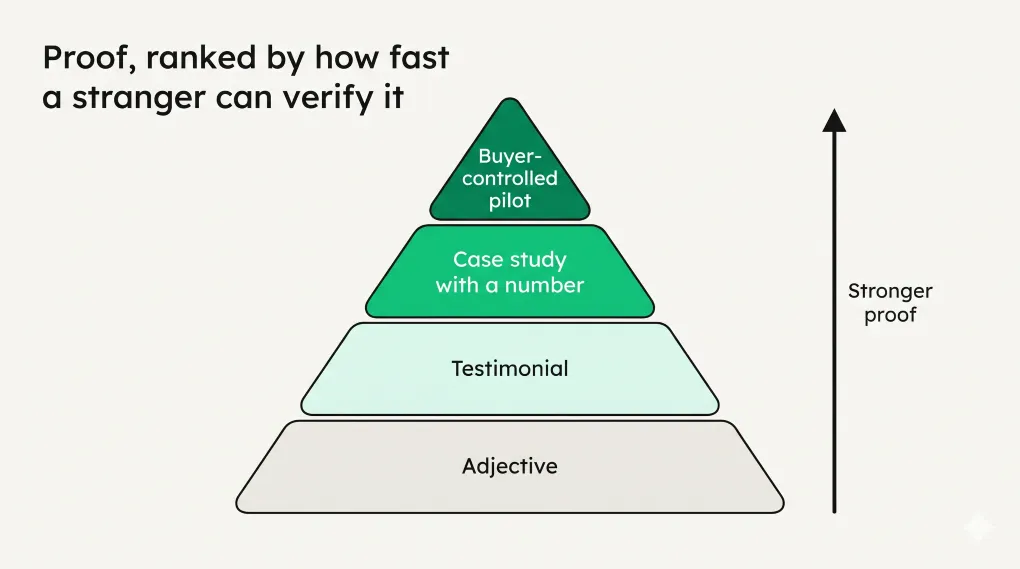
Rank your proofs according to how quickly a stranger can verify it.
- A buyer-controlled pilot is better than a case study
- A case study with a number is better than a testimonial
- A testimonial is better than an adjective
Step 6: Write the statement, then test it
Only now write the positioning statement and headlines (template below). Then run the AI-removal test, show it to five target buyers and ask them to restate it in their own words. If what they say back differs from what you meant, the positioning isn't done.
The AI-removal test
This is the quickest diagnostic we know. Take any headline, subheading or product description and delete the words "AI", "intelligent", "smart" and "automated". Then read what is left.
- Fails: "The AI-powered platform that transforms how teams work." Remove the AI language and you have "the platform that transforms how teams work", which is meaningless.
- Passes: "Reconcile vendor invoices against purchase orders in minutes, with every mismatch explained." Nothing needs to be added back. The sentence names the job, the speed and the proof of reasoning.
If a sentence only works because it says AI, it is leaning on the word, and buyers are tired of that word. Passing sentences can still mention AI later, as the mechanism, but they never depend on it.

Building a messaging framework for your AI product
A positioning statement is for the founders and marketers. An AI product messaging framework turns it into language everyone can use. Keep it on one page with these layers:
- Core message: One sentence, the outcome for the buyer
- Three supporting pillars: Usually, the result (speed, accuracy or cost), the mechanism (why it works) and the assurance (control, security, accuracy). Each pillar gets one sentence
- Proof points per pillar: One verifiable fact, number or customer for each
- Buyer-specific variants: The same core message in the language of each person in the buying group: the economic buyer cares about cost and risk, the end user about time and effort, IT about integration and data, legal about liability
- Objection answers: The 5 questions every prospect asks, with answers sales and marketing both use. For AI products, these typically include accuracy, data privacy, "won't this just be built into [big platform] soon?" and "what happens when it gets it wrong?"
- Banned and preferred words: A short list, covered below
This messaging framework should be used consistently by your team. A new sales representative, the website and a founder's LinkedIn post should all describe the product in recognizably the same way.
TripleDart started as a marketing agency and grew into a GTM partner that describes itself as AI-native, covering SEO, paid media, RevOps, ABM and AI workflows. The new positioning was already defined when Flowtrix began. The site's job was to carry it.
That meant 8+ pages built in four weeks, navigation that organizes a growing service portfolio without overwhelming visitors, and reusable components with a CMS, so the marketing team can publish new case studies and landing pages without developer help. Content updates are now 10x faster, by Flowtrix's measure. We won two silvers at Foxglove Awards 2026 for this project.
The lesson for your own framework: positioning holds only if every page says the same thing and the team can keep it that way as the company changes.
Words to eliminate from your AI product messaging
Avoid using these words in your headlines because they are now so common that they erase meaning:
- "AI-powered", "AI-driven", "AI-native" as the lead descriptor
- "Supercharge", "unlock", "transform", "revolutionize"
- "Intelligent" and "smart" used as adjectives for the product
- "Seamless" and "effortless"
- "10x" without a stated baseline
- "Copilot" or "agent" as a category name, unless you define exactly what it does and does not do
Replace them with the thing itself: the verb the buyer uses ("reconcile", "triage", "draft", "classify"), the object ("invoices", "support tickets") and the measurable change ("in minutes", "without manual entry").
Positioning your AI product for the “difficult” buyers
Most B2B SaaS companies approach AI product positioning to convince the champion/user. AI deals, however, tend to stall with three other people, and your messaging should anticipate each.
Here’s how to align your AI product messaging for various buyer roles involved in closing a deal:
The skeptical operator
They have seen overpromised tools before. They respond to specifics and to admitted limits. Lead with a small, checkable claim ("handles about [X]% of routine cases without review; the rest is routed to your team") instead of a sweeping one. Offer a trial on their data, not a canned demo.
The security and IT reviewer
They want to know where data goes, whether it trains a model, how long it is retained, who can access it and what happens in a breach. If your answers are in a PDF behind a form, your sales cycle will be longer than it needs to be.
Publish a plain-language trust page and reference it in your messaging. Making your security posture a visible part of your positioning is a differentiator in itself, because most competitors treat it as a late-stage hurdle.
The risk owner (Legal/Compliance teams)
The question in their head is "what is our exposure if this is wrong?" Positioning that explains human review, audit trails and escalation paths gives them an answer. Positioning that promises full automation gives them a reason to say no.
Notice that none of these concerns is about how impressive your AI is. They are about how safely and predictably it behaves. In many categories, trust is the real differentiator, and it can be communicated.

Pricing is a part of your AI product positioning
Pricing tells buyers what kind of product you are before they read a word. The following patterns come up repeatedly with AI products:
- Per-seat pricing for a product that replaces work can undercut your own value story. If your tool lets one analyst do the work of three, charging per seat penalizes the efficiency you are selling.
- Usage-based pricing aligns with value but makes budgeting hard. Buyers often want a cap or a predictable tier, particularly in the first year.
- Outcome-linked pricing is the strongest signal of confidence, but only works when the outcome can be measured cleanly and attributed to you.
There’s no universally right model for pricing. The point is that your B2B SaaS pricing page and your positioning should tell the same story.
When you should not lead with AI?
Sometimes the right call is to say less about AI. Consider leading with something else when:
- Your buyers are in a regulated or risk-averse sector: "AI" may raise compliance flags before value registers. Lead with the outcome and control, and explain the AI in the right place.
- The AI is a feature inside a broader product: Making it the headline misdescribes what you sell and invites the wrong comparisons
- Your buyer's problem is well known and the technology is irrelevant to them: Nobody buys a calculator because of the silicon
- Your category is saturated with AI claims: Standing out may mean being the one who talks about the buyer's problem
This is an important decision you need to make. You can lead with the problem on the homepage and be explicit about AI on the product, security and documentation pages, for the readers who go looking.
Make sure your AI product positioning stays relevant
Positioning for AI products gets outdated faster than for most software, because the ground moves. A capability that is a differentiator today may ship as a default in a major platform next quarter. Models improve, prices fall and buyers become more informed.
Treat positioning as a living asset:
- Review quarterly: Re-read your top claims and ask whether each is still true, still unique and still proven.
- Track your "why us" reasons in closed-won and closed-lost notes: If the reasons shift, so should your message.
- Watch for platform risk: If a larger vendor could ship your headline feature, your positioning should rest on something harder to copy: domain depth, data, workflow or trust.
- Eliminate claims that went generic: If three competitors now say what you say, move up the Claim Ladder or choose a different frame.
How to check what AI assistants say about your product?
Many buyers now ask ChatGPT, Gemini, Claude or Perplexity for a shortlist before they ever search on Google. That means these systems' description of your product is a part of your positioning, whether you manage it or not.
Follow the below checklist to understand and rectify how you show up in AI answers.
AI visibility audit
- Write ten questions a real buyer would ask: "best [category] tools for [buyer type]", "[your product] vs [competitor]", "is [your product] good for [use case]".
- Ask each question to at least three assistants. Record whether you are mentioned, how you are described and which sources are cited.
- Compare the descriptions with your positioning statement. Where they differ, find the pages the assistants appear to be drawing on.
- Fix the source: clarify your own pages, publish a plain comparison page, correct outdated third-party listings and make sure your category, buyer and use cases are stated in plain text, not only in images or slogans.
The same discipline that makes positioning work for humans makes it work for these systems: clear, specific, consistent statements about who you serve and what you do, repeated across your site and credible third-party sources.
Fix your AI product positioning with Flowtrix
When every competitor says AI, the word stops carrying information, and buyers respond by trusting specifics instead. Your positioning has to do the work the label no longer can.
A good first step is to conduct a full-fledged audit for your current positioning and fix it before spending more on ads, outbound or content.
If you want a second pair of eyes on the result, that is the kind of work Flowtrix does with AI and SaaS teams. Get your first audit done by us →