What is Kanban?
Kanban is a highly visual Agile project management framework designed to manage work by balancing demands with available capacity. It utilizes a "Kanban Board" (physical or digital, like Trello or Jira) divided into columns representing the stages of a workflow (e.g., "Backlog," "In Design," "In Development," "QA," "Launched"). Tasks are represented as cards that move from left to right as work progresses.
Why Kanban Matters in Enterprise Web Development?
Large-scale website migrations involve massive amounts of moving parts. Kanban prevents chaos and developer burnout.
- Visualizing Bottlenecks: If the "In QA" column suddenly has 15 cards in it, but the "Launched" column has zero, the project manager instantly knows the Quality Assurance team is overwhelmed and needs resources.
- Limiting Work In Progress (WIP): Kanban enforces strict limits on how many tasks can be in a column at once. This stops developers from context-switching between 10 half-finished pages and forces them to complete one page before starting the next.
- Continuous Delivery: Unlike traditional Waterfall management where everything launches at once, Kanban facilitates rolling deployments. As soon as a single Landing Page card reaches "Done," it can be pushed live to generate revenue.
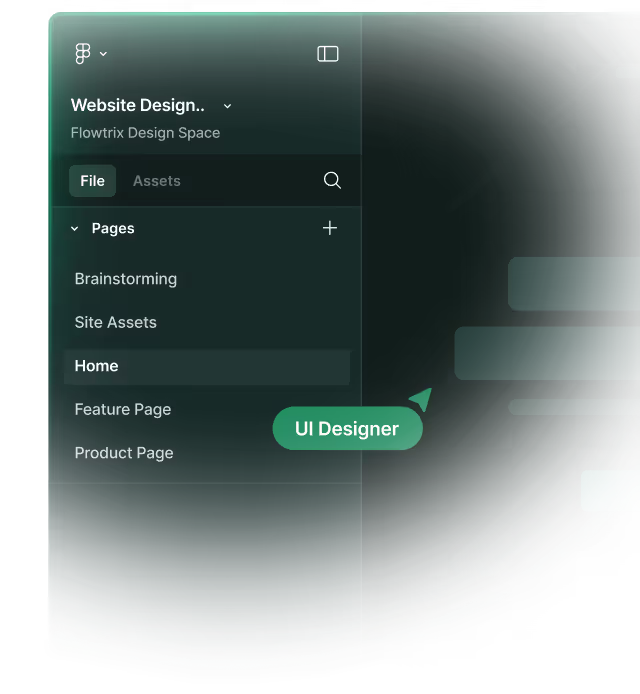
- Transparent Handoffs: It provides a crystal-clear boundary between teams. A designer knows their job is done when they move the Figma card into the "Ready for Dev" column.
Example from Flowtrix Projects
Flowtrix operates as an extension of your internal team, and transparency is our core value. We manage every Webflow Enterprise build and ongoing Growth-Driven Design retainer using shared Kanban boards (via Notion or Jira). Clients have 24/7 visibility into exactly which custom API integration or new CMS template is currently being coded, entirely eliminating the "black box" of agency development.
Master Webflow.
Get insights directly.





.svg)

.svg)



%201.svg)


.svg)
.svg)